The same script, six weeks apart
Our hero video was made on 17 July. On 26 August we gave the engine the same script again, word for word, and rendered it a second time. Nothing about the words changed.
What the engine fixed on its own
The same subject stays the same subject. Every frame is written by a call that has never seen the other frames, so a recurring character used to be described afresh each time: "in glasses and a button-up shirt" once, plain "the business owner" four times after that. The storyboard now writes a cast list once and every scene quotes it. On the frame descriptions the model returns, an identifying phrase survived 5 times out of 17 before, and 23 out of 24 after.
A black-and-white style stays black and white. The drawing side was told at length that the look comes from your chosen style. The writing side was never told, so a storyboard would ask for "a large bold red stop sign" and the red would win. Neither side may name a colour now.
The board stays the board. Styles with a coloured or a dark board were washing out to grey wherever the drawing had not reached yet.
What it did not fix
The August render still had a disembodied hand in almost every scene, drawn a little better than in July and still slightly wrong: fingers in the wrong count, a thumb that does not bend that way.
The engine was doing what it was told. The script asked for a hand in every scene. Six weeks of work on how well we draw did nothing about what we asked to be drawn.
So we rewrote the scene descriptions. Not the words anybody hears, which are unchanged: only the instruction for what appears in each frame. Where a hand held a marker, a marker now lies on the board with one stroke trailing off. Where a hand pointed at a choice, the choice is ringed. That is the second video above, and it took an afternoon.
What this is worth to you
If a video comes out not quite right, the reflex is to blame the drawing. Often the brief asked for something that is hard to draw and easy to draw badly.
Ask for objects, not for people performing actions. A marker and an unfinished stroke says "being drawn" as clearly as a hand does, and it comes out right every time.
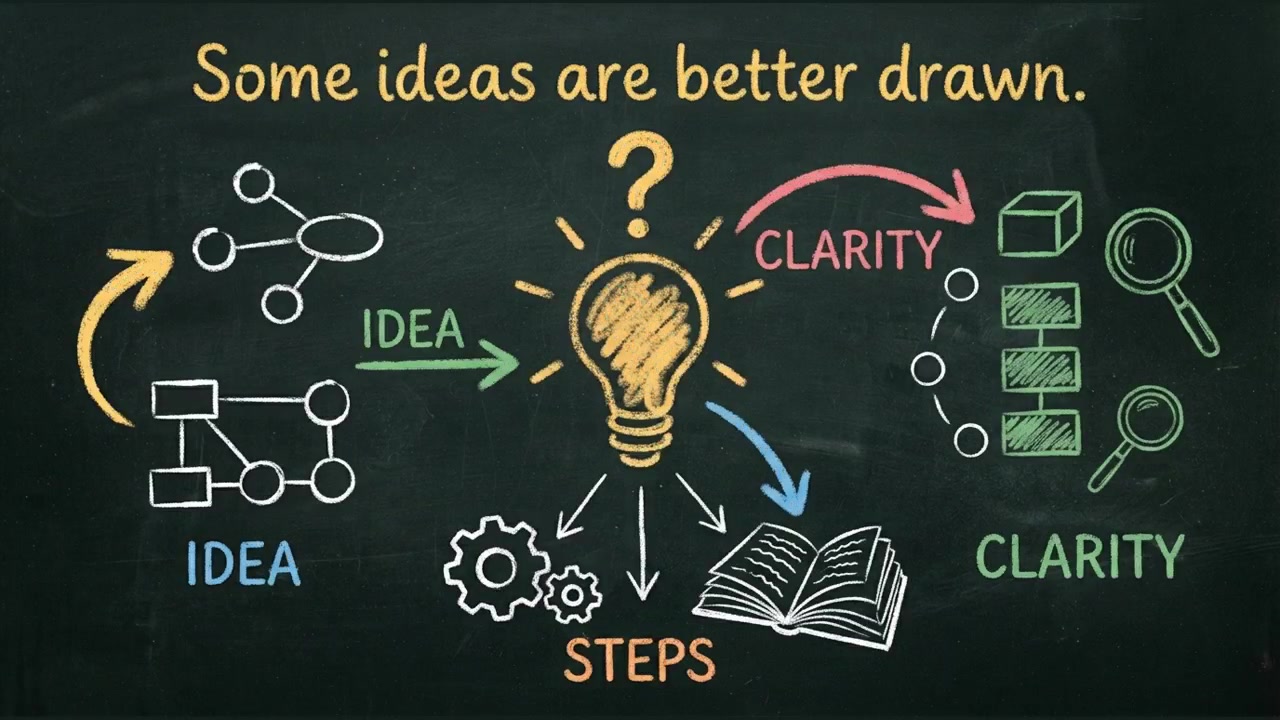
Name what you want, not how it should feel. "A clean simple diagram" is a hope, not a request. We wrote exactly that and got a decorative pattern instead of a diagram. "Three steps, two gears and an open book, each on its own arrow" is a request.
Say what must not be in the frame. One sentence at the end about what does not belong is worth three sentences of atmosphere.
Judge a scene, not a frame. The problems that survive into a finished video are consistency problems, and a single frame cannot show them.
You can edit any scene's description in the studio and redraw that one frame without remaking the video, which is where this kind of fixing actually happens.