Why does a day have 24 hours?
Twelve parts for the night, twelve for the day, from ancient Egypt.
A day has 24 hours because ancient Egyptians split the night into 12 parts, marked by stars, and later the daytime into 12 as well. These seasonal hours stretched and shrank through the year. The Greek astronomer Hipparchus probably first divided the whole day into 24, and mechanical clocks made equal hours stick.
Why twelve is less certain. One theory, from the historian Georges Ifrah, is finger counting: a thumb can tap twelve finger bones on one hand.
The script
The narration is lettered on screen word for word, one scene at a time.
-
 Scene 1 · 0:00–0:04Voiceover
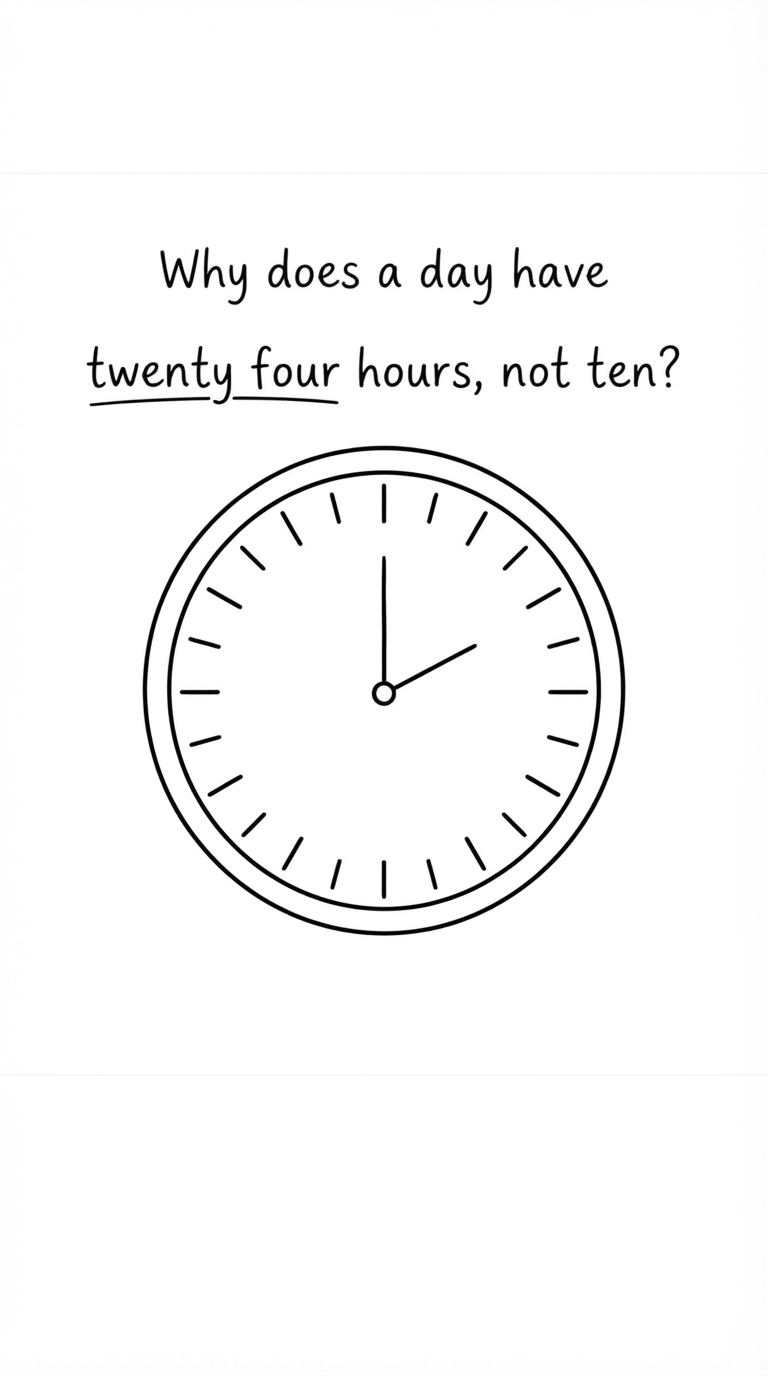
Why does a day have twenty four hours, not ten?
PictureA clock face with hour marks.
-
 Scene 2 · 0:04–0:07Voiceover
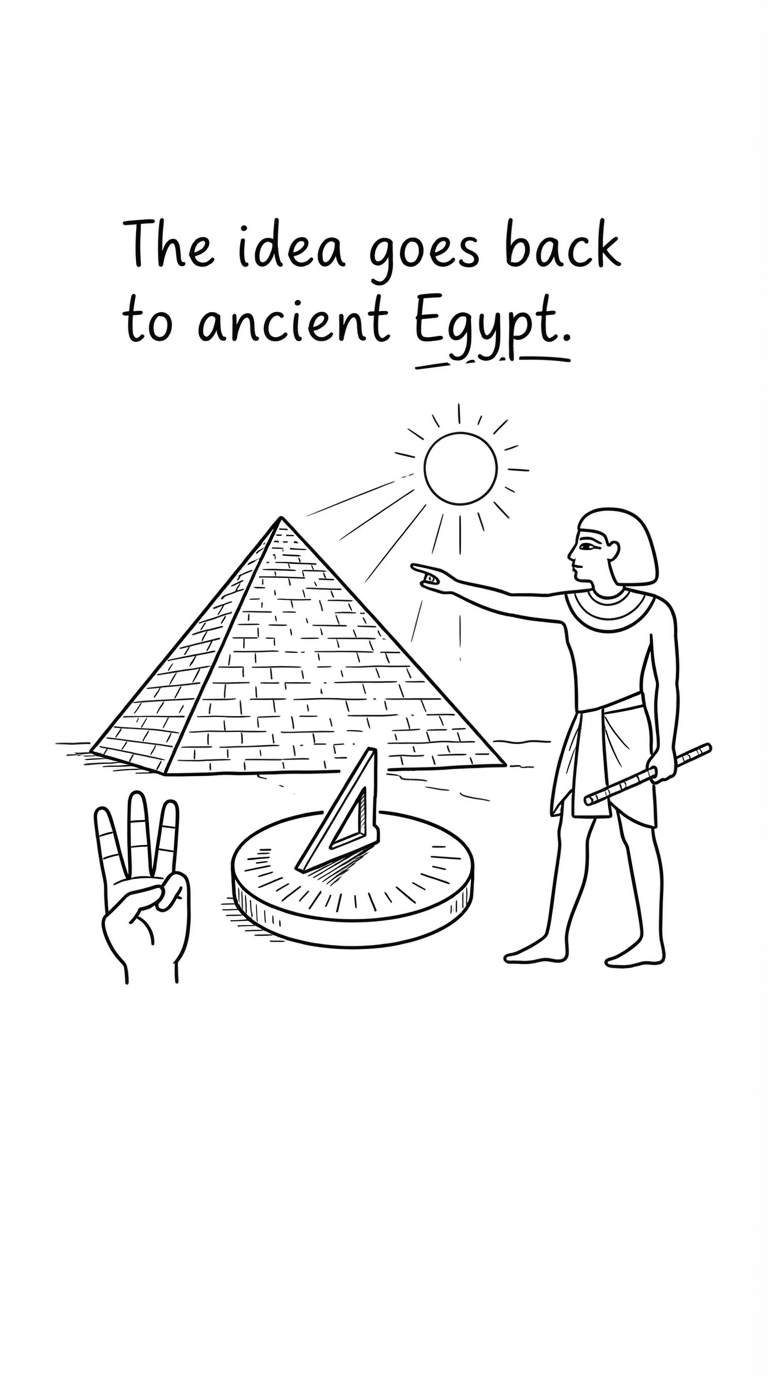
The idea goes back to ancient Egypt.
PictureAn Egyptian man beside a pyramid pointing at the Sun, with a sundial and a raised hand.
-
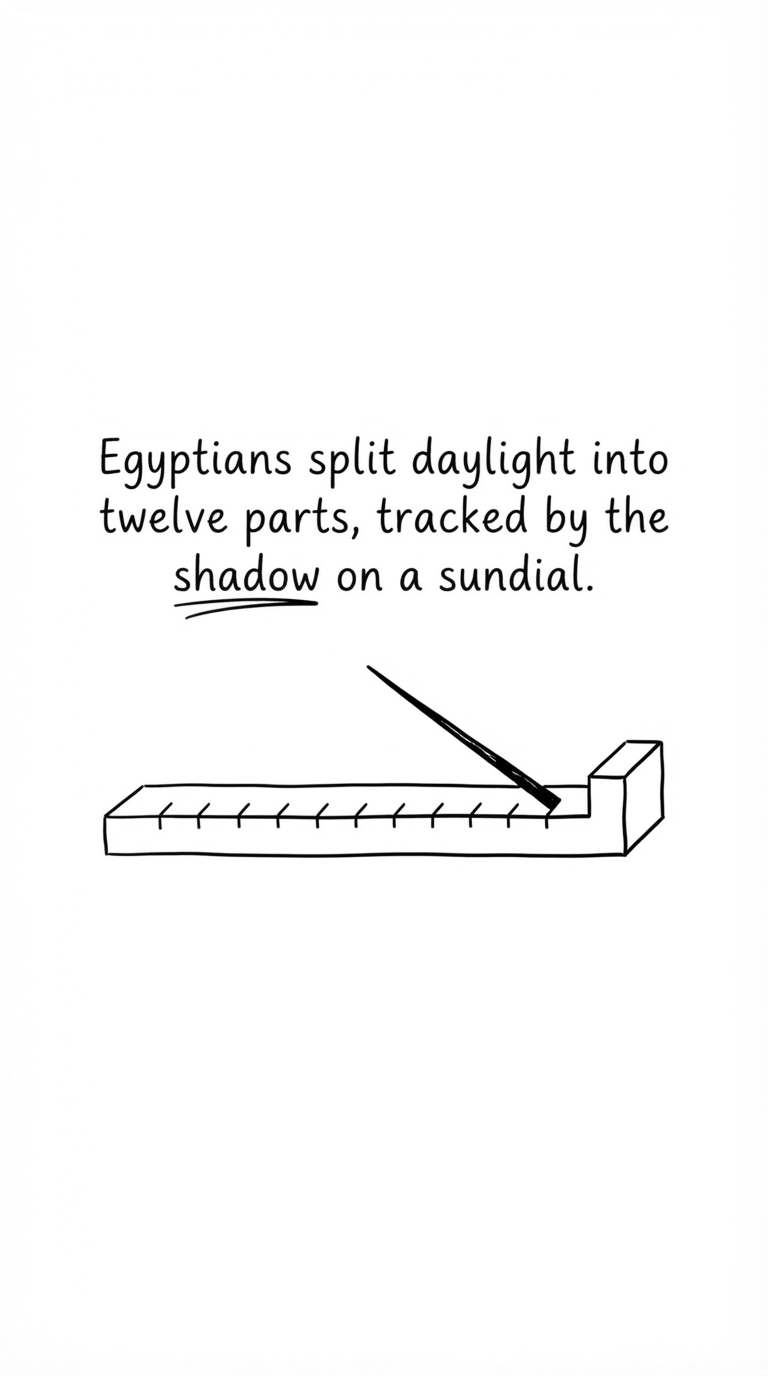 Scene 3 · 0:07–0:13Voiceover
Egyptians split daylight into twelve parts, tracked by the shadow on a sundial.
PictureA sundial bar with a raised stick casting a shadow across hour marks.
-
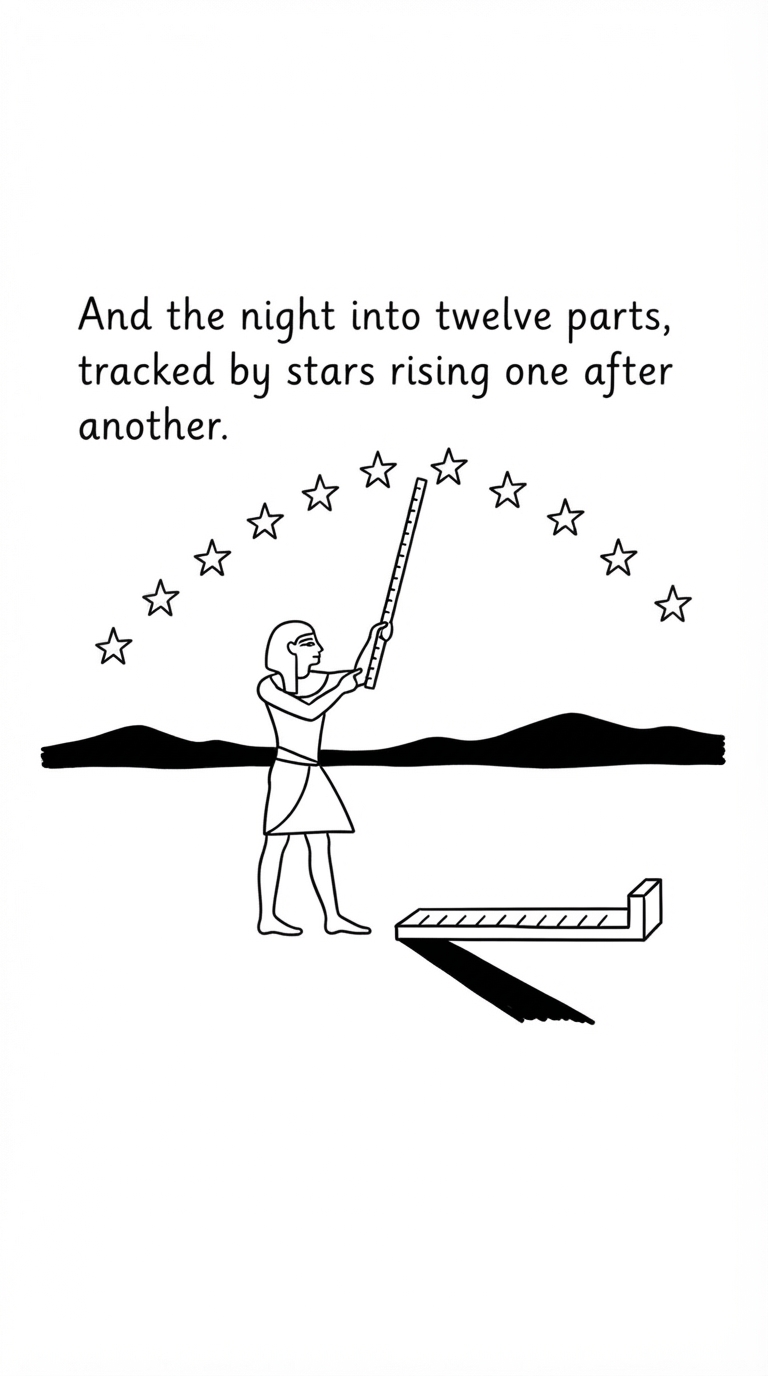 Scene 4 · 0:13–0:19Voiceover
And the night into twelve parts, tracked by stars rising one after another.
PictureAn Egyptian man sighting a row of stars along a rod at night, beside a shadow clock.
-
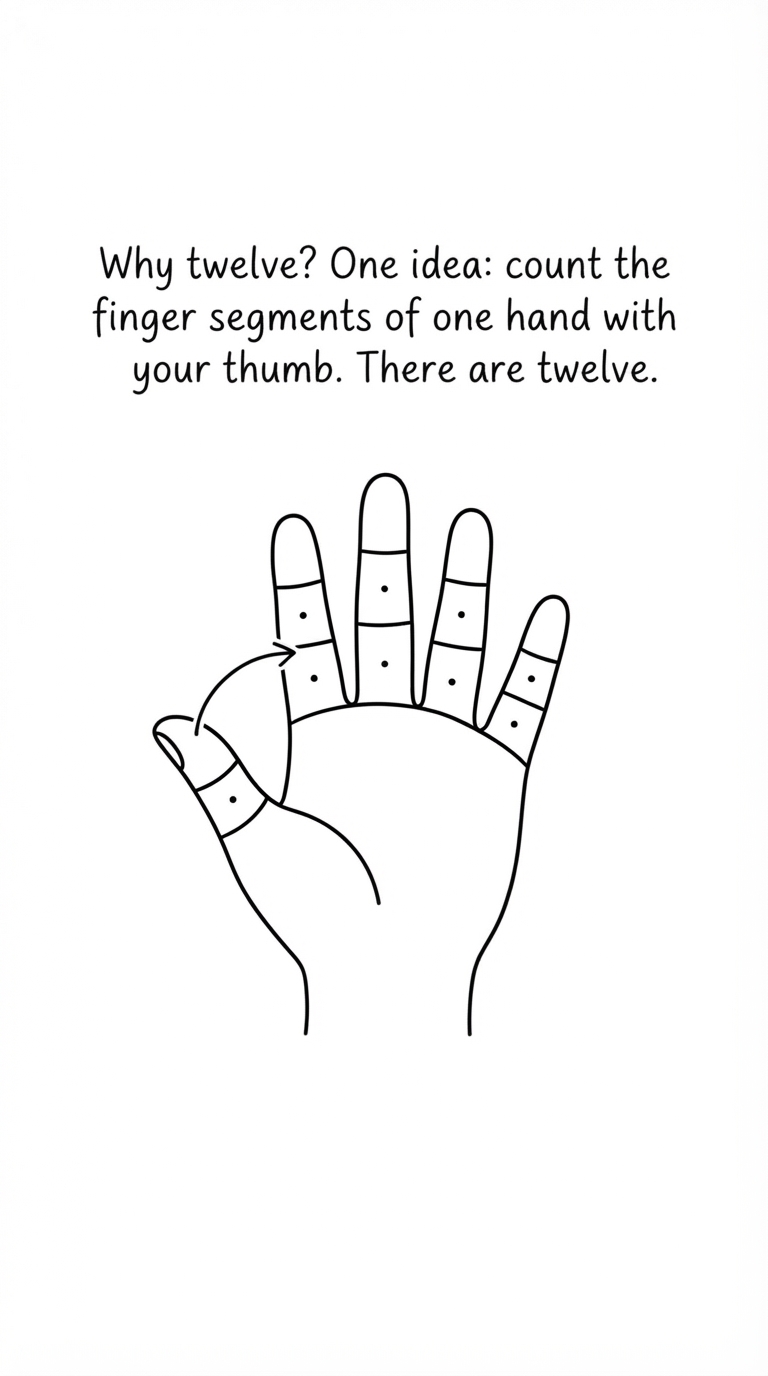 Scene 5 · 0:19–0:27Voiceover
Why twelve? One idea: count the finger segments of one hand with your thumb. There are twelve.
PictureA hand with the thumb touching the finger segments, each marked with a dot.
-
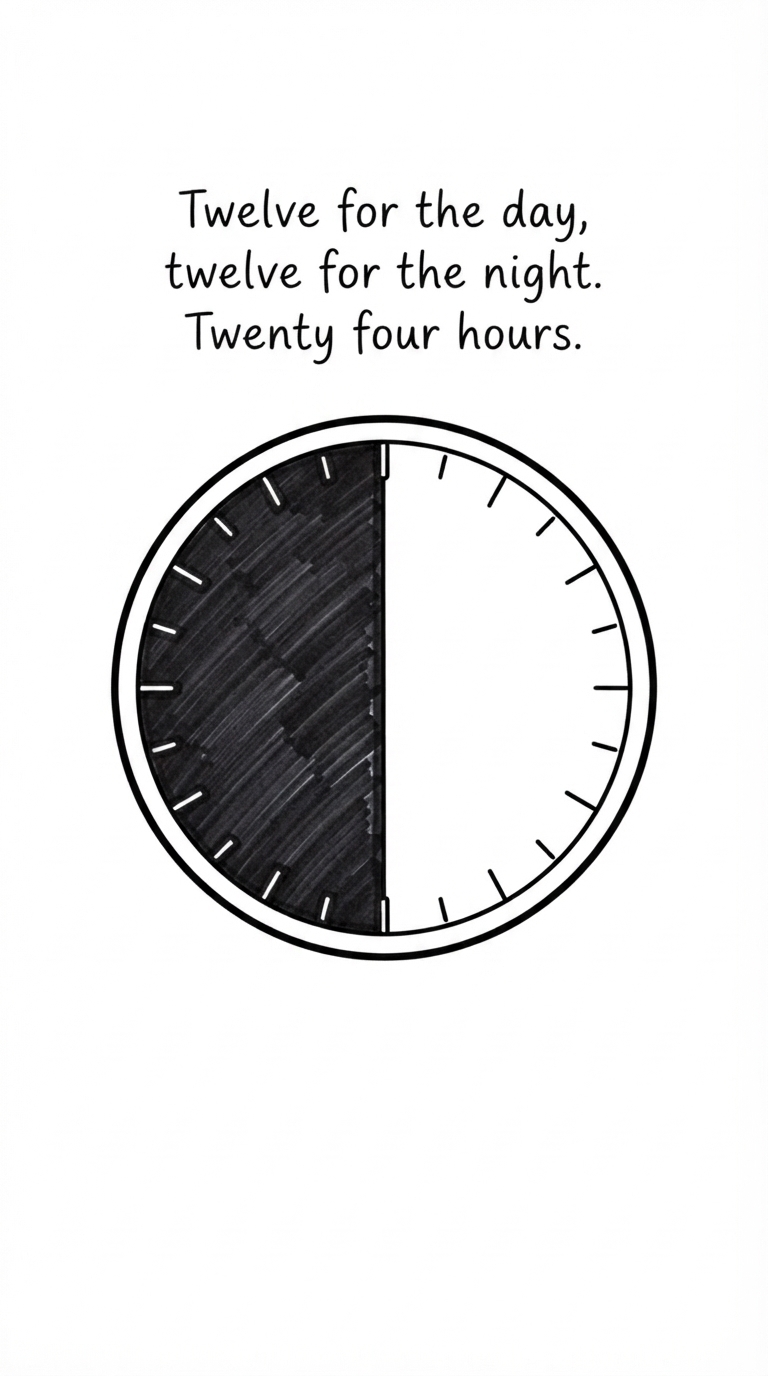 Scene 6 · 0:27–0:35Voiceover
Twelve for the day, twelve for the night. Twenty four hours.
PictureA clock face half black and half white, for night and day.
From star hours to atomic seconds
The count began at night. In ancient Egypt the yearly Nile flood came with the rise of the star Sirius before dawn and the appearance of 12 constellations across the night sky, and the Egyptians divided the night into 12 intervals. These were seasonal hours, longer in summer than in winter. The day was divided later and became the more important half, and the system spread to Greece and then Rome.
The Greeks first counted 12 seasonal hours from sunrise to sunset and split the night into three or four watches; by the Hellenistic period the night had 12 hours too. The astronomer Hipparchus probably first divided the whole day and night into 24 hours, and in the first century BCE the Tower of the Winds in Athens tracked a 24-hour day with sundials and mechanical indicators. Medieval astronomers such as al-Biruni then split the hour into 60 minutes of 60 seconds, following Babylonian astronomy.
Source: Hour, WikipediaWhy twelve, and why sixty? The historian Georges Ifrah offered a speculative answer: finger counting. Using the thumb as a pointer, you can count to 12 on the bones of the other four fingers of one hand, while the other hand keeps track of how many dozens you have counted, up to five dozen, or 60. The method is still used in many parts of Asia.
Source: Duodecimal, WikipediaEqual hours won because of machines. Early mechanical clocks showing unequal hours had to be adjusted every morning and evening, while 24 equal hours needed adjusting only a few times a month. France tried a 10-hour day of 100-minute hours from 1794, but mandatory use was dropped within months. Today the hour is defined as exactly 3,600 atomic seconds, and since 1972 an hour has run 3,601 seconds 27 times, to keep clocks in step with Earth's gradually slowing spin.
Source: Hour, WikipediaHow this video was made
We wrote the 6 narration lines and a one-line picture brief for each scene. explain.ink drew the scenes by hand in the chosen style, recorded the voiceover and rendered the MP4.
- Style
- Whiteboard
- Voice
- Gunner (warm, confident narrator)
- Format
- Vertical 9:16, 1080x1920, 35 seconds
- Redraws
- Scenes 2 and 5 were redrawn before the final render
The story, in dates
- Ancient Egypt Egyptians divide the night into 12 parts, marked by 12 constellations. Source: Hour, Wikipedia
- 1st century BCE The Tower of the Winds in Athens tracks a 24-hour day with sundials and mechanical indicators. Source: Hour, Wikipedia
- Middle Ages Astronomers such as al-Biruni and Sacrobosco divide the hour into 60 minutes of 60 seconds. Source: Hour, Wikipedia
- 1794 Revolutionary France introduces decimal time: 10 hours a day, 100 minutes an hour. Source: Hour, Wikipedia
- 1795 Mandatory decimal time is suspended, six months after it began. Source: Hour, Wikipedia
- 1972 Leap seconds begin; 27 have been added since to match Earth's slowing rotation. Source: Hour, Wikipedia
Questions people ask
Is every day 24 hours?
On average, yes, but not exactly. A solar day can run up to 7.9 seconds more or less than 24 hours through the year, daylight saving time makes one 23-hour and one 25-hour civil day, and a day with a leap second lasts 86,401 seconds.
Source: Day, WikipediaWhy is 60 minutes one hour?
Medieval astronomers such as al-Biruni and Sacrobosco divided the hour into 60 minutes, each of 60 seconds, following Babylonian astronomy.
Source: Hour, WikipediaWhy is a day 23 hours and 56 minutes?
That is the sidereal day: one turn of the Earth measured against the distant stars, about 23 hours 56 minutes 4 seconds. The everyday 24-hour day is measured against the Sun, and is longer because the Earth also moves along its orbit while it spins.
Source: Sidereal time, WikipediaAre days getting shorter?
No, over the long run they are getting longer. The Moon's tides gradually slow the Earth's rotation, which is why leap seconds have been added to clocks since 1972.
Source: Hour, WikipediaHow did people measure time in ancient times?
By the sky and by simple devices. Egyptians first marked the hours of the night by the rising of constellations, in ancient India daytime was measured by the length of shadows, and Indian timekeepers also used a bowl with a hole set in still water.
Source: Hour, Wikipedia