What is the Pale Blue Dot?
A photo of Earth from 6 billion kilometers, taken at Carl Sagan's urging.
The Pale Blue Dot is a photograph of Earth taken by the Voyager 1 space probe on February 14, 1990, from over 6 billion kilometers away. Earth fills less than one pixel. Carl Sagan pushed NASA to take it and later named his 1994 book after it.
Sagan admitted the picture had little scientific value. He wanted it for perspective, and wrote that it showed our duty to cherish Earth, "the only home we've ever known."
The script
The narration is lettered on screen word for word, one scene at a time.
-
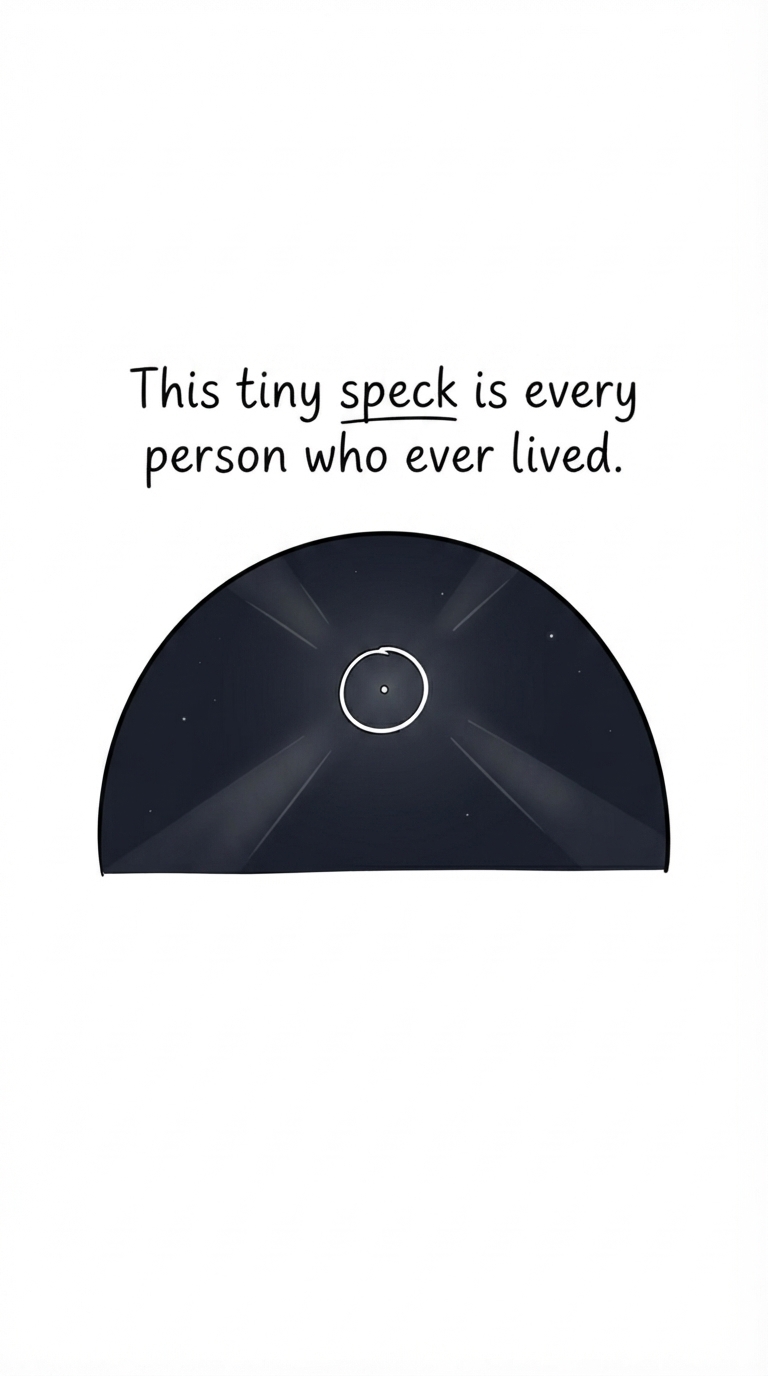 Scene 1 · 0:00–0:05Voiceover
This tiny speck is every person who ever lived.
PictureA dark dome of space with a small circled dot in the center and faint bands of light.
-
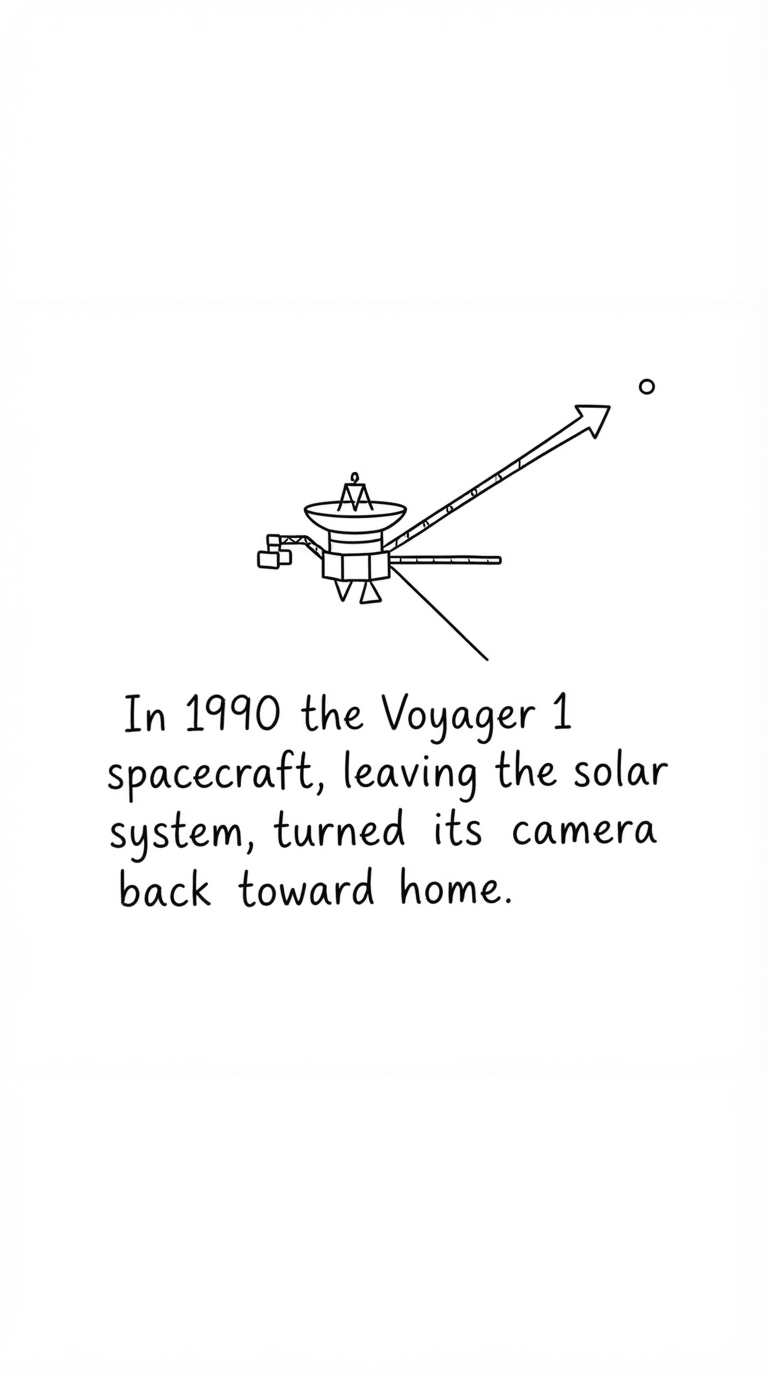 Scene 2 · 0:05–0:12Voiceover
In 1990 the Voyager 1 spacecraft, leaving the solar system, turned its camera back toward home.
PictureThe Voyager spacecraft with an arrow pointing back toward a tiny dot.
-
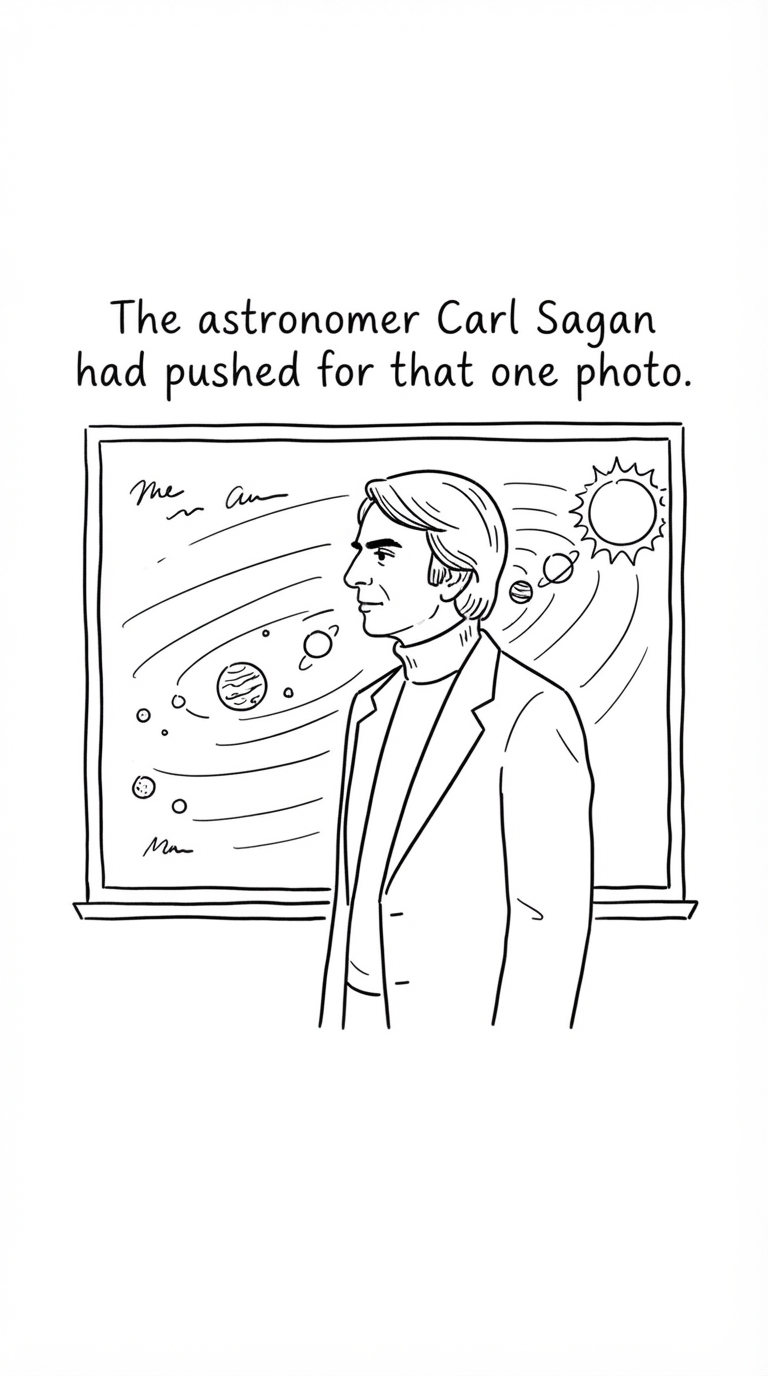 Scene 3 · 0:12–0:16Voiceover
The astronomer Carl Sagan had pushed for that one photo.
PictureCarl Sagan standing in front of a board with a drawing of the solar system.
-
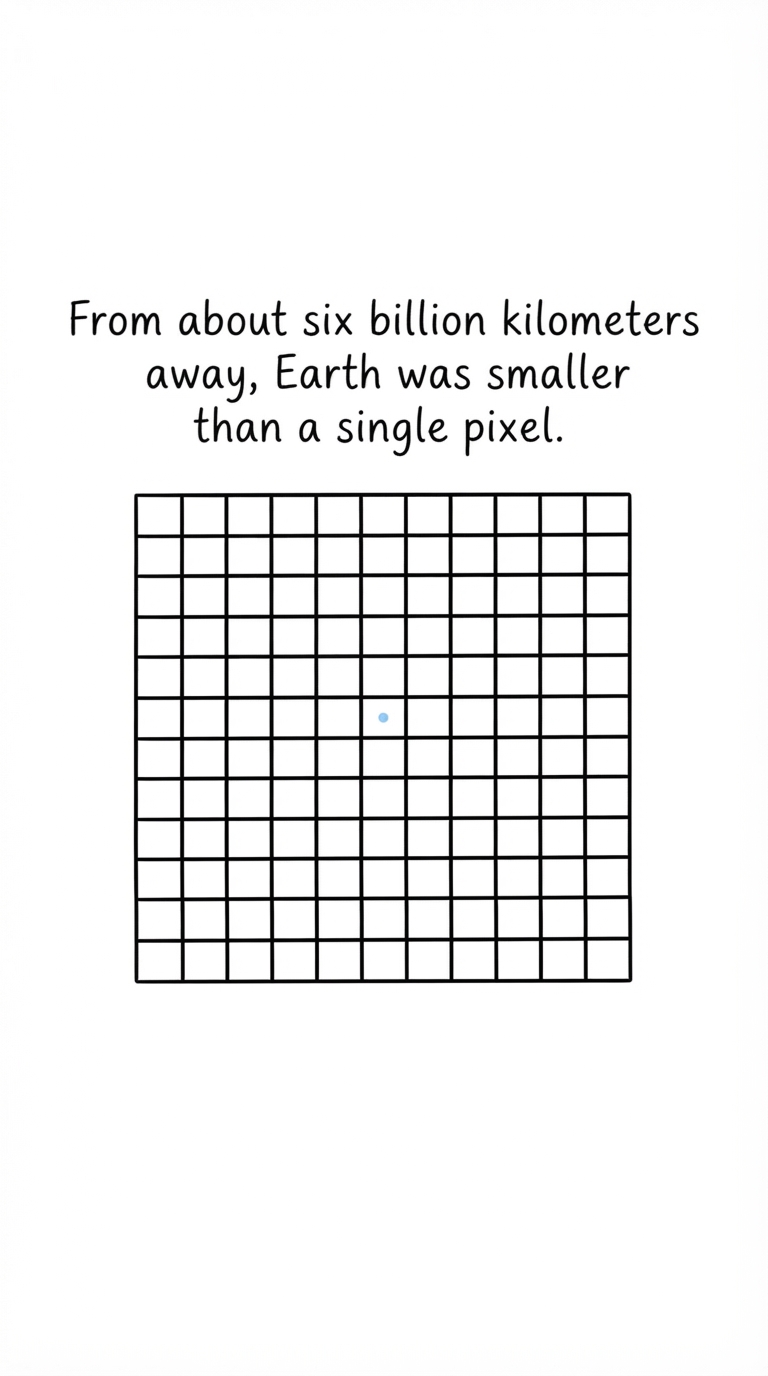 Scene 4 · 0:16–0:21Voiceover
From about six billion kilometers away, Earth was smaller than a single pixel.
PictureA grid of pixels with one faint dot inside a single square.
-
 Scene 5 · 0:21–0:27Voiceover
He called it the pale blue dot, and wrote that it is the only home we have ever known.
PictureCarl Sagan writing at a desk, with the photo of the dot pinned on the wall.
-
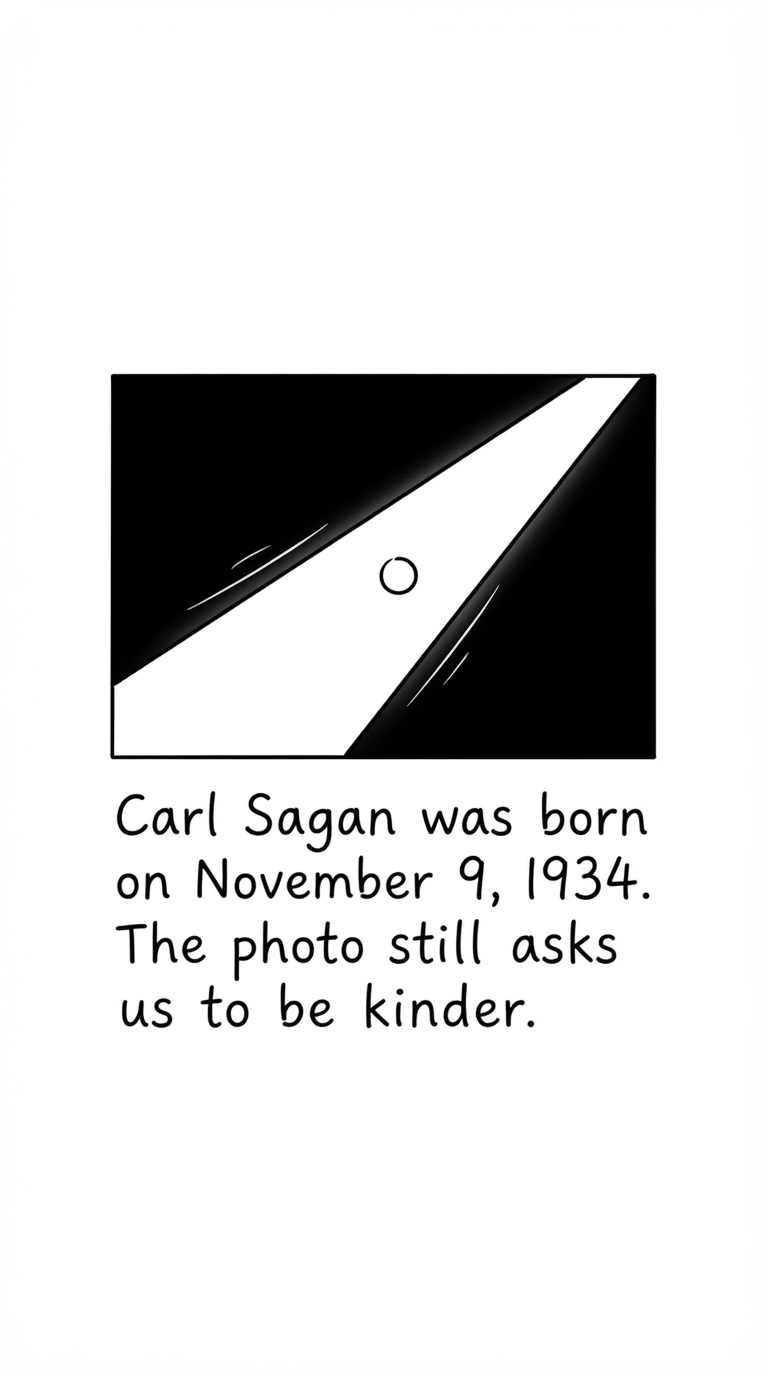 Scene 6 · 0:27–0:37Voiceover
Carl Sagan was born on November 9, 1934. The photo still asks us to be kinder.
PictureA tiny dot inside a band of light across black space.
One last look back
The photo almost did not happen. Voyager 1, launched in 1977, flew past Jupiter in 1979 and Saturn in 1980, and it had only been expected to keep in touch through the Saturn encounter. After Saturn, Carl Sagan proposed one last image of Earth. He admitted it would have little scientific value, since Earth would be too small to show any detail, but argued it would give a perspective on humanity's place in the universe. There were fears that pointing the camera so close to the Sun could ruin it, and the plan only moved in 1989, with NASA's administrator Richard Truly stepping in to make sure it was taken.
The exposures were taken at 04:48 GMT on February 14, 1990, when Voyager 1 was 6,055 million kilometers from Earth. The data waited on an onboard tape recorder and came home between March and May, each signal taking about five and a half hours to arrive. Three frames, shot through blue, green and violet filters, were combined into the final image, in which Earth takes up 0.12 of a pixel. The bands of light across it are sunlight reflected inside the camera. Soon after, Voyager 1's cameras were switched off for good.
Earth looks blue mainly because its air scatters blue sunlight more than red, the same reason the sky looks blue from the ground; the oceans add a little. It is pale rather than deep blue because white light from clouds mixes in. Life plays a part too: the oxygen made by photosynthetic life keeps the air clear to visible light, which lets that scattering show.
In his 1994 book Pale Blue Dot, Sagan read the photo as a picture of how small and brief humanity's place in the cosmos is. Everyone who ever lived, he wrote, lived on that speck, and there is nowhere else, at least for now, for our species to go. He drew a moral from it: a duty to treat one another more kindly and to protect the planet. NASA marked the photo's 25th anniversary in 2015 and released a reprocessed version, Pale Blue Dot Revisited, in 2020.
Source: Pale Blue Dot, WikipediaHow this video was made
We wrote the 6 narration lines and a one-line picture brief for each scene. explain.ink drew the scenes by hand in the chosen style, recorded the voiceover and rendered the MP4.
- Style
- Whiteboard
- Voice
- Gunner (warm, confident narrator)
- Format
- Vertical 9:16, 1080x1920, 37 seconds
- Redraws
- None: every scene was kept as first drawn
The story, in dates
- Nov 9, 1934 Carl Sagan is born. Source: Carl Sagan, Wikipedia
- Sep 5, 1977 Voyager 1 is launched to study the outer Solar System. Source: Pale Blue Dot, Wikipedia
- 1980 After the Saturn flyby, Sagan proposes one last photo of Earth. Source: Pale Blue Dot, Wikipedia
- Feb 14, 1990 Voyager 1 photographs Earth from 6 billion kilometers as part of a family portrait of the Solar System. Source: Pale Blue Dot, Wikipedia
- 1994 Sagan publishes Pale Blue Dot, the book that names and interprets the photo. Source: Pale Blue Dot, Wikipedia
- Aug 25, 2012 Voyager 1 enters interstellar space, the first spacecraft to do so. Source: Voyager 1, Wikipedia
- 2020 NASA releases Pale Blue Dot Revisited for the photo's 30th anniversary. Source: Pale Blue Dot, Wikipedia
Questions people ask
How far away was Voyager 1 when it took the Pale Blue Dot?
About 6,055 million kilometers (3,762 million miles), or 40.47 astronomical units. At that distance the radio signal carrying the image took about five and a half hours to reach Earth.
Source: Pale Blue Dot, WikipediaWhy does the Earth seem blue from space?
Mainly because the atmosphere scatters blue sunlight more than red light, which is also why the sky looks blue. The oceans add a little, and clouds mix in white light, which makes the dot pale.
Source: Pale Blue Dot, WikipediaWhat did Carl Sagan say about the Pale Blue Dot?
He wrote that everyone who ever lived lived on that tiny dot, that the image shows how foolish human self-importance is, and that it underlines our responsibility to treat each other more kindly and to protect the planet.
Source: Pale Blue Dot, WikipediaWhat is Carl Sagan's Pale Blue Dot book about?
The 1994 book takes the photo as its starting point and reads it as a picture of humanity's tiny, fleeting place in the cosmos, with Earth as the only world known to harbor life.
Source: Pale Blue Dot, WikipediaWhere is Voyager 1 now?
In interstellar space, which it entered in 2012. As of November 2026 it is about 173 astronomical units (25.9 billion kilometers) away, the most distant human-made object, and it is projected to reach one light day from Earth on November 18, 2026.
Source: Voyager 1, Wikipedia