Why do snowflakes have six arms?
Ice freezes in a hexagonal pattern, and the arms follow its corners.
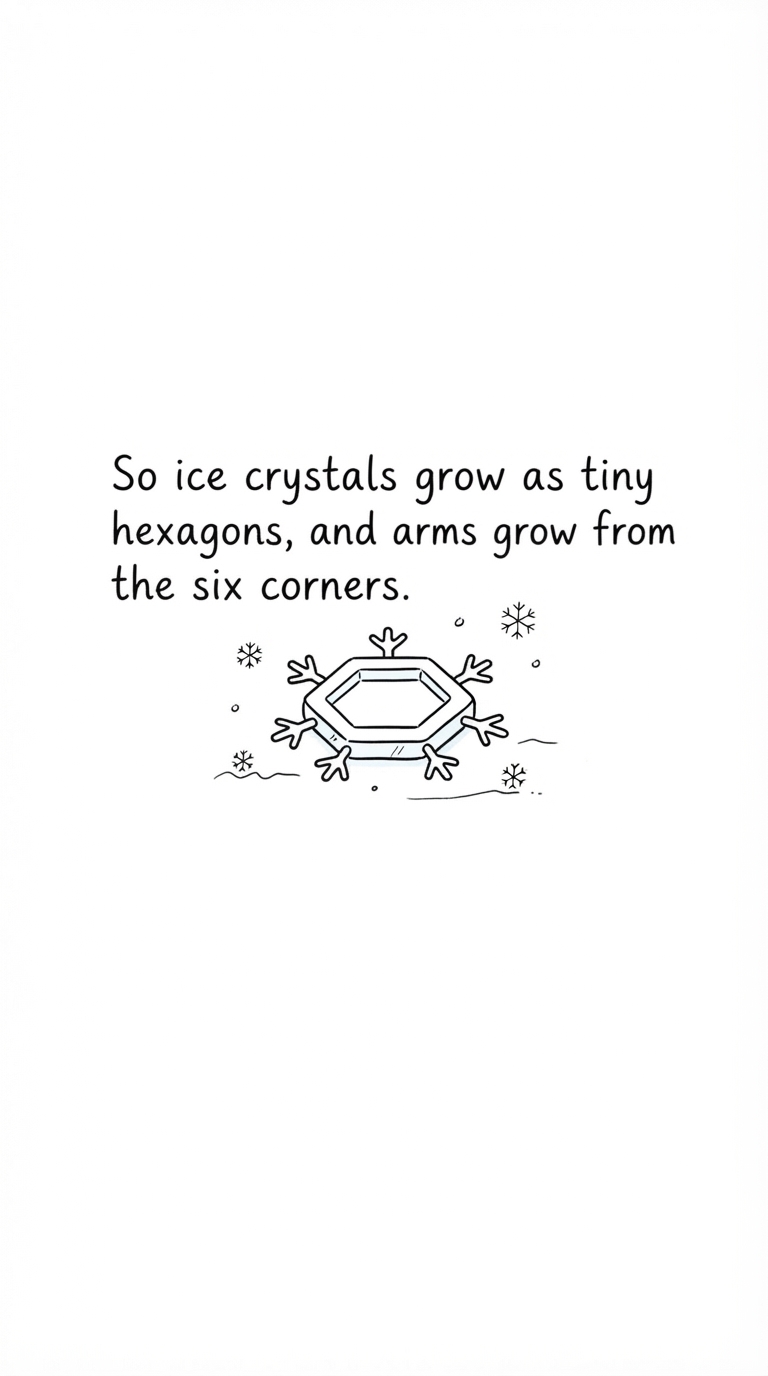
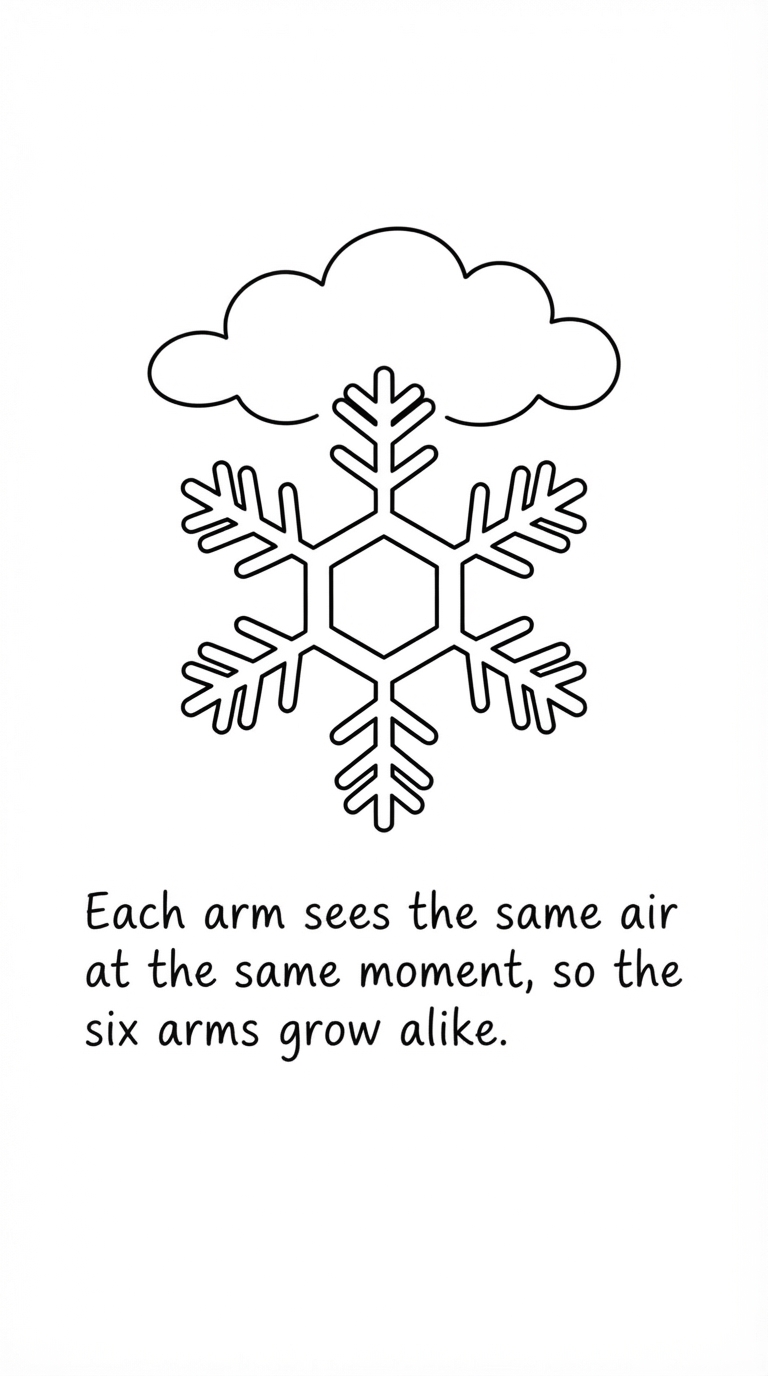
Snowflakes have six arms because ice is a hexagonal crystal. A new flake starts as a tiny hexagon, and an arm grows from each of its six corners. The arms look alike because they grow in nearly the same air at the same time, as the flake falls through the cloud.
Perfect six-armed flakes are rare, though. Studies suggest fewer than 0.1% show the ideal shape; most snow is irregular, and a few flakes grow with three or twelve branches.
The script
The narration is lettered on screen word for word, one scene at a time.
-
 Scene 1 · 0:00–0:07Voiceover
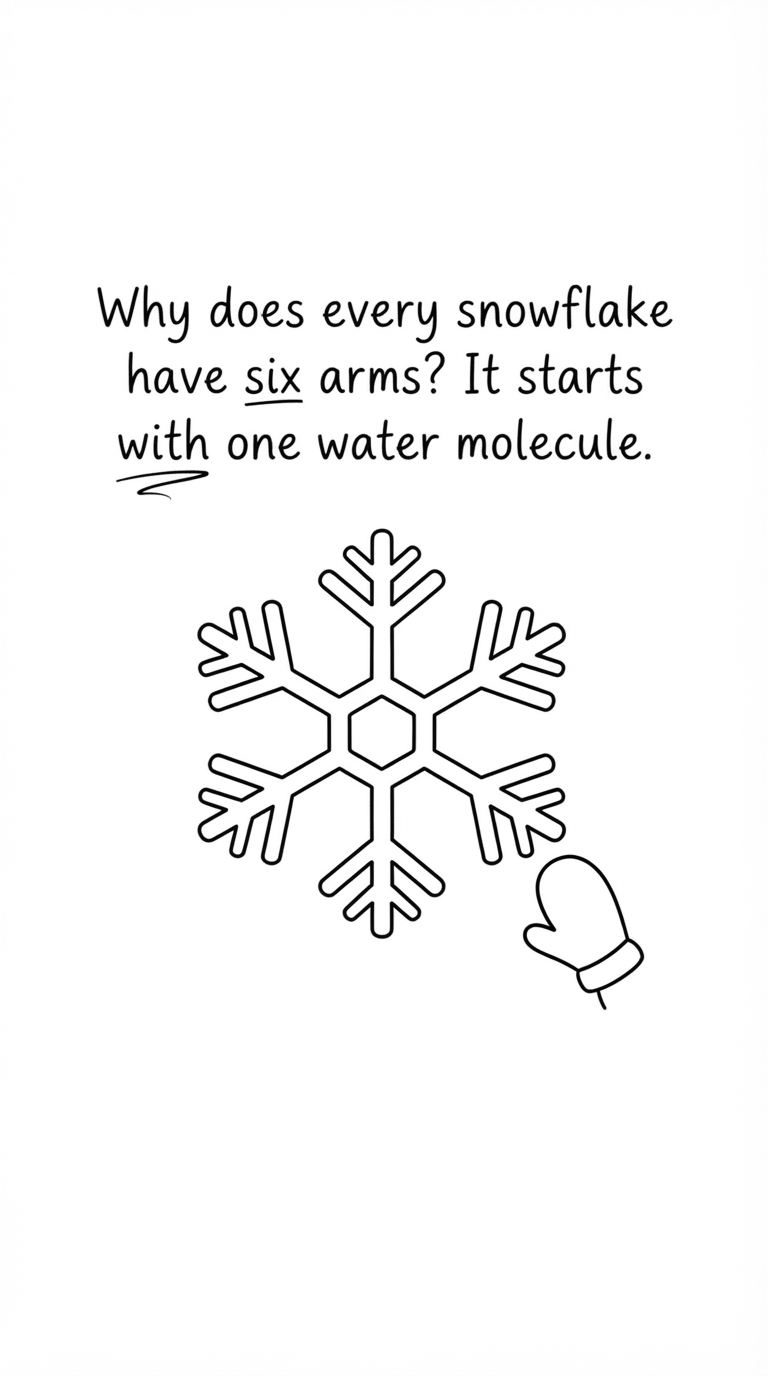
Why does every snowflake have six arms? It starts with one water molecule.
PictureA six-armed snowflake next to a mitten.
-
 Scene 2 · 0:07–0:13Voiceover
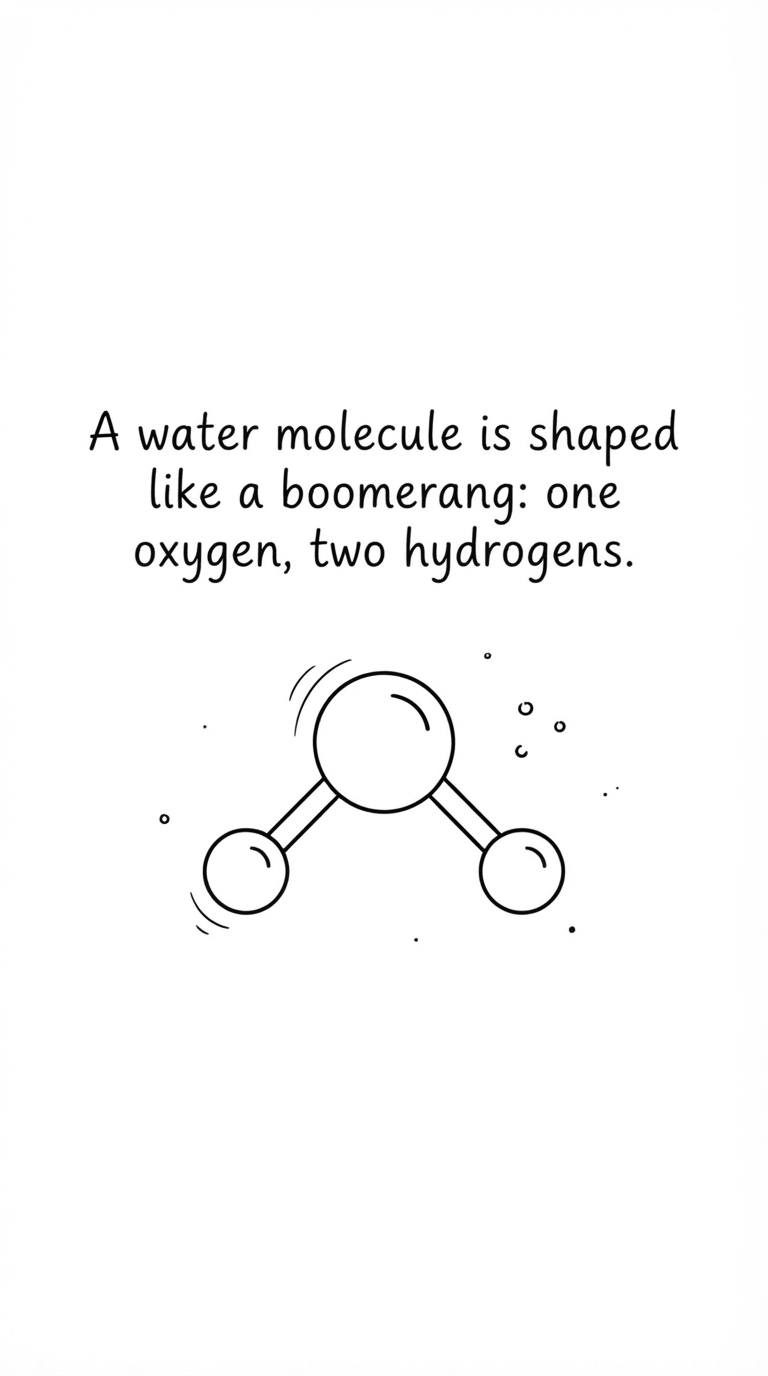
A water molecule is shaped like a boomerang: one oxygen, two hydrogens.
PictureA water molecule: one large ball joined to two small balls at an angle.
-
 Scene 3 · 0:13–0:18Voiceover
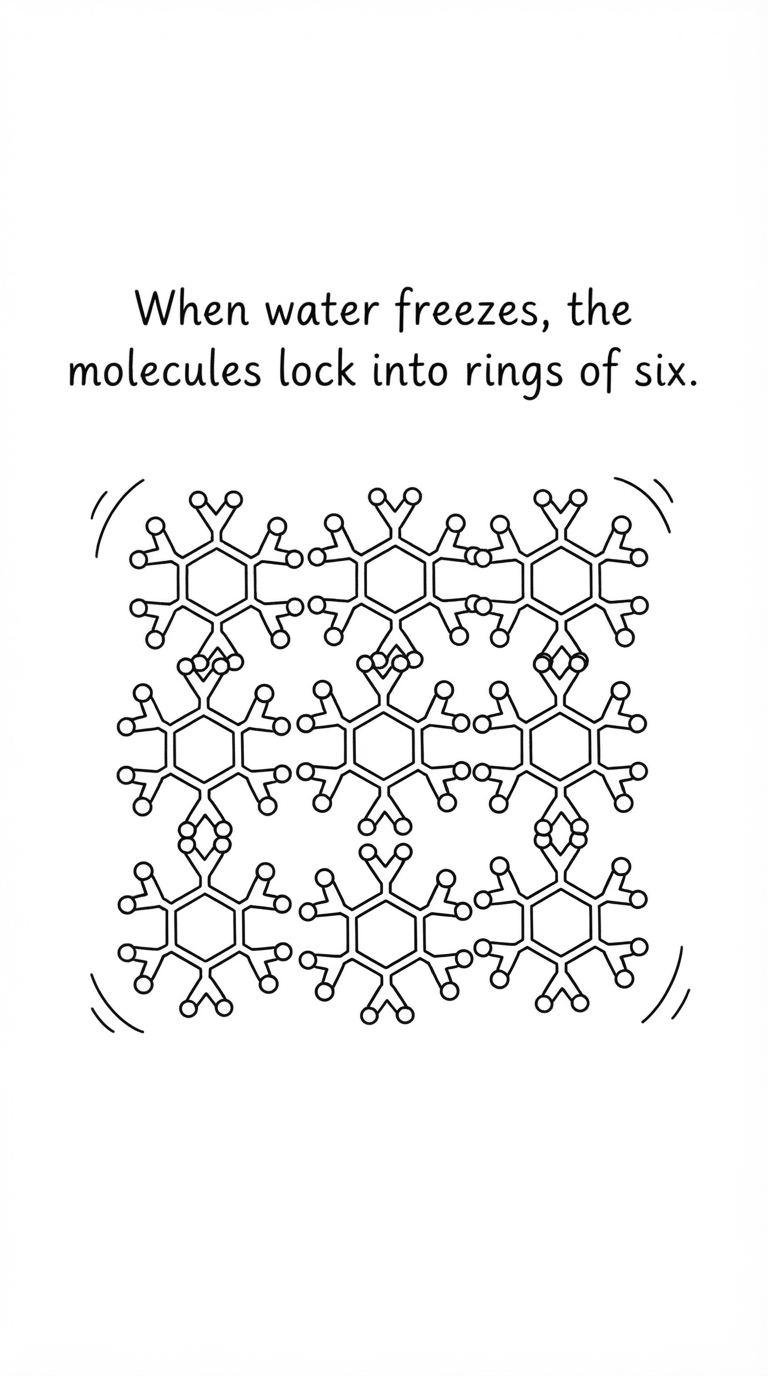
When water freezes, the molecules lock into rings of six.
PictureA lattice of linked six-sided rings, like a sheet of ice.
-
 Scene 4 · 0:18–0:25Voiceover
So ice crystals grow as tiny hexagons, and arms grow from the six corners.
PictureA tiny flat hexagonal ice plate with snowflakes around it.
-
 Scene 5 · 0:25–0:32Voiceover
Each arm sees the same air at the same moment, so the six arms grow alike.
PictureA large six-armed snowflake under a cloud.
-
 Scene 6 · 0:32–0:41Voiceover
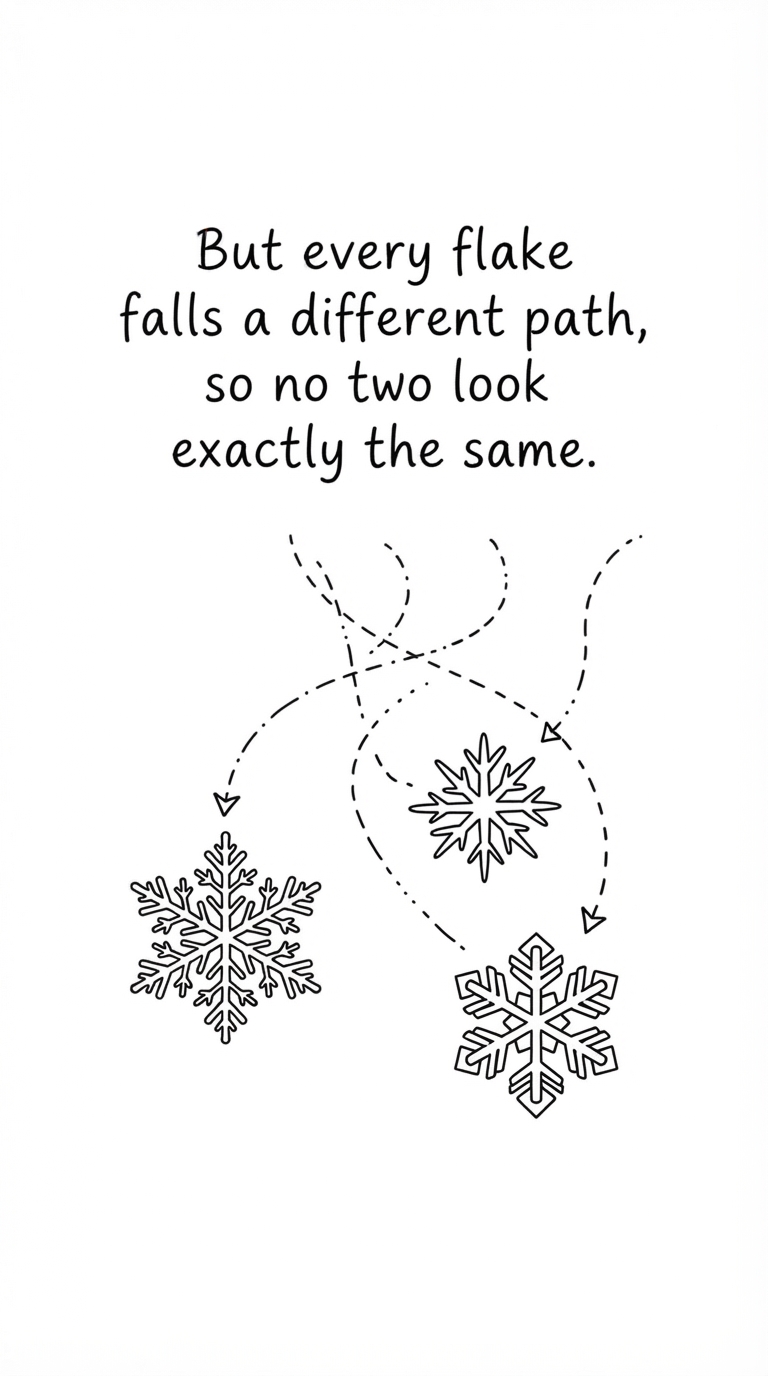
But every flake falls a different path, so no two look exactly the same.
PictureThree different snowflakes falling along separate dashed paths.
From Kepler's question to the snow lab
People have puzzled over the six arms for centuries. Albertus Magnus wrote what is thought to be the oldest detailed description of snow around 1250, and Olaus Magnus published the first snowflake drawings in 1555. In 1611 the astronomer Johannes Kepler wrote a short treatise trying to explain why snow crystals are hexagonal, and René Descartes drew hexagonal flakes in 1637.
Source: Timeline of snowflake research, WikipediaThe modern picture came from cameras and cold rooms. From 1885 Wilson Bentley photographed thousands of snowflakes through a microscope, showing how varied they are. Ukichiro Nakaya later related crystal shape to the conditions a flake forms in: down to about -3 °C flakes form thin plates, down to -8 °C columns and needles, and down to -22 °C plates again, often with branching arms.
Source: Snowflake, WikipediaIt starts with the molecule. Water is bent, not straight: its two hydrogen atoms sit at an angle of about 104.5 degrees around the oxygen atom, which gives the molecule its polar charge.
Source: Properties of water, WikipediaThe six arms come from the crystal. Ice has a hexagonal structure, so a young flake is a minute hexagon, and its six arms then grow independently from the corners. Because the air around the flake is nearly the same on every side, each arm tends to grow the same way, though that is not guaranteed. In practice, studies suggest fewer than 0.1% of flakes show ideal six-fold symmetry. At around -2 °C flakes can rarely form with three-fold symmetry, and very occasionally flakes with twelve branches are seen.
No two are alike for a simple reason: a typical flake holds about 10 quintillion water molecules, which grow at different rates as the temperature and humidity change on the way down. Nearly identical flakes have been grown under controlled conditions, but they are very unlikely in nature. Scientists Magono and Lee sorted fresh snow crystals into 80 shapes, from needles and columns to plates, and snow looks white, although ice is clear, because the many small facets scatter light.
Source: Snowflake, WikipediaHow this video was made
We wrote the 6 narration lines and a one-line picture brief for each scene. explain.ink drew the scenes by hand in the chosen style, recorded the voiceover and rendered the MP4.
- Style
- Whiteboard
- Voice
- Gunner (warm, confident narrator)
- Format
- Vertical 9:16, 1080x1920, 41 seconds
- Redraws
- Scene 1 (2 times) was redrawn before the final render
The story, in dates
- 1555 Olaus Magnus publishes the earliest known snowflake diagrams. Source: Timeline of snowflake research, Wikipedia
- 1611 Johannes Kepler tries to explain why snow crystals are hexagonal. Source: Timeline of snowflake research, Wikipedia
- 1885 Wilson Bentley begins photographing snowflakes through a microscope. Source: Snowflake, Wikipedia
- Jan 1887 Snowflakes claimed to be 38 cm (15 inches) wide fall at Fort Keogh, Montana, the largest aggregated flakes on record. Source: Snowflake, Wikipedia
- 1936 Ukichiro Nakaya creates snow crystals in a lab and charts their shape against temperature and moisture. Source: Timeline of snowflake research, Wikipedia
- 1988 Researchers grow artificial snow crystals in an updraft, confirming Nakaya's diagram. Source: Timeline of snowflake research, Wikipedia
Questions people ask
Do all snowflakes have six sides?
No. Six-fold symmetry is the pattern ice tends toward, but most snow particles are irregular, and studies suggest fewer than 0.1% of snowflakes show the ideal six-armed shape.
Source: Snowflake, WikipediaHow many sides do snowflakes have, 6 or 7?
Six. The symmetry comes from the hexagonal crystal structure of ice. The rare exceptions are three-sided flakes, which form around -2 °C, and twelve-branched flakes, which still keep a six-fold pattern.
Source: Snowflake, WikipediaHow rare is a 12-sided snowflake?
Very rare. Twelve-branched snowflakes are only very occasionally observed, and they keep the six-fold symmetry of ordinary flakes.
Source: Snowflake, WikipediaIs each snowflake actually unique?
Almost certainly in nature. A typical flake holds about 10 quintillion water molecules that grow differently as conditions change on the way down. Nearly identical flakes have been grown in labs, but they are very unlikely to be found outdoors.
Source: Snowflake, WikipediaWhat exactly is a snowflake?
A single ice crystal large enough to fall through the atmosphere as snow. It forms around a tiny particle and grows as water freezes onto it, taking a shape set by the temperature and humidity it passes through.
Source: Snowflake, WikipediaWhat are the main types of snowflakes?
Magono and Lee's classification has 80 shapes in eight main groups: needles, columns, plates, column-and-plate combinations, columns with side planes, rimed crystals, irregular crystals and germs, the tiny starting crystals.
Source: Snowflake, Wikipedia