Where did Friendsgiving come from?
Thanksgiving with the friends you choose, usually before the family dinner.
Friendsgiving is a Thanksgiving-style meal shared with friends, usually potluck, held before the family dinner or instead of it. It began with young adults who could not or did not want to go home for the holiday. The word first appeared online in 2007.
Merriam-Webster added it to the dictionary in 2020. By NPR's count in 2025, as many as one in five Americans celebrate it, most as a second meal in the Thanksgiving season rather than a replacement.
The script
The narration is lettered on screen word for word, one scene at a time.
-
 Scene 1 · 0:00–0:06Voiceover
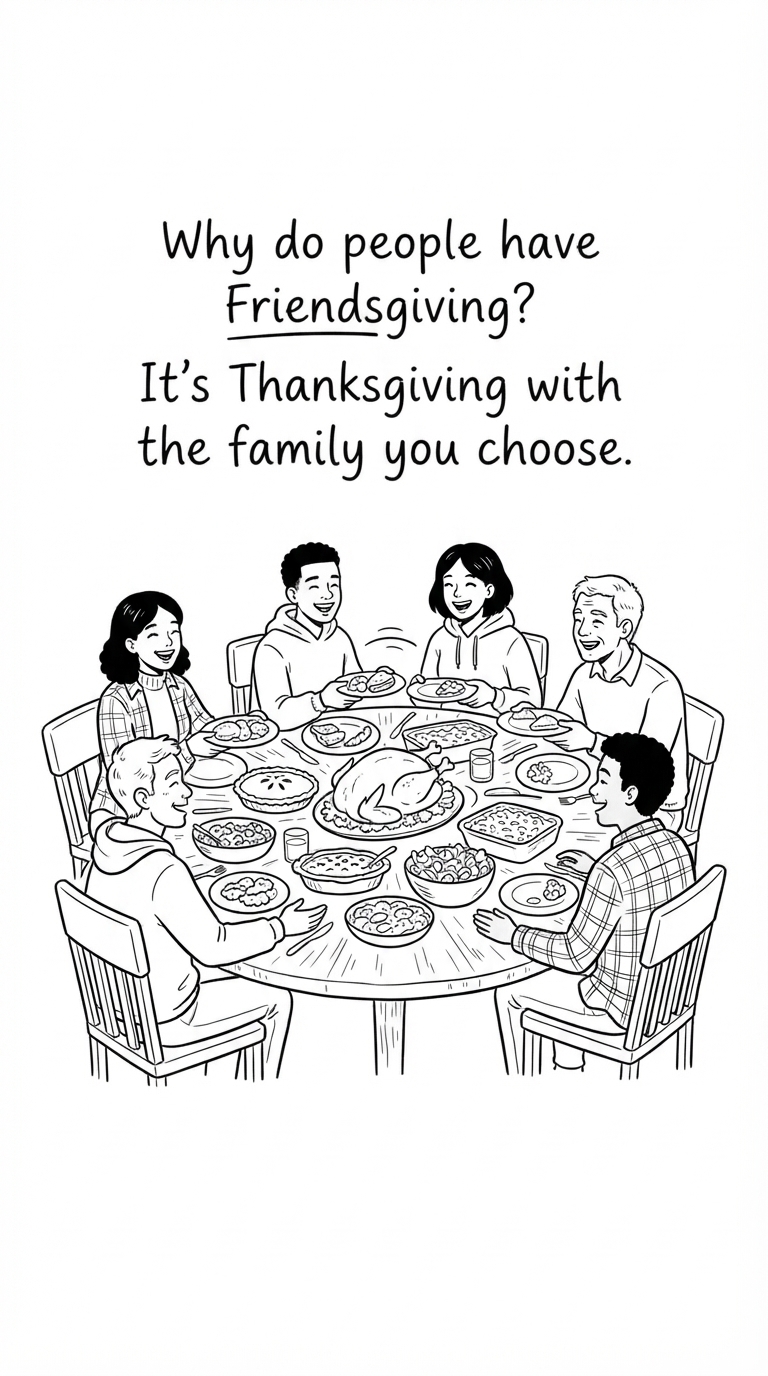
Why do people have Friendsgiving? It's Thanksgiving with the family you choose.
PictureFriends around a round table full of dishes, with a turkey in the middle.
-
 Scene 2 · 0:06–0:11Voiceover
The word first showed up around 2007, mostly online.
PictureAn open laptop with chat messages on the screen and a heart in a speech bubble.
-
 Scene 3 · 0:11–0:15Voiceover
Young people who couldn't fly home began cooking for each other instead.
PictureA young woman cooking at a stove by a window, with a plane flying past outside.
-
 Scene 4 · 0:15–0:20Voiceover
Everyone brings a dish, so no one cooks the whole meal alone.
PictureThree friends arriving at a door, each carrying a dish: a pie, a bowl and a pot.
-
 Scene 5 · 0:20–0:24Voiceover
Photos online made it spread, and dictionaries added the word.
PictureA phone screen showing a photo of friends at a dinner table, with hearts floating above it.
-
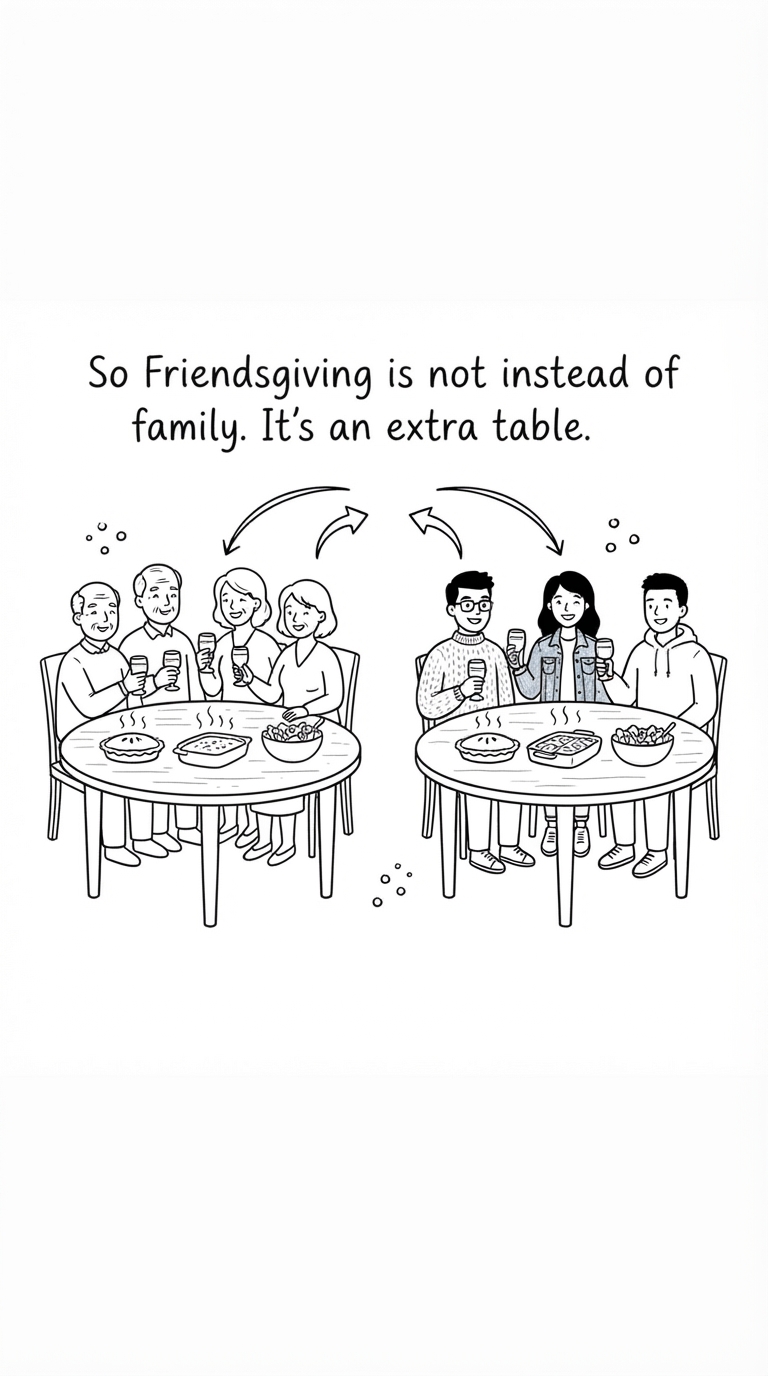 Scene 6 · 0:24–0:31Voiceover
So Friendsgiving is not instead of family. It's an extra table.
PictureTwo tables side by side, older relatives at one and young friends at the other, with arrows between them.
Older than the word
Thanksgiving with friends instead of family is decades older than its name. In the mid-1960s Alice and Ray Brock hosted Thanksgiving dinners for friends, many of them estranged from their own families. Arlo Guthrie came to one in 1965, and those dinners partly inspired his song Alice's Restaurant, which became a Thanksgiving tradition of its own. A Charlie Brown Thanksgiving, from 1973, also centers on a holiday meal among friends.
The word itself first appeared in 2007, for an informal meal, and by 2011 it had caught on: that year it turned up in a liqueur advertisement and in an episode of The Real Housewives of New Jersey. Google searches for it were rare before 2012 but regular by 2013, the same year the Emily Post Institute began getting etiquette questions about it. Merriam-Webster added it to the dictionary in 2020.
It is most common in places with many transplants, for whom going home for the holiday is hard, and articles in 2018 described it as especially popular in cities and among millennials. It matters in the LGBTQ+ community, where many have strained relationships with their families, and offices hold it as a potluck holiday party. What started as an alternative to the family dinner has, for most people, become an extra one.
Not everyone sees it the same way. The New York Times called it more than a riff on Thanksgiving, and Reason magazine called it cultural flourishing. Critics read it as a sign of millennials forming households later, or of their lower living standards. The idea has also crossed the Atlantic: in the 2020s it reached the United Kingdom, where Thanksgiving is not a public holiday.
Source: Friendsgiving, WikipediaHow this video was made
We wrote the 6 narration lines and a one-line picture brief for each scene. explain.ink drew the scenes by hand in the chosen style, recorded the voiceover and rendered the MP4.
- Style
- Whiteboard
- Voice
- Gunner (warm, confident narrator)
- Format
- Vertical 9:16, 1080x1920, 31 seconds
- Redraws
- None: every scene was kept as first drawn
The story, in dates
- 1965 Arlo Guthrie attends one of Alice and Ray Brock's Thanksgiving dinners for friends, which partly inspire his song Alice's Restaurant. Source: Friendsgiving, Wikipedia
- 1973 A Charlie Brown Thanksgiving is released, built around a holiday meal among friends. Source: Friendsgiving, Wikipedia
- 2007 The word Friendsgiving is first used, according to Merriam-Webster, for an informal meal. Source: Friendsgiving, Wikipedia
- 2011 The term catches on, appearing in a liqueur advertisement and a reality TV episode. Source: Friendsgiving, Wikipedia
- 2013 Google searches for the word become regular, and the Emily Post Institute starts getting etiquette questions about it. Source: Friendsgiving, Wikipedia
- 2020 Merriam-Webster adds Friendsgiving to the dictionary, and a comedy film called Friendsgiving is released. Source: Friendsgiving, Wikipedia
- 2025 NPR reports that as many as 20% of Americans celebrate Friendsgiving. Source: Friendsgiving, Wikipedia
Questions people ask
Is Friendsgiving usually before or after Thanksgiving?
Usually before. Most people hold it as a separate meal in the days before the family Thanksgiving dinner, though some hold it on Thanksgiving Day itself instead of going home.
Source: Friendsgiving, WikipediaWhat is the purpose of Friendsgiving?
It began as a holiday meal for people who could not or did not want to go home for Thanksgiving, often young adults who had moved away. Today most people celebrate it as an extra gathering with friends during the Thanksgiving season.
Source: Friendsgiving, WikipediaWhat are the rules of Friendsgiving?
There are no fixed rules. It is usually potluck, with each guest bringing a dish. The many published guides to hosting one exist, as one food critic noted in 2019, because many hosts have never thrown a large dinner party before.
Source: Friendsgiving, WikipediaWhat is the difference between Thanksgiving and Friendsgiving?
Thanksgiving is the holiday itself, traditionally spent with family. Friendsgiving is a meal with friends on or near it, often potluck, and for most people an extra gathering rather than a replacement.
Source: Friendsgiving, WikipediaWhat is the date of Thanksgiving in 2026?
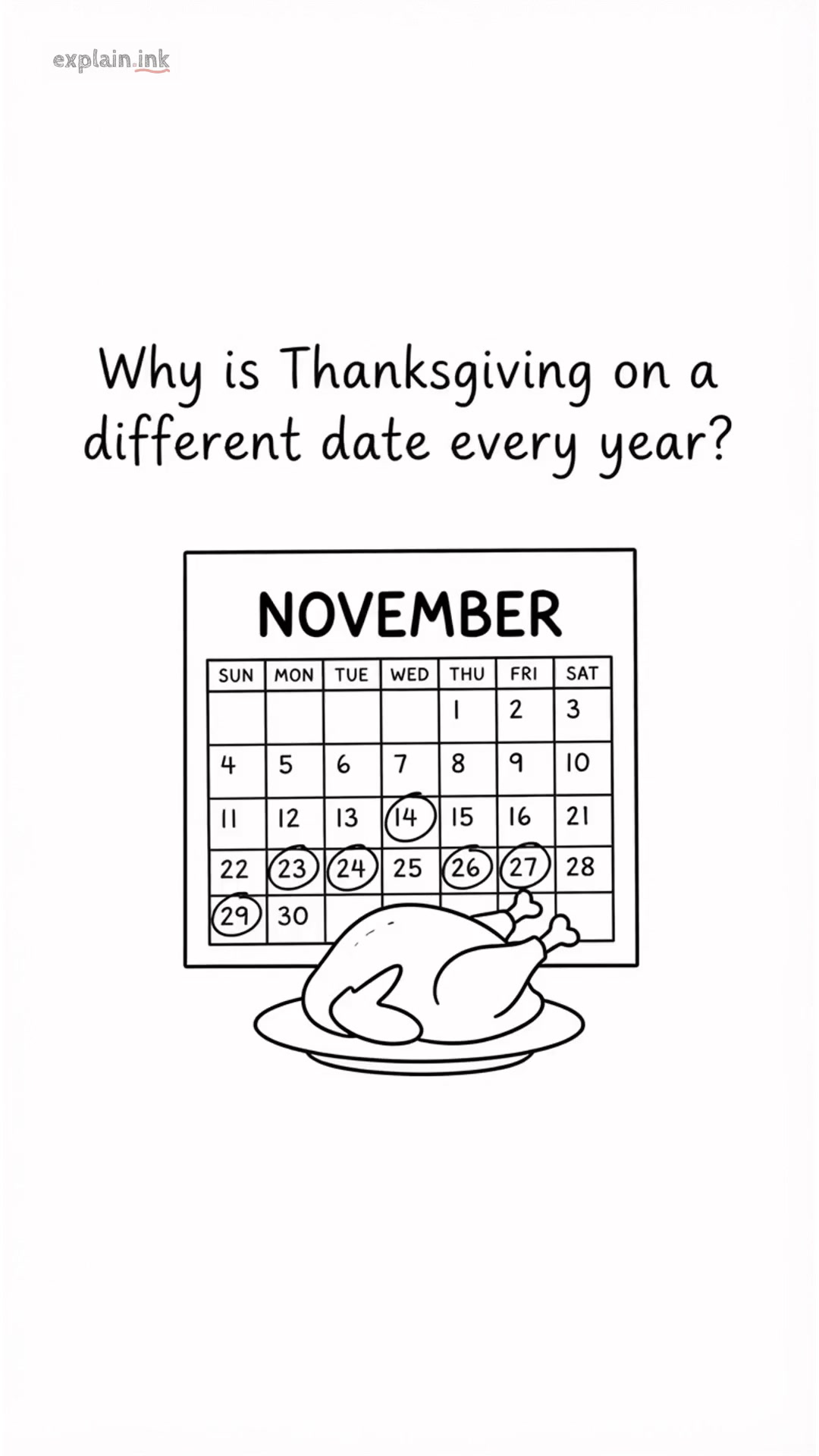
Thursday, November 26, 2026, the fourth Thursday of November.
Source: Thanksgiving (United States), Wikipedia