Why is it called Black Friday?
Not red ink turning black. Traffic cops in Philadelphia.
Black Friday got its name from Philadelphia police, who used it for the day after Thanksgiving, when shoppers and tourists jammed downtown and officers worked extra-long shifts. The story about stores finally moving from red ink into the black came decades later, in the 1980s.
Philadelphia merchants disliked the name and tried to rebrand the day Big Friday in 1961, without success. The red-to-black explanation first appeared in print in 1981, as the term spread across the country.
The script
The narration is lettered on screen word for word, one scene at a time.
-
 Scene 1 · 0:00–0:05Voiceover
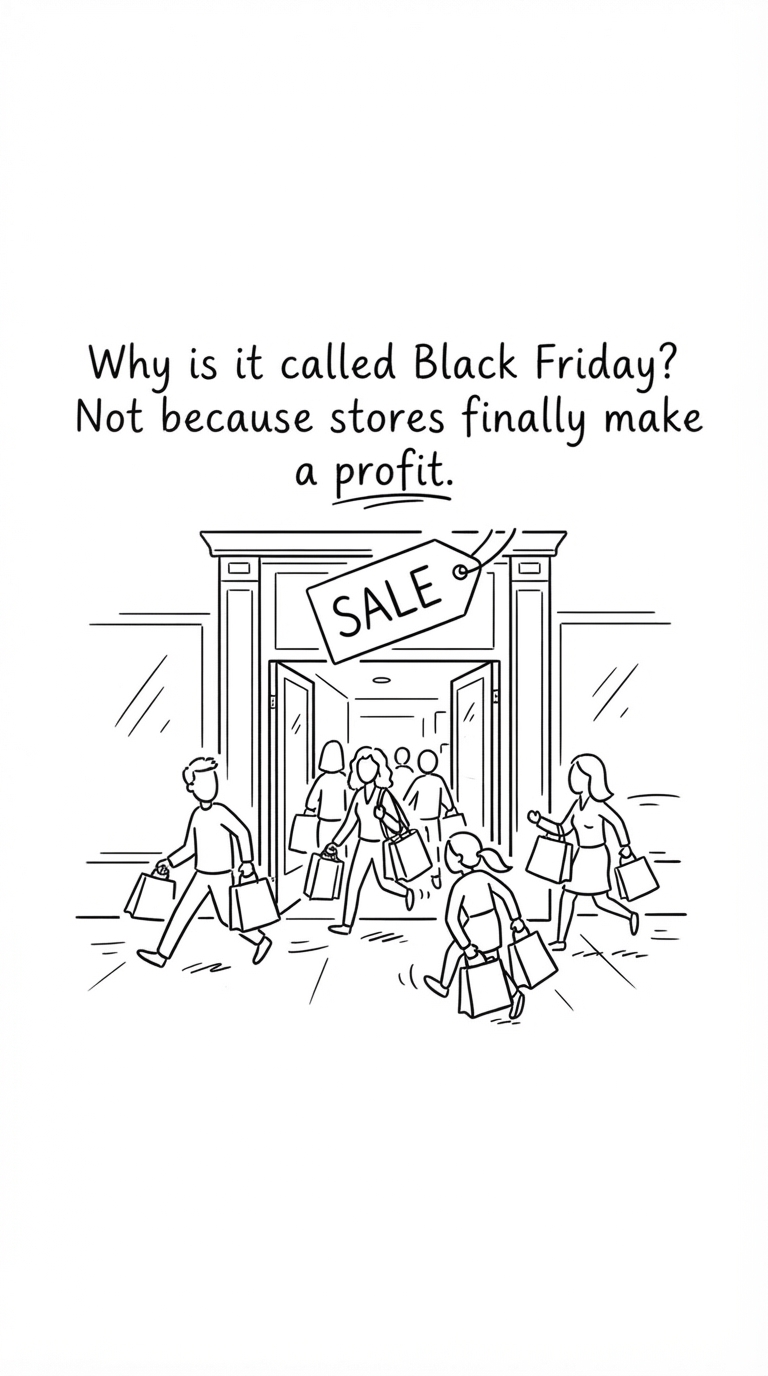
Why is it called Black Friday? Not because stores finally make a profit.
PictureShoppers carrying bags rushing into a store under a big SALE tag.
-
 Scene 2 · 0:05–0:10Voiceover
In the 1960s, Philadelphia police used the name for the day after Thanksgiving.
PictureA police officer with a whistle directing traffic at a street corner.
-
 Scene 3 · 0:10–0:16Voiceover
Shoppers and visitors flooded downtown before the big Army-Navy football game.
PictureA police officer directing crowds and old cars on a downtown street under a NAVY and ARMY football banner.
-
 Scene 4 · 0:16–0:22Voiceover
Officers worked long shifts in traffic jams and crowds, so they called it black.
PictureA tired police officer wiping his forehead in a traffic jam of old cars.
-
 Scene 5 · 0:22–0:28Voiceover
Stores disliked the name, so a nicer story spread: books going from red ink to black.
PictureAn open accounting ledger with negative numbers on one page and positive numbers on the other, and a pen.
-
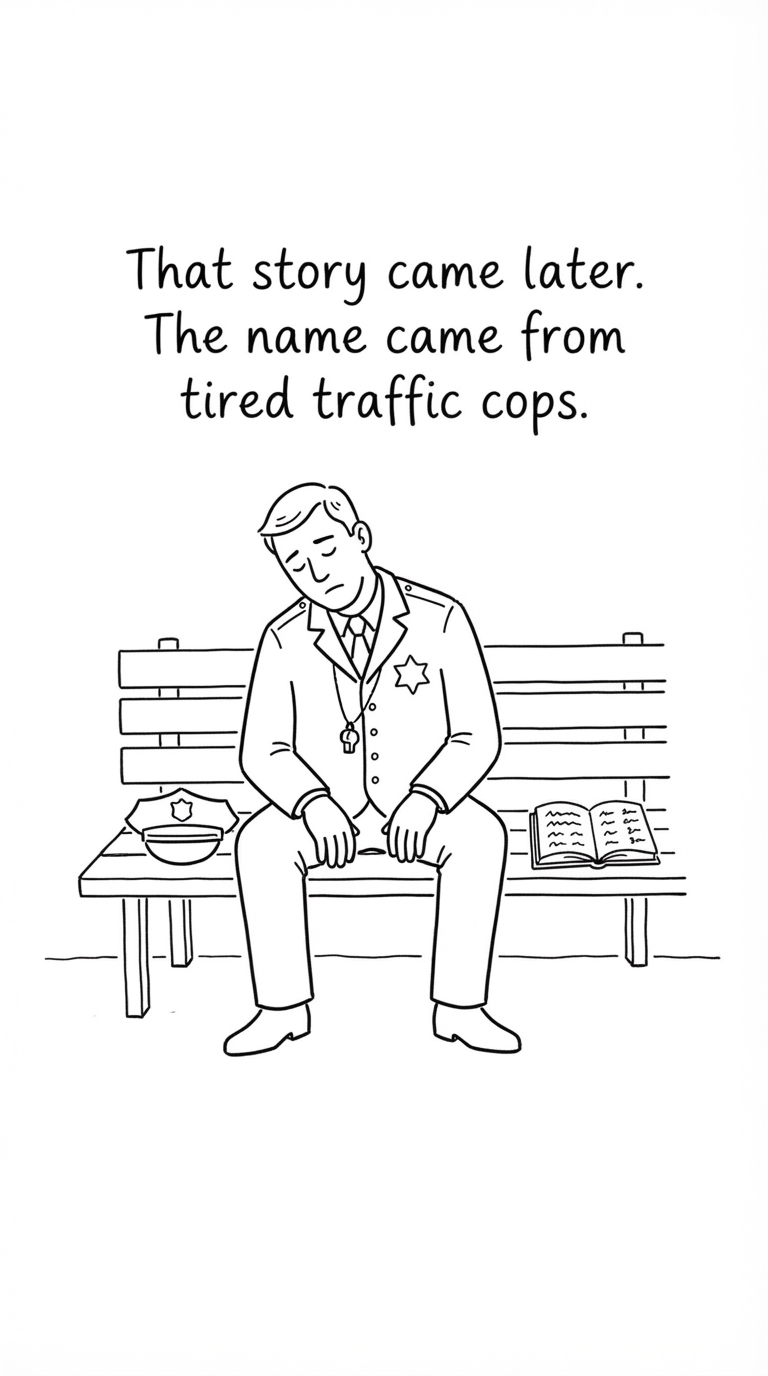 Scene 6 · 0:28–0:35Voiceover
That story came later. The name came from tired traffic cops.
PictureA police officer sitting on a bench with his hat off, resting.
Where the name came from, and where the day went
Black has been attached to days of disaster for centuries. The most significant American Black Friday before shopping was the gold panic of 1869, when financiers Jay Gould and James Fisk tried to corner the gold market and President Grant broke the run by releasing government gold. The first known use of the name for the day after Thanksgiving came in a factory trade journal in 1951, about workers calling in sick to get a four-day weekend. It did not catch on.
Source: Black Friday (shopping), WikipediaThe meaning that stuck came from Philadelphia. In the 1950s, police there used Black Friday for the chaos when suburban shoppers and tourists flooded the city ahead of the Army-Navy football game, played that Saturday. Officers could not take the day off and worked extra-long shifts. By 1961 the name was common enough in the city that merchants tried, and failed, to replace it with Big Friday.
Source: HISTORY: History of Black FridayThe term spread slowly. When The New York Times first used it in 1975, it still meant the busiest shopping and traffic day of the year in Philadelphia, and as late as 1985 retailers in Cincinnati and Los Angeles had not heard of it. As it gained national attention in the early 1980s, merchants who objected to a gloomy name offered the red-ink-to-black-ink explanation, first published in 1981.
The day itself keeps changing. Stores opened earlier and earlier, until some opened on Thanksgiving evening, a trend nicknamed Black Thursday. After 2014, when spending over the holiday weekend fell 11%, many went back to closing on Thanksgiving, and Target said in 2021 it would stay closed for good. Shopping has also moved online: Black Friday online sales reached a record $9.12 billion in 2022.
Source: Black Friday (shopping), WikipediaHow this video was made
We wrote the 6 narration lines and a one-line picture brief for each scene. explain.ink drew the scenes by hand in the chosen style, recorded the voiceover and rendered the MP4.
- Style
- Whiteboard
- Voice
- Gunner (warm, confident narrator)
- Format
- Vertical 9:16, 1080x1920, 35 seconds
- Redraws
- Scenes 1 and 4 were redrawn before the final render
The story, in dates
- 1869 A gold market panic gives the US its most significant Black Friday before the shopping one. Source: Black Friday (shopping), Wikipedia
- Nov 1951 A factory trade journal uses Black Friday for the day after Thanksgiving, meaning workers who call in sick. Source: Black Friday (shopping), Wikipedia
- 1961 Philadelphia merchants try to rename the day Big Friday. The name is quickly forgotten. Source: Black Friday (shopping), Wikipedia
- Nov 29, 1975 The New York Times first uses the term, still for Philadelphia's busiest shopping and traffic day. Source: Black Friday (shopping), Wikipedia
- Nov 28, 1981 The Philadelphia Inquirer prints the earliest known red-ink-to-black-ink explanation. Source: Black Friday (shopping), Wikipedia
- Nov 28, 2005 The National Retail Federation coins Cyber Monday for the Monday after Thanksgiving. Source: Cyber Monday, Wikipedia
- 2021 Target says its stores will stay closed on Thanksgiving for good. Source: Black Friday (shopping), Wikipedia
Questions people ask
Why was Friday called Black Friday?
Philadelphia police named it in the 1950s. On the day after Thanksgiving, shoppers and tourists flooded the city before the Army-Navy football game, and officers had to work extra-long shifts in the crowds and traffic.
Source: HISTORY: History of Black FridayWhat was Black Friday originally called?
It has been called Black Friday since the police in Philadelphia used the name. In 1961 the city's merchants tried to rebrand it as Big Friday, but the new name was quickly forgotten.
Source: Black Friday (shopping), WikipediaWhat does black mean on Black Friday?
For centuries black has been applied to days of disaster, and for Philadelphia police it meant the crowds and traffic of the day. The idea that it means stores moving from loss to profit was added in the early 1980s.
Source: Black Friday (shopping), WikipediaWhat is the Black Friday sale?
The start of the Christmas shopping season: stores run heavily promoted discounts and often open early, sometimes at midnight or even on Thanksgiving. Some extend the deals to Cyber Monday or a whole Cyber Week.
Source: Black Friday (shopping), WikipediaHow does Black Friday compare to Cyber Monday?
Black Friday began with crowds in stores. Cyber Monday, three days later, is a term the National Retail Federation coined in 2005 for online shopping. On November 30, 2020 it was the biggest online shopping day in US history, at $10.7 billion.
Source: Cyber Monday, WikipediaWhen is Black Friday in 2026?
On Friday, November 27, 2026, the day after Thanksgiving, which falls on Thursday, November 26.
Source: Black Friday (shopping), Wikipedia