What is a shooting star?
Not a star: a speck of space dust burning up in the air.
A shooting star is a meteor: the streak of light a small piece of space rock or dust, called a meteoroid, makes as it enters Earth's atmosphere. Meteoroids range from grains to objects about a meter wide, and an estimated 25 million of them and other bits of space debris enter the atmosphere every day.
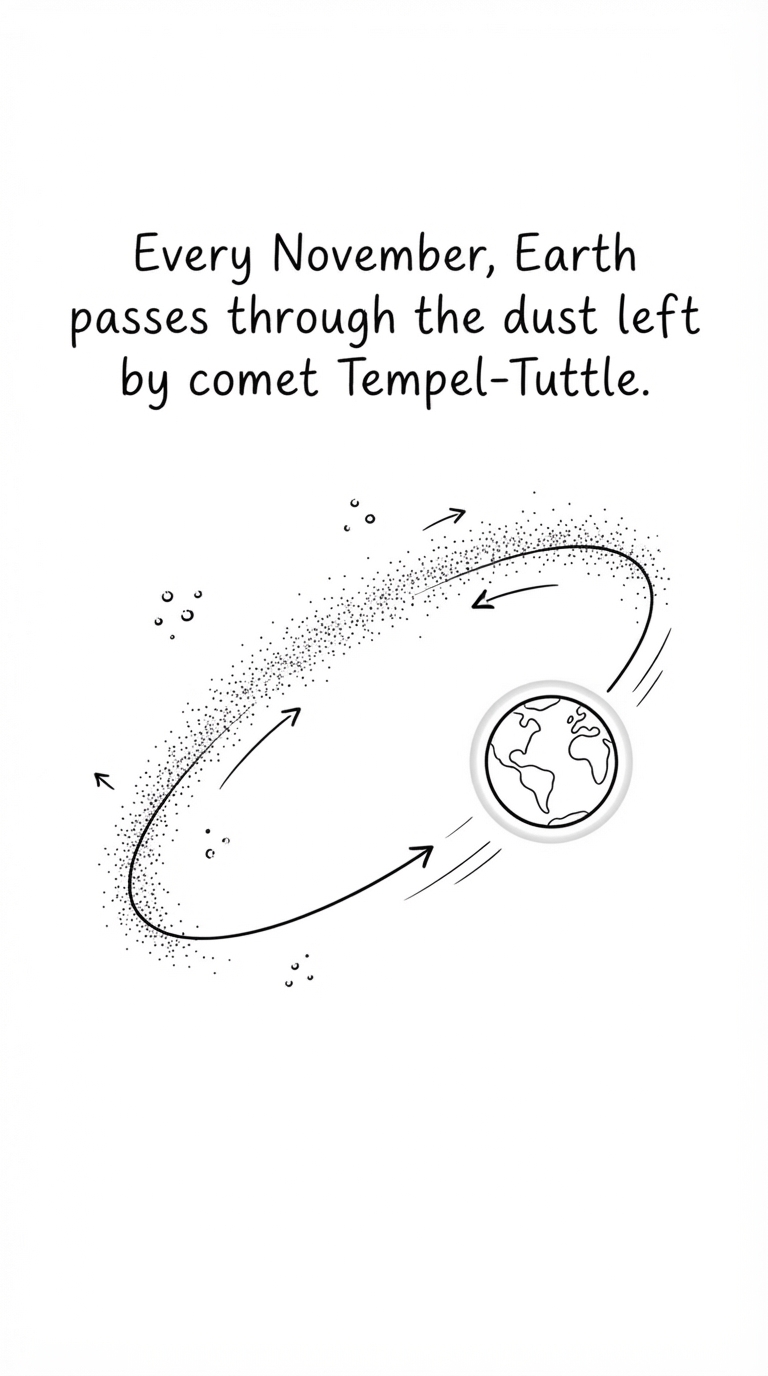
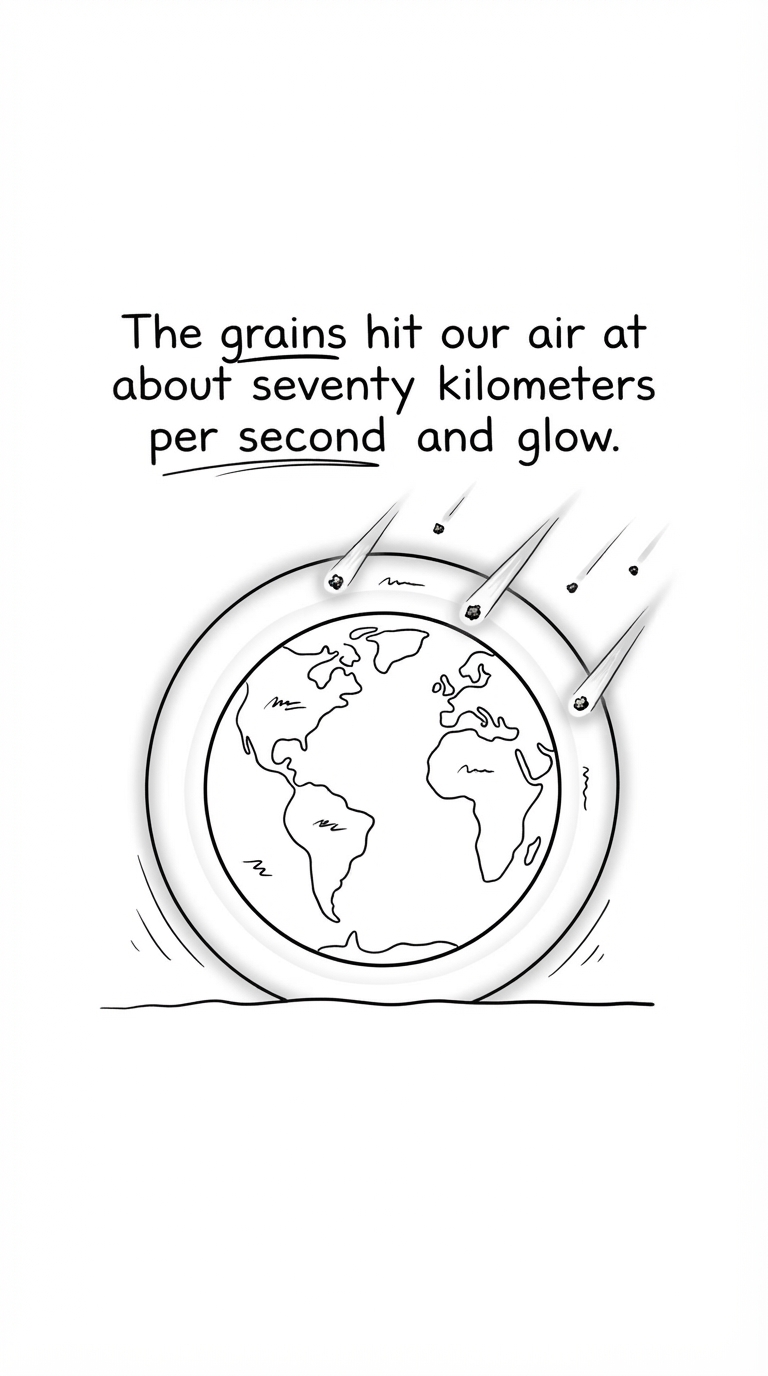
In mid-November Earth crosses dust from comet Tempel-Tuttle, producing the Leonids, which hit at about 70 km per second, the fastest annual shower.
The script
The narration is lettered on screen word for word, one scene at a time.
-
 Scene 1 · 0:00–0:06Voiceover
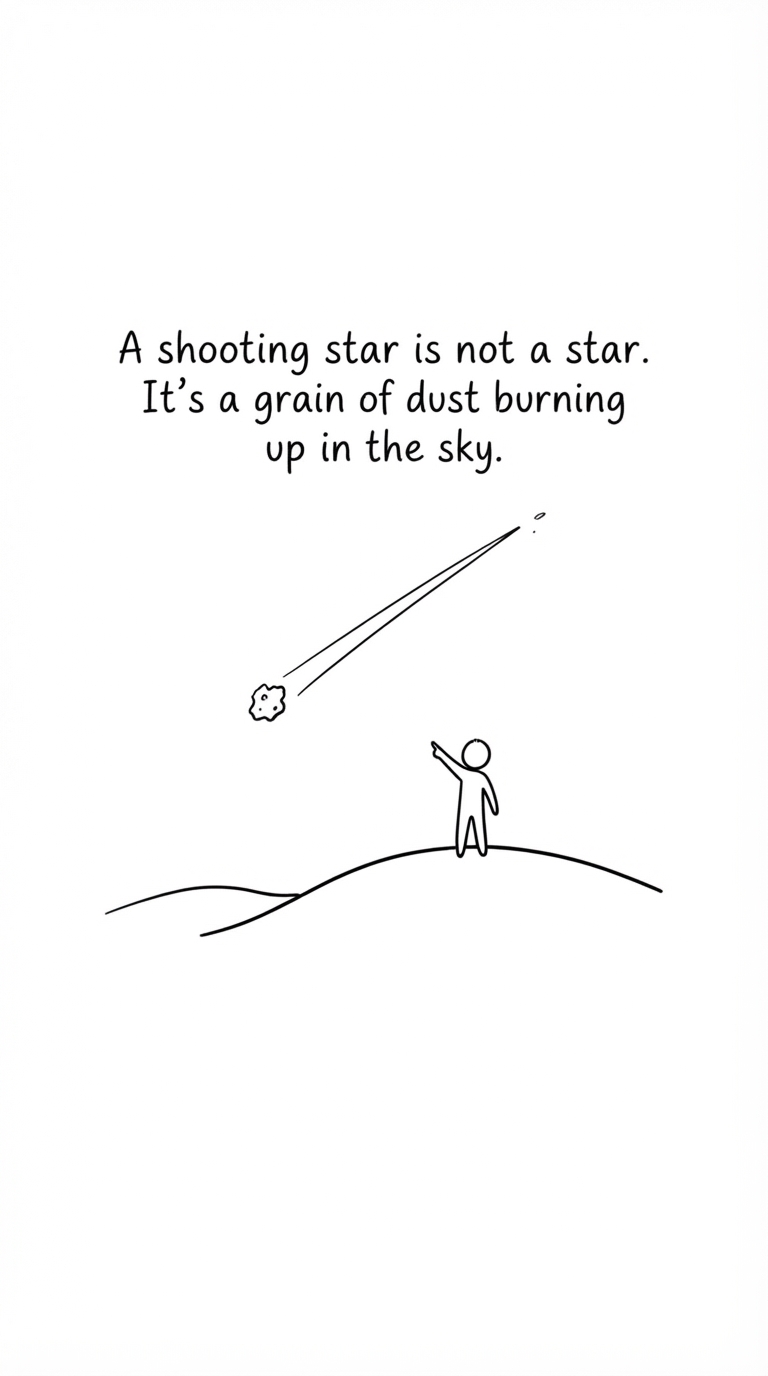
A shooting star is not a star. It's a grain of dust burning up in the sky.
PictureA small figure on a hill pointing at a streak across the sky.
-
 Scene 2 · 0:06–0:11Voiceover
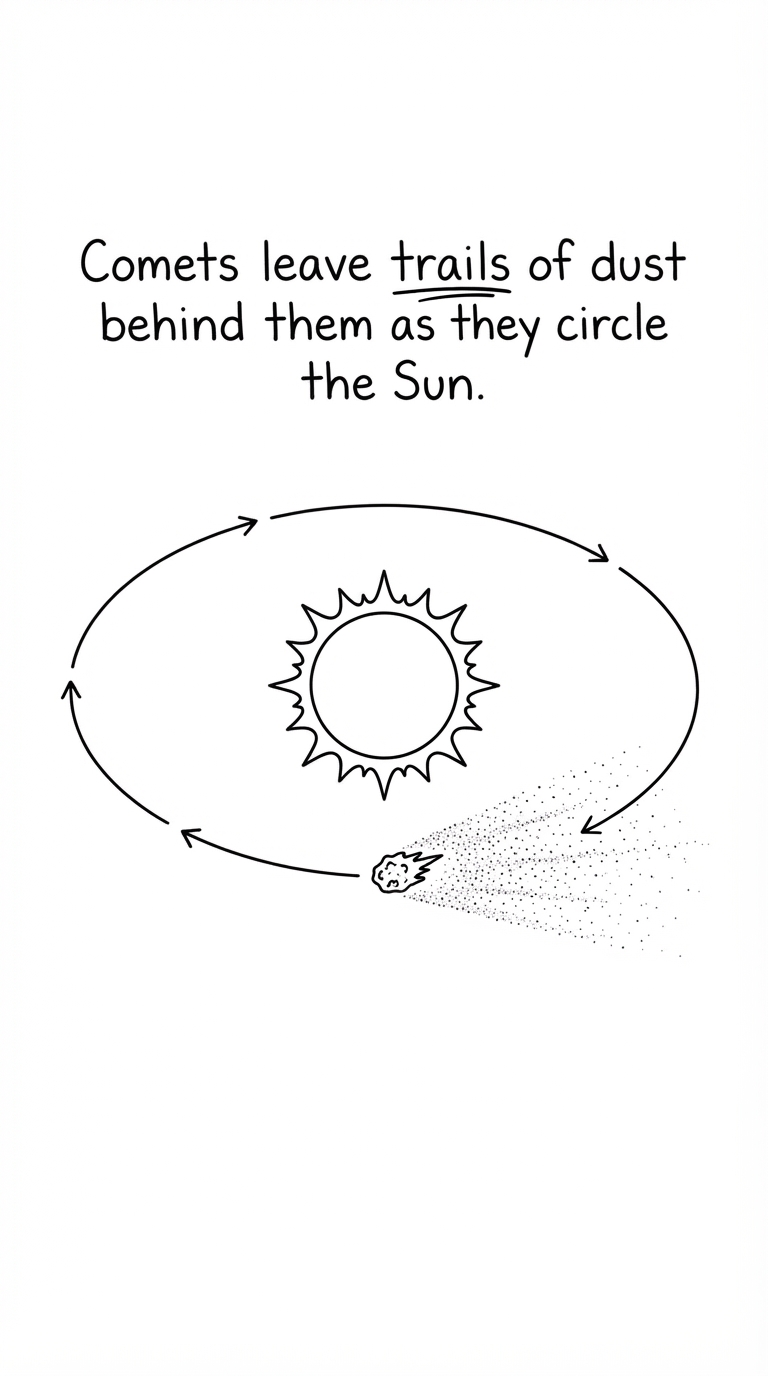
Comets leave trails of dust behind them as they circle the Sun.
PictureA comet circling the Sun, leaving a trail of dust along its orbit.
-
 Scene 3 · 0:11–0:17Voiceover
Every November, Earth passes through the dust left by comet Tempel-Tuttle.
PictureEarth passing through a dusty ring of particles.
-
 Scene 4 · 0:17–0:22Voiceover
The grains hit our air at about seventy kilometers per second and glow.
PictureGrains streaking into Earth's glowing atmosphere.
-
 Scene 5 · 0:22–0:27Voiceover
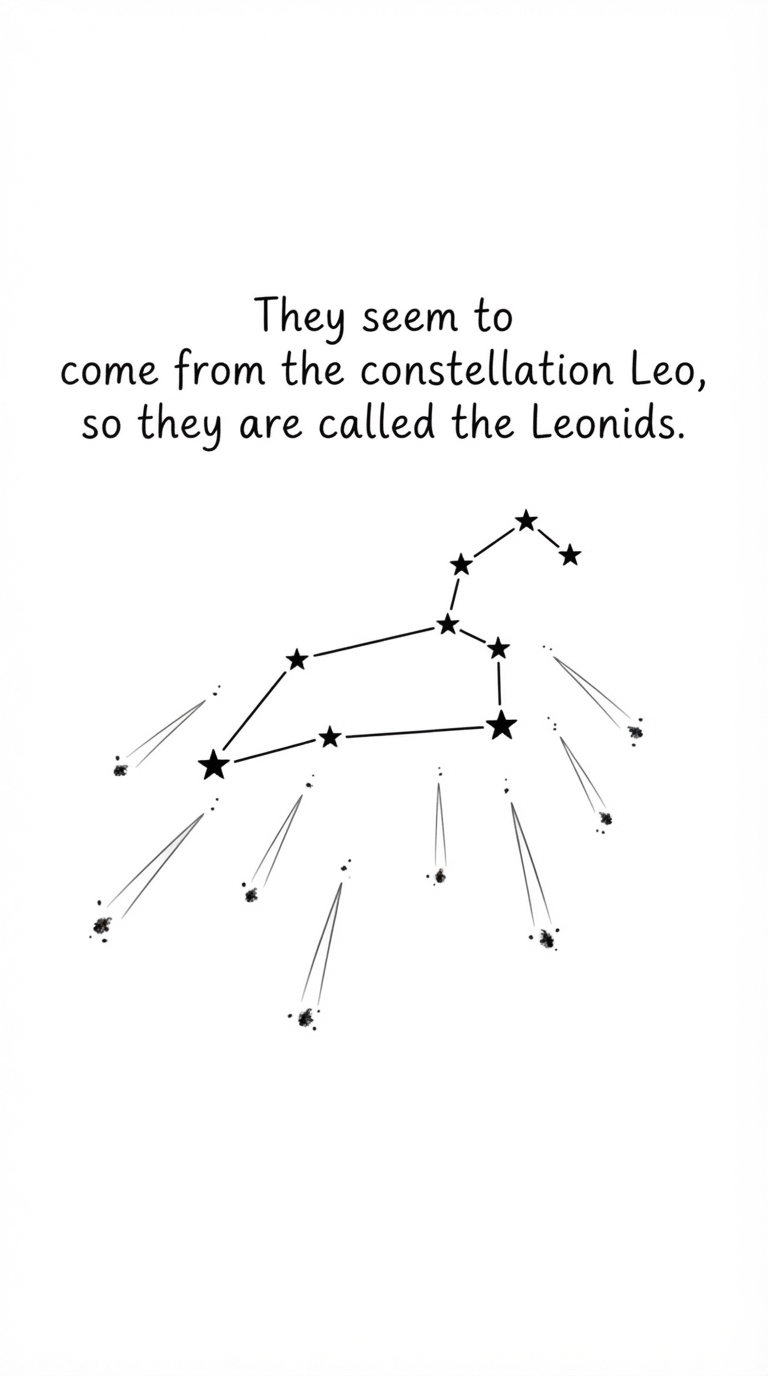
They seem to come from the constellation Leo, so they are called the Leonids.
PictureThe constellation Leo with meteors streaking away from it.
-
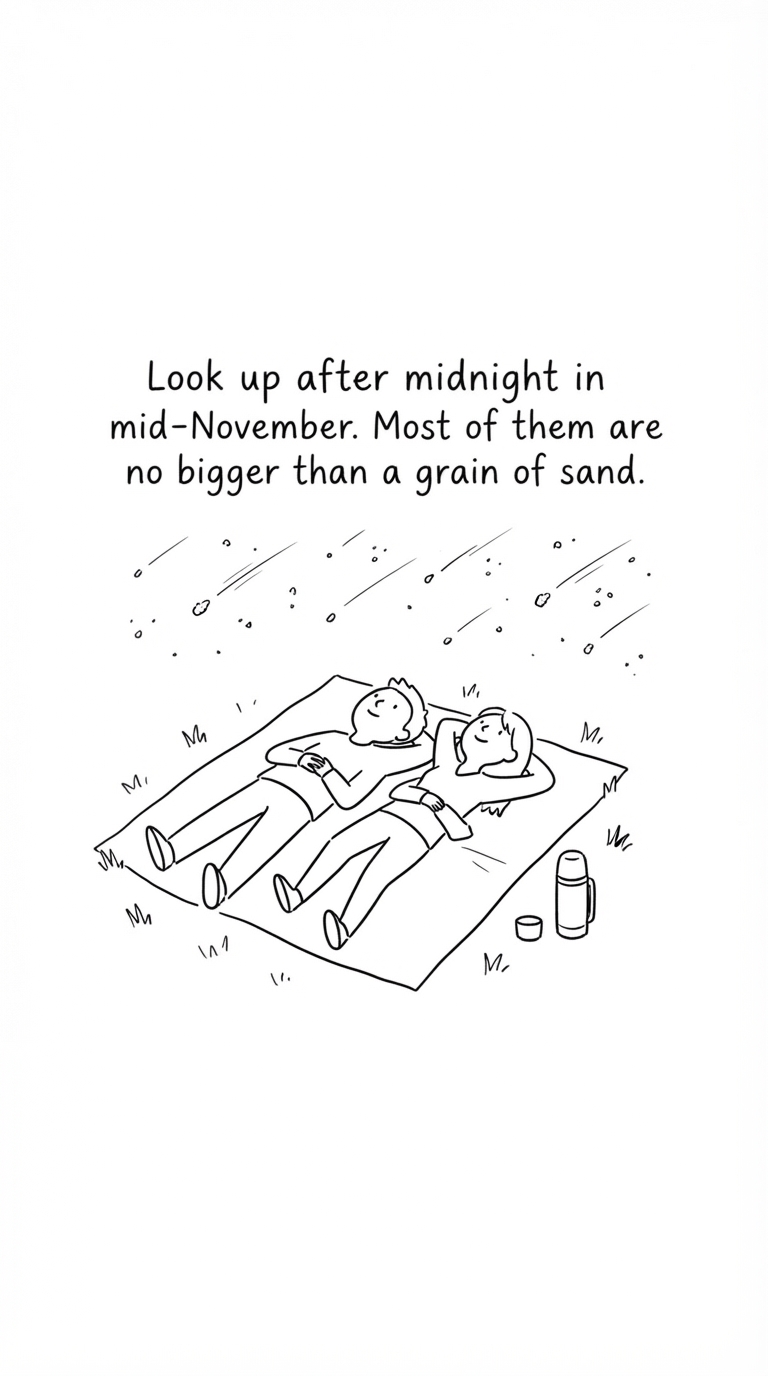 Scene 6 · 0:27–0:36Voiceover
Look up after midnight in mid-November. Most of them are no bigger than a grain of sand.
PictureTwo people lying on a blanket watching meteors, with a thermos beside them.
Not weather, but comet dust
Three words cover the whole story. A meteoroid is a small body in space, from a grain to about a meter across. A meteor is the light it makes passing through the atmosphere, the thing we call a shooting star. A meteorite is whatever survives and reaches the ground. Most meteoroids come from the asteroid belt, others are dust from comets, and some are fragments knocked off the Moon or Mars. About 15,000 tonnes of this material enters the atmosphere each year.
Source: Meteoroid, WikipediaFor a long time meteors were thought to be weather. In 1794 Ernst Chladni proposed that they came from outer space. After the great storm of November 1833, Denison Olmsted showed the streaks radiated from a point in the constellation Leo and arrived as a cloud of space dust. In 1866 Giovanni Schiaparelli showed that the Leonids shared an orbit with a comet, and in 1951 Fred Whipple described comets as dirty snowballs that shed dust as the Sun heats them.
Source: Meteor shower, WikipediaThat 1833 storm is still the most famous. One estimate put the peak at over one hundred thousand meteors an hour across North America east of the Rockies. Native American nations marked it: the Cheyenne established a peace treaty, the Lakota calendar was reset, and many birthdays were later counted from it. Abraham Lincoln commented on it years afterward. Another great Leonid storm in 1966 peaked above 40 meteors per second.
Source: Leonids, WikipediaYou do not need a storm to see one. The most reliable shower is the Perseids, peaking around August 12 at more than one meteor a minute, followed by the Geminids and Quadrantids. The Leonids peak around November 17 and are usually calmer than the Perseids, except in their storm years, roughly every 33 years, which coincide with the return of comet Tempel-Tuttle. The last came in 1999 to 2002, and astronomers do not expect the next until around 2034, or even 2099.
Source: Meteor shower, WikipediaHow this video was made
We wrote the 6 narration lines and a one-line picture brief for each scene. explain.ink drew the scenes by hand in the chosen style, recorded the voiceover and rendered the MP4.
- Style
- Whiteboard
- Voice
- Gunner (warm, confident narrator)
- Format
- Vertical 9:16, 1080x1920, 36 seconds
- Redraws
- Scenes 3 and 5 were redrawn before the final render
The story, in dates
- 1794 Ernst Chladni proposes that meteors come from outer space. Source: Meteor shower, Wikipedia
- Nov 12-13, 1833 The great Leonid storm: by one estimate over one hundred thousand meteors an hour over North America. Source: Leonids, Wikipedia
- 1866 Giovanni Schiaparelli links meteor showers to comets. Source: Meteor shower, Wikipedia
- 1951 Fred Whipple describes comets as dirty snowballs that shed dust. Source: Meteor shower, Wikipedia
- 1966 A Leonid storm over the Americas peaks above 40 meteors per second. Source: Leonids, Wikipedia
- 1999-2002 The most recent Leonid storms. Source: Meteor shower, Wikipedia
Questions people ask
Are shooting stars actually stars?
No. A shooting star is a meteor, the light made by a small piece of rock or dust from space as it enters Earth's atmosphere. Meteoroids can be as small as grains.
Source: Meteoroid, WikipediaWhat are the three types of meteors?
The meteoroids that make meteors fall into three main types: iron, stone and stony-iron. Almost all contain nickel and iron from space.
Source: Meteoroid, WikipediaWhen can I see the Leonids?
Every November. The shower usually peaks around November 18, with some meteors spread over several days either side, and the exact peak changes from year to year.
Source: Leonids, WikipediaCan shooting stars happen at any time?
Yes. Apart from showers, there is a steady background of 5 to 8 sporadic meteors an hour on any night.
Source: Leonids, WikipediaWhat do shooting stars look like in real life?
Usually a single brief streak of light. In a meteor storm, with at least 1,000 meteors an hour, observers have described it as stars falling from the sky, or as fireworks.
Source: Meteor shower, Wikipedia