An explainer video script, taken apart
This is the second video on this site taken apart in full, and it was written a different way from the first. Ten scenes, a drawn yellow legal pad, and a script that does not describe its pictures in prose at all. It declares them: one named object per slot, and a list of the exact words allowed to appear in the frame.
Then, after each frame is drawn, the engine reads the lettering back off the picture and counts every word that is in the frame but not in the list. Those counts are printed further down, unedited, including the four scenes where the count was not zero.
The script
Ten scenes: a title, eight content scenes, a close. Every caption is printed in its frame, every spoken line is the narration over it, and one word per caption is marked for underlining.
| # | Caption, printed in the frame | Spoken over it |
|---|---|---|
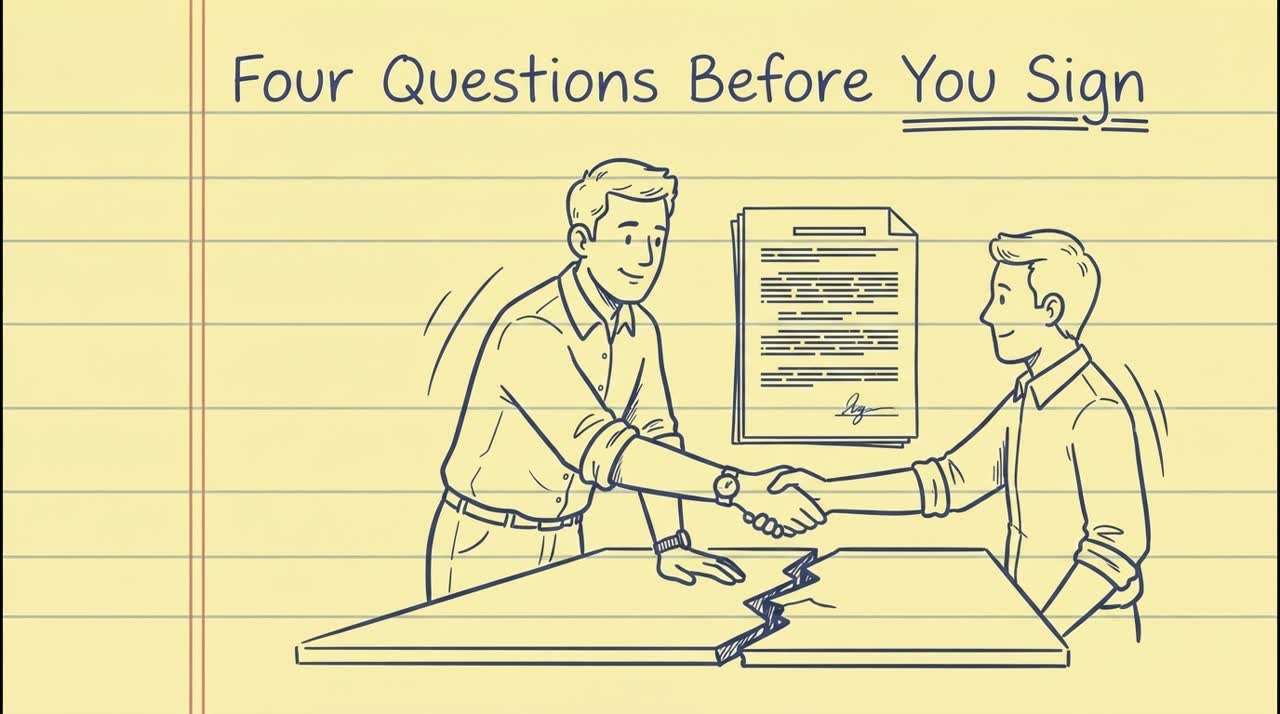
| 1 | Four Questions Before You Sign | You sign a contract on trust, right up until the day a dispute breaks out. |
| 2 | One hidden clause can cost you your entire business. | Same line, word for word. |
| 3 | Does the person signing actually have legal authority? | First, does the person signing actually have legal authority? |
| 4 | Without formal approval, the whole deal falls apart. | Without formal board approval or power of attorney, the whole deal falls apart. |
| 5 | When do your real obligations actually start? | Second, when do your real obligations actually start? |
| 6 | How do you exit if things go wrong? | Third, how do you exit if things go wrong? |
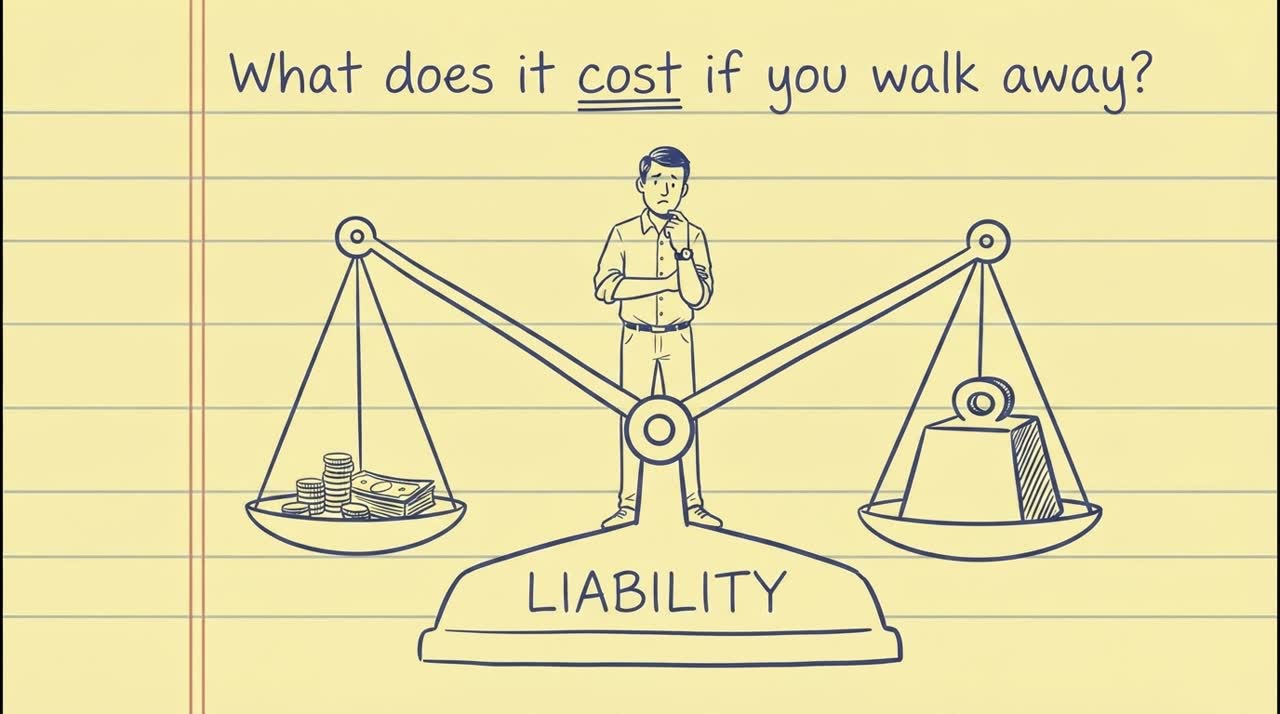
| 7 | What does it cost if you walk away? | Fourth, what does it cost if you walk away? |
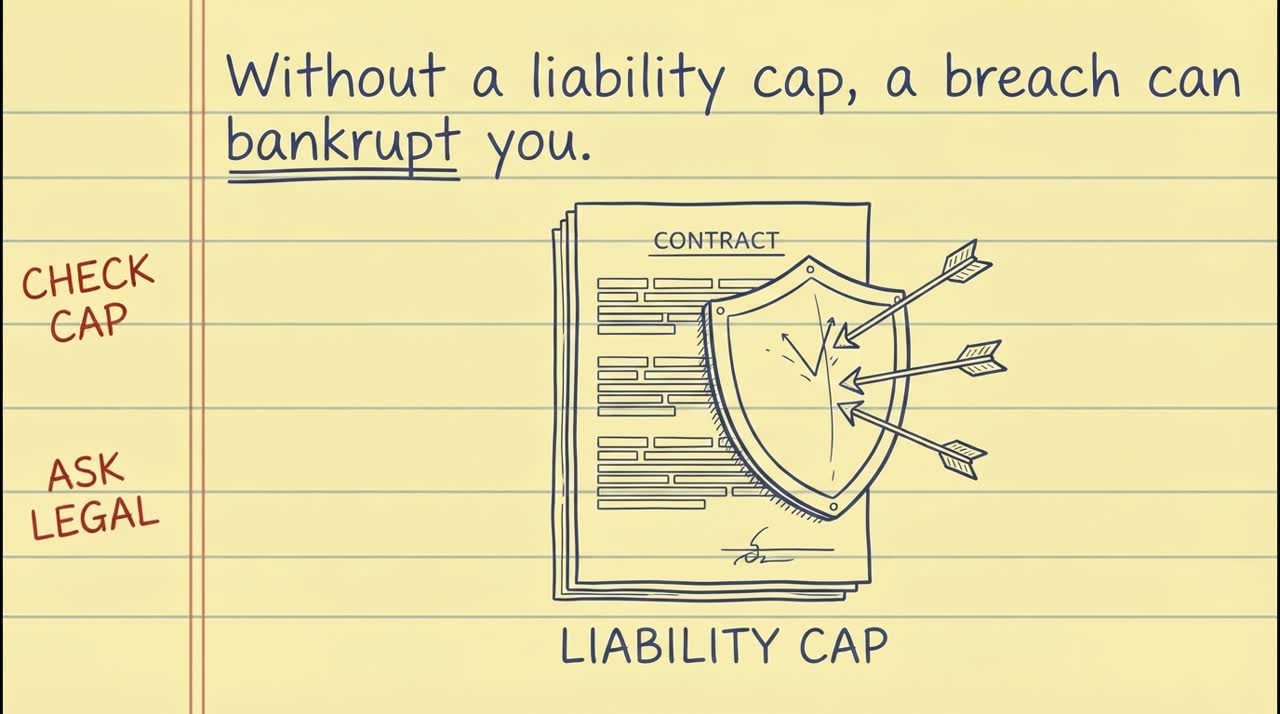
| 8 | Without a liability cap, a breach can bankrupt you. | Without a liability cap, a single breach can bankrupt you. |
| 9 | Ten minutes checking these four points saves months in court. | Ten minutes spent checking these four points saves months in court. |
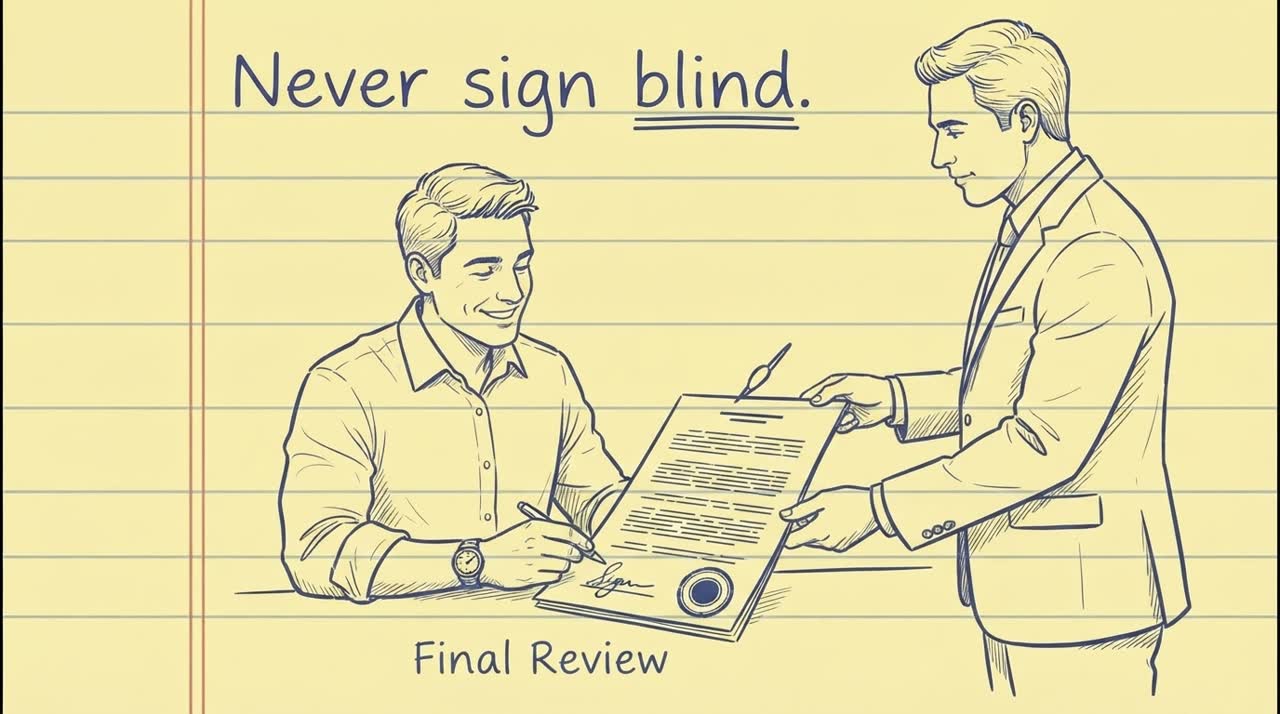
| 10 | Never sign blind. | Never sign blind, let legal counsel review before you put your name on the line. |
Four questions, one per scene, each with a consequence scene behind it. The count in the caption of scene 9 is the count of scenes that asked a question, which is the sort of thing worth checking before rendering rather than after.
A frame declared, not described
Here is scene 2, exactly as the job holds it.
layout: hero
node: contract_doc  slot: centre  name: magnified contract clause
  draw: The contract_doc: a tall multi-page paper agreement with structured paragraph
  blocks and a signature line at the bottom. A magnifying glass is positioned over the
  page, focusing on a specific paragraph. Inside the lens of the magnifying glass, the
  text is enlarged and highlighted with a thick circular warning mark and double underlines.
texts:
  "One hidden clause can cost you your entire business."
  "PERSONAL GUARANTEE: 100% UNCAPPED LIABILITY"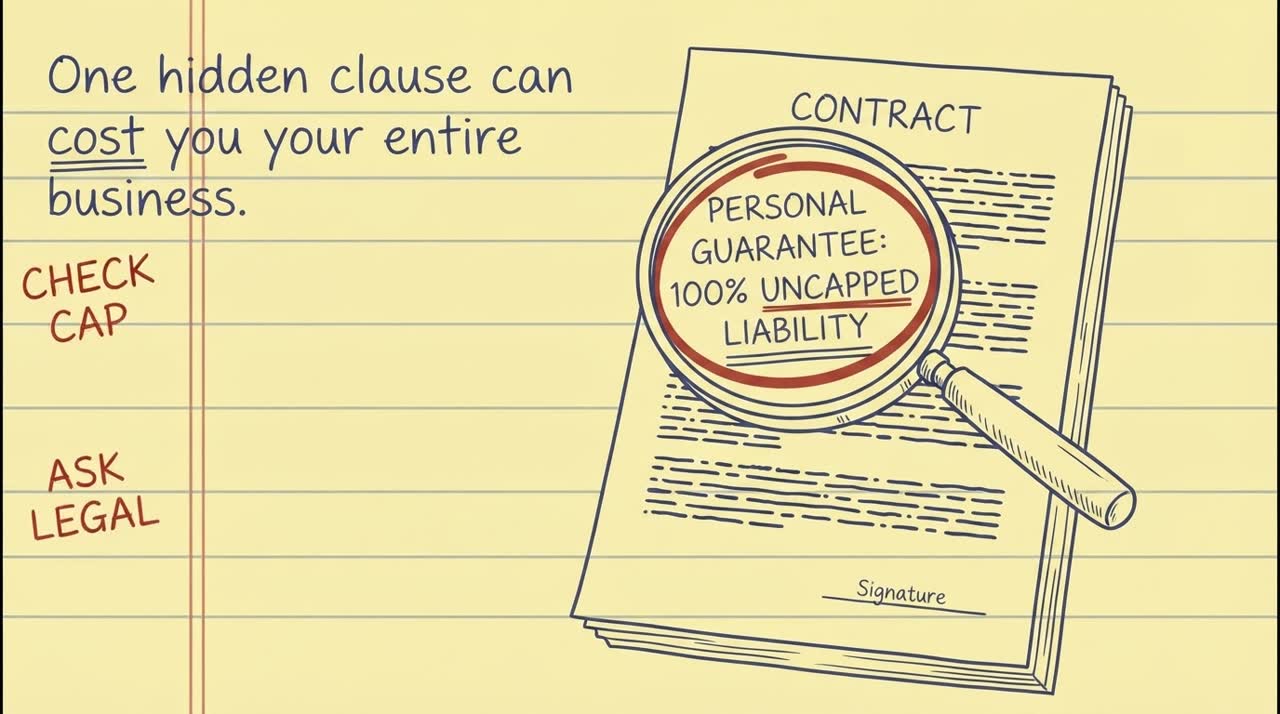
Four fields, and each one is doing a job the prose version has to do the long way round.
The node has an id, and the id is the point. contract_doc appears in scenes 2, 4 and 8. signee appears in scenes 3, 6, 7 and 10. Same id, same object, and the description travels with the id instead of being retyped in every scene. That is the difference from writing each frame as a self-contained paragraph, where keeping an object identical means copying the same sentence four times and any drift in the wording becomes drift in the drawing.
The slot puts it somewhere. centre, left, right, hero. Not a sentence about where things stand, a slot name, which does not get paraphrased away.
The texts field is an allow-list. These are the strings permitted in the frame, and there is no rule that says the drawing gets to add its own. That matters more than it looks, and the next two sections are about what happens when the drawing adds them anyway.
Scene 9 uses the other layout and shows what a link is.
layout: three-column
node: timer       slot: left    name: ten minute clock
node: checklist   slot: centre  name: four point checklist
node: court_gavel slot: right   name: cancelled court time
link: checklist to court_gavel  label: SAVES  style: solid  curve: none
texts:
  "Ten minutes checking these four points saves months in court."
  "10 MINUTES"  "AUTHORITY"  "OBLIGATIONS"  "EXIT PATH"  "LIABILITY CAP"
  "SAVES"  "MONTHS IN COURT"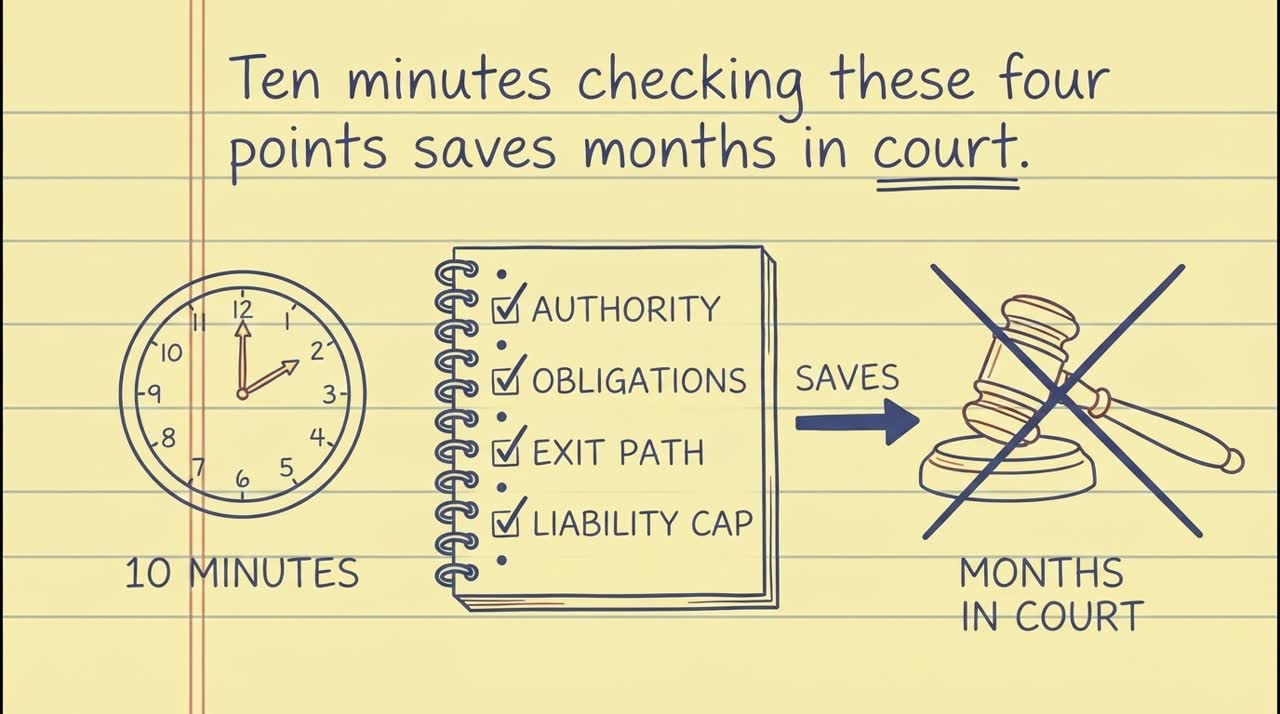
Three columns, in the order declared. The link came back as an arrow with its label on it. All eight permitted strings are in the frame. This is the closest thing to a clean result anywhere in either of our two worked examples, and it is the most tightly specified frame of the ten.
The style, and the trap inside it
The look is one choice, made once, applied to all ten scenes, and read from a picture. This is the picture.
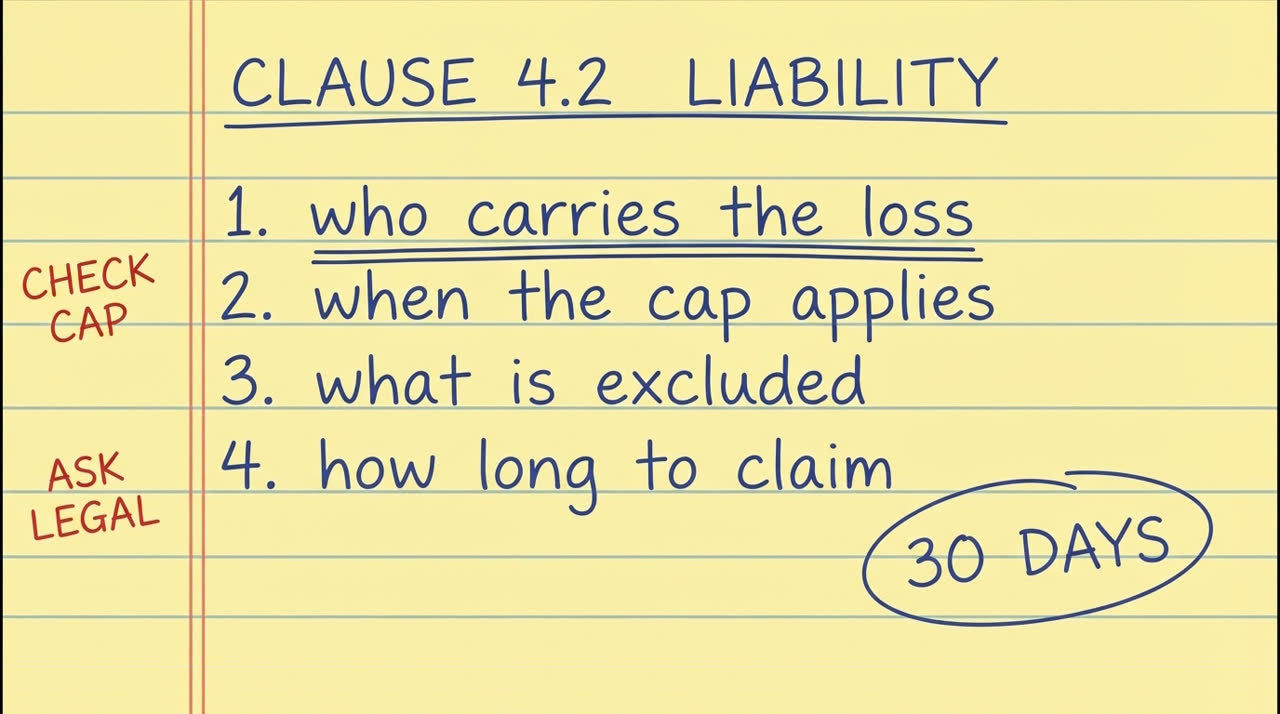
Ruled yellow paper, blue handwriting, a red margin rule, and red notes written out in the margin. Nothing in any scene says yellow, or blue, or handwritten. The style carries all of it.
Now look at the margin of scene 2 again. CHECK CAP and ASK LEGAL, in red, in the margin. Those two phrases are not in the script. They are not in that scene's allow-list. They are on the reference picture, and they were copied off it into the frame along with the paper and the ink.
That is the trap, and it is the same one we hit with a style card from our own catalogue on the other worked example: whatever is written on the reference gets treated as part of the look. A style reference should carry no lettering you are not prepared to see in every frame. Handwriting, yes. Handwritten words, no.
What the engine noticed by itself
After a frame is drawn, the lettering is read back off the picture and compared with that scene's allow-list. Words in the frame that are not in the list are counted as invented. Words repeated from an earlier scene are counted as echoed. If the count is high enough the frame is drawn again, and the version with fewer faults is the one that ships.
Here is that record for all ten scenes, straight out of the job.
| Scene | Faults | Lettering that was not asked for | Redraw |
|---|---|---|---|
| 1 | 0 | none | clean |
| 2 | 5 | CONTRACT, CHECK, ASK, LEGAL, Signature; CAP echoed | redrawn, came back with 7, first kept |
| 3 | 1 | CONTRACT; Sign echoed | redrawn, came back with 4, first kept |
| 4 | 2 | Signature, twice | redrawn, came back with 6, first kept |
| 5, 6, 7 | 0 | none | clean, drawn once |
| 8 | 3 | CHECK CAP, ASK LEGAL, CONTRACT | redrawn |
| 9 | 2 | 11 and 12, the numerals on the clock face; 10 echoed | redrawn |
| 10 | 0 | Sign echoed | clean |
Three things in that table are worth taking seriously.
Six of the ten scenes came back with lettering nobody asked for. Not wrong lettering, and nothing misspelled: the words CONTRACT and Signature are simply labels the drawing added to a document because documents in drawings tend to be labelled. Two of them, CHECK CAP and ASK LEGAL, came off the style reference.
A redraw is not automatically better. In scenes 2, 3 and 4 the second attempt came back with more invented lettering than the first, so the first was kept. The check is worth having because it decides on a count rather than on hope, but it does not make a bad frame good.
The clock counted as lettering. Scene 9 was charged two faults for the numerals 11 and 12 on a clock face, which is exactly right in principle and slightly absurd in practice. If you ask for a clock you are asking for a dial with numbers on it, and a check that reads every glyph in the frame will find them.
The ten frames
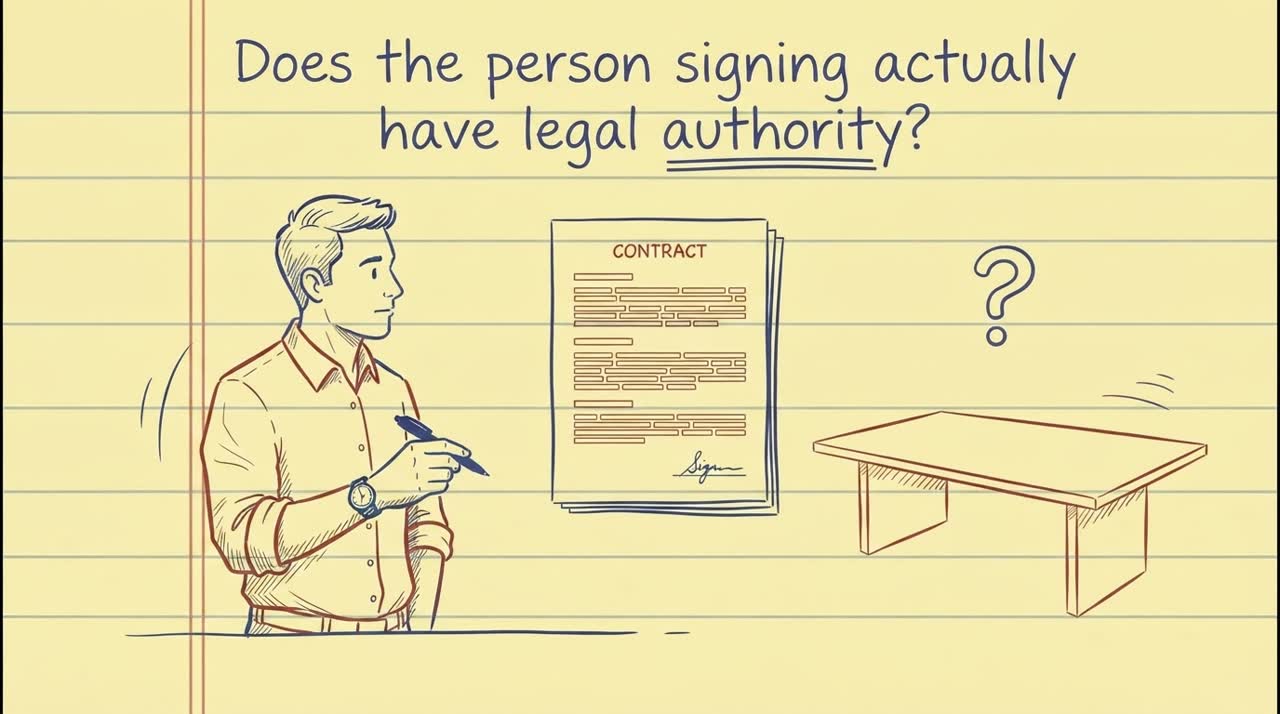
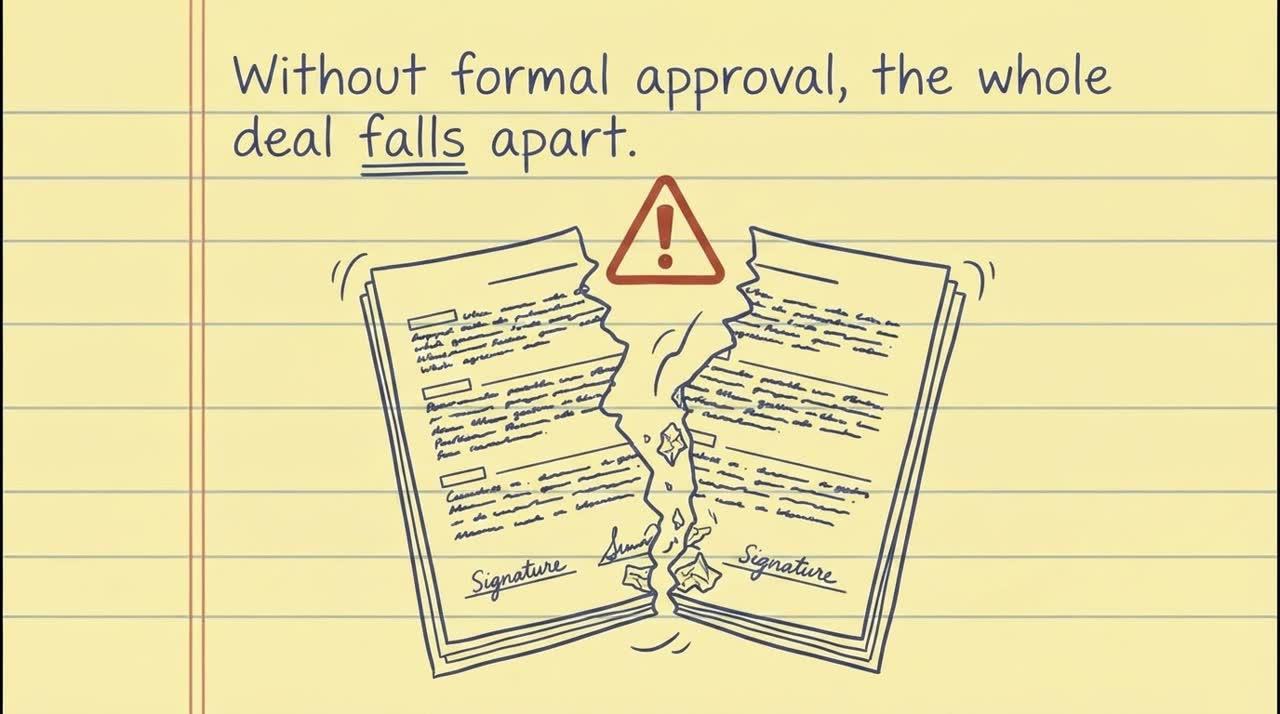
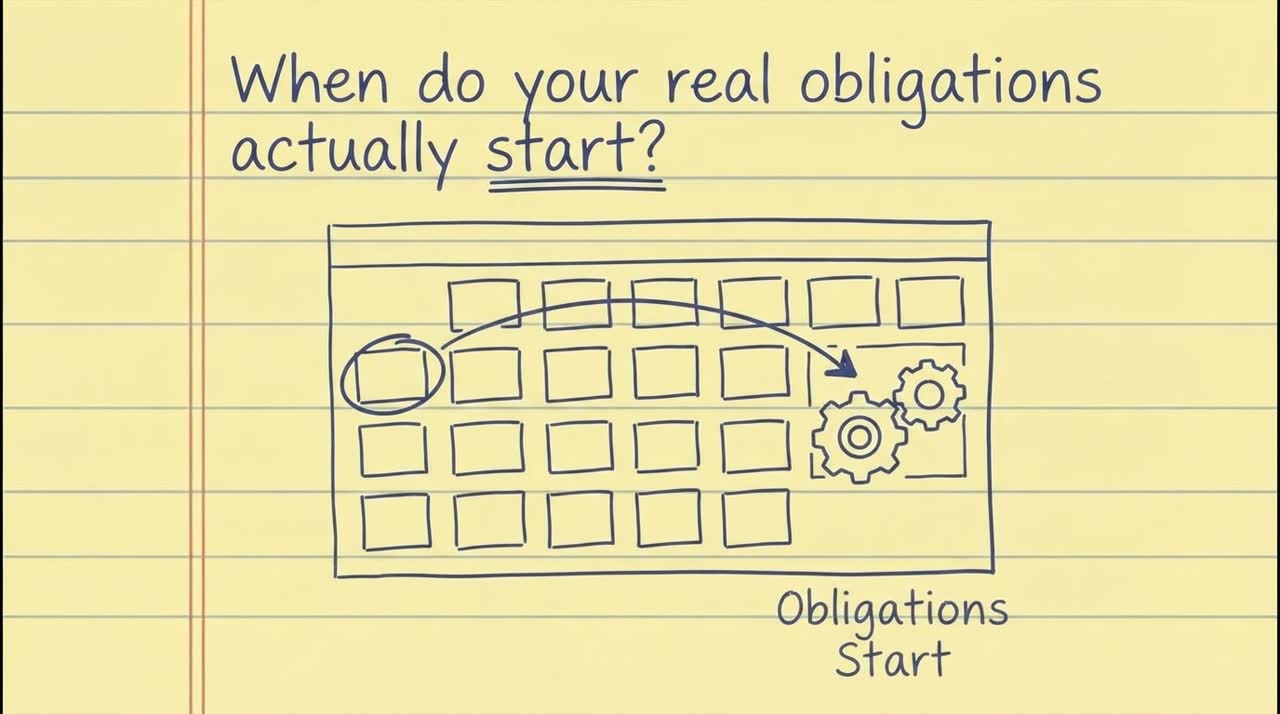
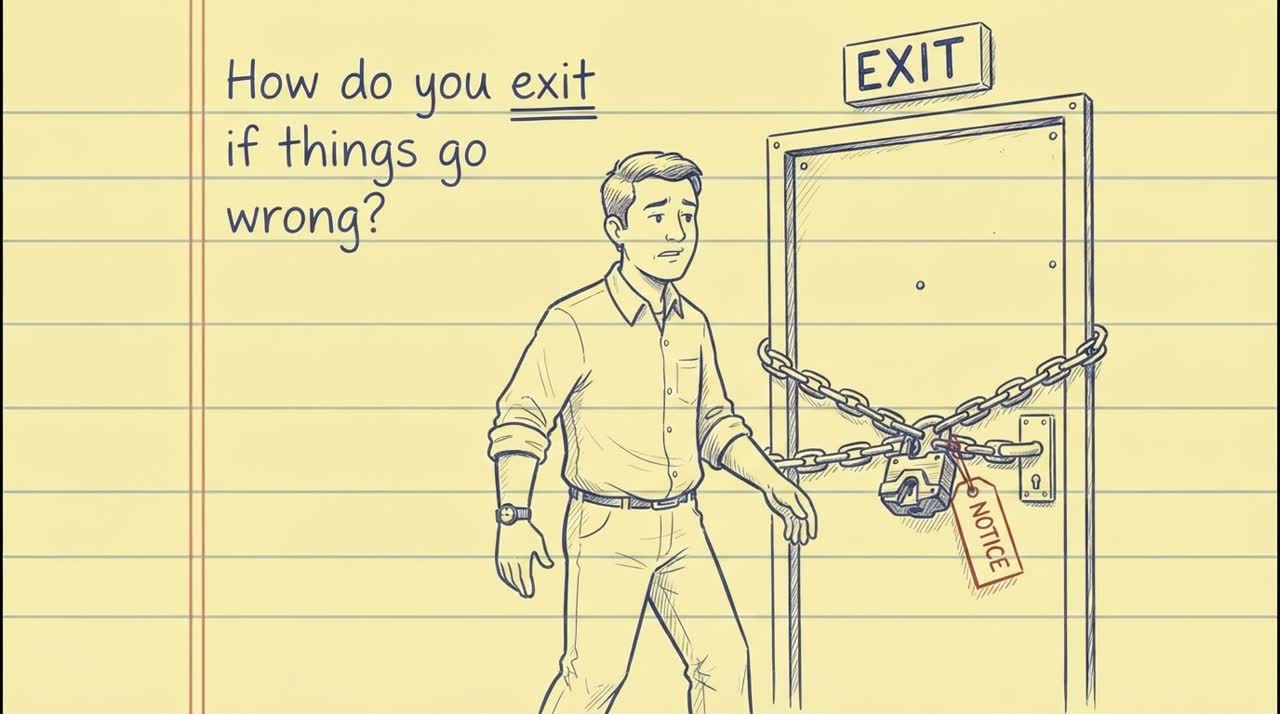
Which way to write
Both worked examples on this site come out of the same engine. They differ in how much of the frame is written as a sentence and how much is written as a field.
| Written as a paragraph | Declared as a frame | |
|---|---|---|
| A recurring object | The same sentence retyped in every scene it appears in | One id, written once, used in four scenes |
| Arrangement | Prose, and it drifts: two rows of two came back as one row of four | A layout name and a slot per object |
| Printed words | Written into the sentence, and anything not written gets invented | A list, which can then be checked against the drawing |
| Unasked-for lettering | Found by looking at the frames yourself | Counted, and a redraw offered against the count |
The honest summary is that neither stops a style from having habits. The flat card style turned a single card into a flow diagram no matter how the scene was written, and this legal pad copied its own margin notes into two frames. What the declared version buys is that you find out, by number, before you watch the video.
The practical order is the same either way. Write the words. Settle what recurs and give each one a fixed name. List what is printed. Choose the style last, and choose it by what it already draws.
Start a video. Planning it costs nothing, and the price is on the screen before anything is drawn.