A video storyboard, written out in full
This is one finished video taken apart, with nothing tidied up. Five captions, five spoken lines, five illustration briefs word for word, and the five frames that came back from them. Four of the five frames differ from what was asked for, and those four are the useful part of the page.
The video explains the difference between a policy, a process, a procedure and a work instruction. It runs fifty-seven seconds and cost one render.
What a storyboard is here
Three fields per scene, and nothing else exists:
| Field | What it does |
|---|---|
| caption | The line printed across the top of the frame. The only text a viewer with the sound off actually reads. |
| spoken | The narration over that frame. One or two sentences, because the frame lasts about eleven seconds. |
| illustration | The description the picture is drawn from. This is the field that decides whether the video comes back the way you pictured it. |
The one fact behind everything below: each frame is drawn on its own, from the words of its own scene and nothing else. Scene four does not know what scene one looked like. Anything you leave out of a scene is invented afresh inside it.
The storyboard, all five scenes
This is the exact text the video was rendered from, copied out of the job.
[title] Policy vs procedure

[scene 1]
[caption] FOUR WORDS, ONE FOLDER
[voice] Four words share one folder and get used as if they meant the same thing. They sit at four different levels, and mixing them up is what an audit finds.
[drawing] The frame is filled edge to edge with one flat dark ground. Four rectangles of exactly equal size and equal height stand in two rows of two, evenly spaced, with a gap between them, each rectangle a flat single colour with square corners and a flat edge. Each rectangle holds one simple white line drawing in its upper half and one line of white capitals in its lower half. The top left rectangle holds a plain rectangular sheet of paper and the word POLICY. The top right rectangle holds three small squares joined left to right by two short straight lines and the word PROCESS. The bottom left rectangle holds three short horizontal lines with the numerals 1, 2 and 3 down their left side and the word PROCEDURE. The bottom right rectangle holds a plain spanner and the words WORK INSTRUCTION. Nothing else appears in the frame: no further shapes, no additional drawings, no page furniture, no border, no logo and no style name.

[scene 2]
[caption] A POLICY SAYS WHAT MUST BE TRUE
[voice] A policy states what has to be true here. A limit, a rule, a period of time. It says nothing about how the work is carried out.
[drawing] The frame is filled edge to edge with one flat dark ground. Two rectangles of exactly equal size and equal height stand side by side in the middle of the frame, with a gap between them, each rectangle a flat single colour with square corners and a flat edge. The left rectangle holds a plain rectangular sheet of paper drawn as a simple white line drawing at its top, beneath it one line of white capitals reading POLICY, and beneath that two lines of smaller white capitals reading SPEND OVER $500 IS APPROVED FIRST and RECEIPTS ARE KEPT SEVEN YEARS. The right rectangle holds a plain square tick box with a tick inside it drawn as a simple white line drawing at its top, and beneath it one line of white capitals reading WHAT MUST BE TRUE. Nothing else appears in the frame: no further shapes, no additional drawings, no page furniture, no border, no logo and no style name.

[scene 3]
[caption] A PROCEDURE SAYS HOW IT IS DONE
[voice] A procedure is the next level down. One task, taken in order, with the exception written where it will actually be found.
[drawing] The frame is filled edge to edge with one flat dark ground. Two rectangles of exactly equal size and equal height stand side by side in the middle of the frame, with a gap between them, each rectangle a flat single colour with square corners and a flat edge. The left rectangle holds three short horizontal lines with the numerals 1, 2 and 3 down their left side drawn as a simple white line drawing at its top, beneath it one line of white capitals reading PROCEDURE, and beneath that three lines of smaller white capitals reading 1. FILL FORM F-12, then 2. ATTACH THE RECEIPT, then 3. SEND TO YOUR MANAGER. The right rectangle holds a plain straight arrow pointing to the right drawn as a simple white line drawing at its top, and beneath it one line of white capitals reading HOW IT IS DONE. Nothing else appears in the frame: no further shapes, no additional drawings, no page furniture, no border, no logo and no style name.

[scene 4]
[caption] THE TEST: CAN IT BE DONE TODAY
[voice] Here is the test. If it can be carried out today, step by step, it is a procedure. If it can only be true or false, it is a policy.
[drawing] The frame is filled edge to edge with one flat dark ground. Two rectangles of exactly equal size and equal height stand side by side in the middle of the frame, with a gap between them, each rectangle a flat single colour with square corners and a flat edge. The left rectangle holds a plain rectangular sheet of paper drawn as a simple white line drawing at its top, beneath it one line of white capitals reading CAN ONLY BE TRUE, and beneath that one line of smaller white capitals reading POLICY. The right rectangle holds three short horizontal lines with the numerals 1, 2 and 3 down their left side drawn as a simple white line drawing at its top, beneath it one line of white capitals reading CAN BE DONE TODAY, and beneath that one line of smaller white capitals reading PROCEDURE. Nothing else appears in the frame: no further shapes, no additional drawings, no page furniture, no border, no logo and no style name.

[scene 5]
[caption] THE RULE AND THE ROUTINE
[voice] Write the policy once. Write a procedure for every task it touches. The auditor reads the first one. The work runs on the second.
[drawing] The frame is filled edge to edge with one flat dark ground. One rectangle stands in the middle of the frame, wide enough to span most of the frame, a flat single colour with square corners and a flat edge. Inside it, at the top, two simple white line drawings side by side with a gap between them: on the left a plain rectangular sheet of paper, on the right three short horizontal lines with the numerals 1, 2 and 3 down their left side. Beneath the two drawings, one line of white capitals across the middle reading POLICY IS THE RULE. PROCEDURE IS THE ROUTINE. Below that line, separated by one thin white horizontal rule, one line of smaller white capitals reading SOP TEMPLATE, ONE PAGE. Nothing else appears in the frame: no further shapes, no additional drawings, no page furniture, no border, no logo and no style name.
Two things about that text are worth naming before the frames.
Every object is described where it is used, every time. The sheet of paper is "a plain rectangular sheet of paper" in scenes one, two, four and five, the same words each time. The numbered list is "three short horizontal lines with the numerals 1, 2 and 3 down their left side" in scenes one, three, four and five, the same words each time. Not a paraphrase and not a back reference. "The same sheet as before" means nothing to a frame that has never seen before.
Every printed string is written out. The frame prints SPEND OVER $500 IS APPROVED FIRST because the brief contains that string in capitals. Ask for "a couple of example rules" and you get invented rules, in an invented number, in invented wording.
The style comes after the words
The order is not a preference. Write the storyboard first, choose the style second. Nothing in the text above says navy, coral or amber, and nothing in it names a style. The look is a single choice, made once, applied to all five scenes at render time, and it is read from a picture rather than typed into a scene.
That division is the working method in one line. The storyboard says what is in the frame and what is printed in it. The style says what it is drawn like. Neither is allowed into the other's field, which is also why every illustration brief above ends with the same clause: no border, no logo and no style name.
Here is the exact picture this video was drawn from.
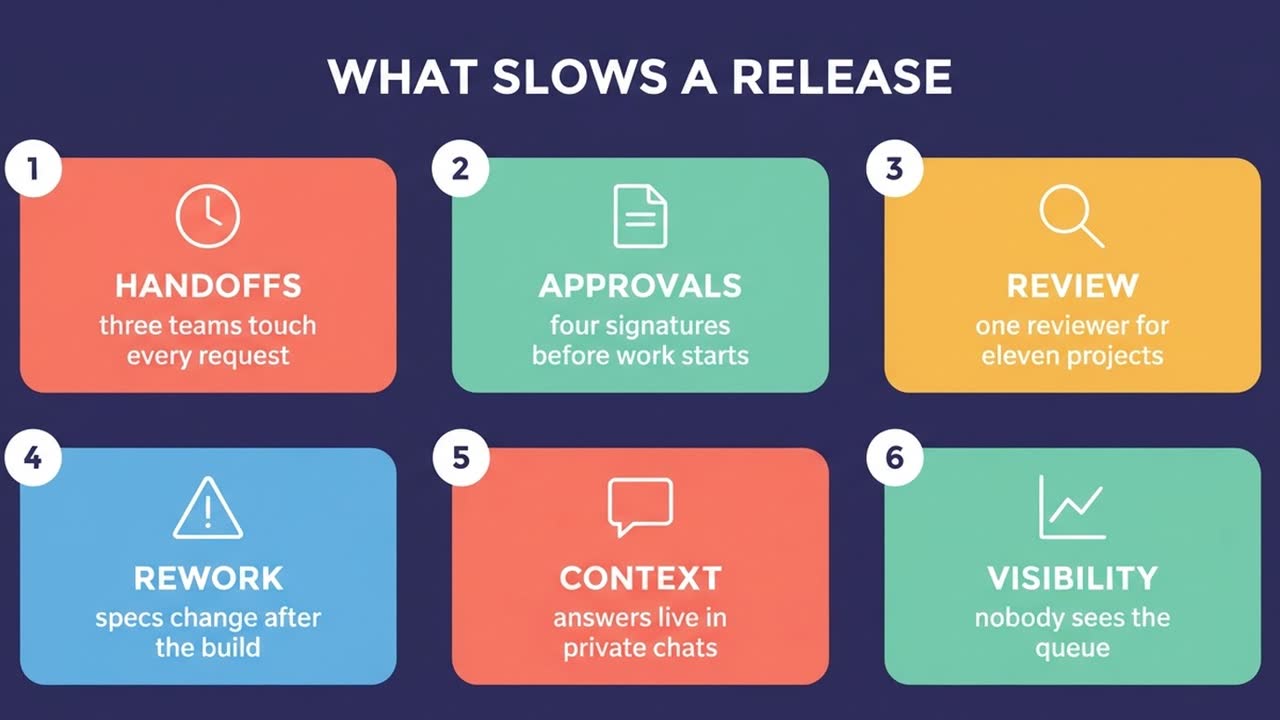
It is a bad reference, and it is worth looking at closely for that reason. It began as a card from our own style catalogue, and those cards carry the style name printed along the bottom edge; used as it was, the name came back printed inside the frames of the video. The strip was cropped off, which fixed the name and nothing else.
What it still is, is a picture of a finished scene rather than a sheet of samples. It has a headline of its own, six cards of its own, its own words, its own numbered circles. And those things came through. The white numbered circles in the top corners of scene four, which no brief asked for, are that reference's circles. The rounded corners the briefs asked to be square are its corners. The pattern of one bold word with two smaller lines under it, which the frames keep reaching for, is its pattern.
A style reference is a picture of the look and nothing else: the surface, the line, the palette, the set of shapes the style draws, and at most a sample of its lettering set on placeholder words. No headline, no caption, no watermark, no style name, and nothing that reads as a finished frame.
The last thing to know before choosing. A style is not a neutral coat of paint, it has habits, and it will impose them on any brief you write. This one draws flat cards with rounded corners, line icons and connecting arrows. Scene five asked for one wide card and got a flow diagram. Scene two asked for a sheet of paper and got a spiral notepad, in both halves of the frame. No wording inside a single scene overrode either. So pick a style by what it already draws, not by what you hope it will do, and expect its habits to show up in your frames. Every one of them is on a single page, each playing.
Scene by scene, brief against frame
Scene 1
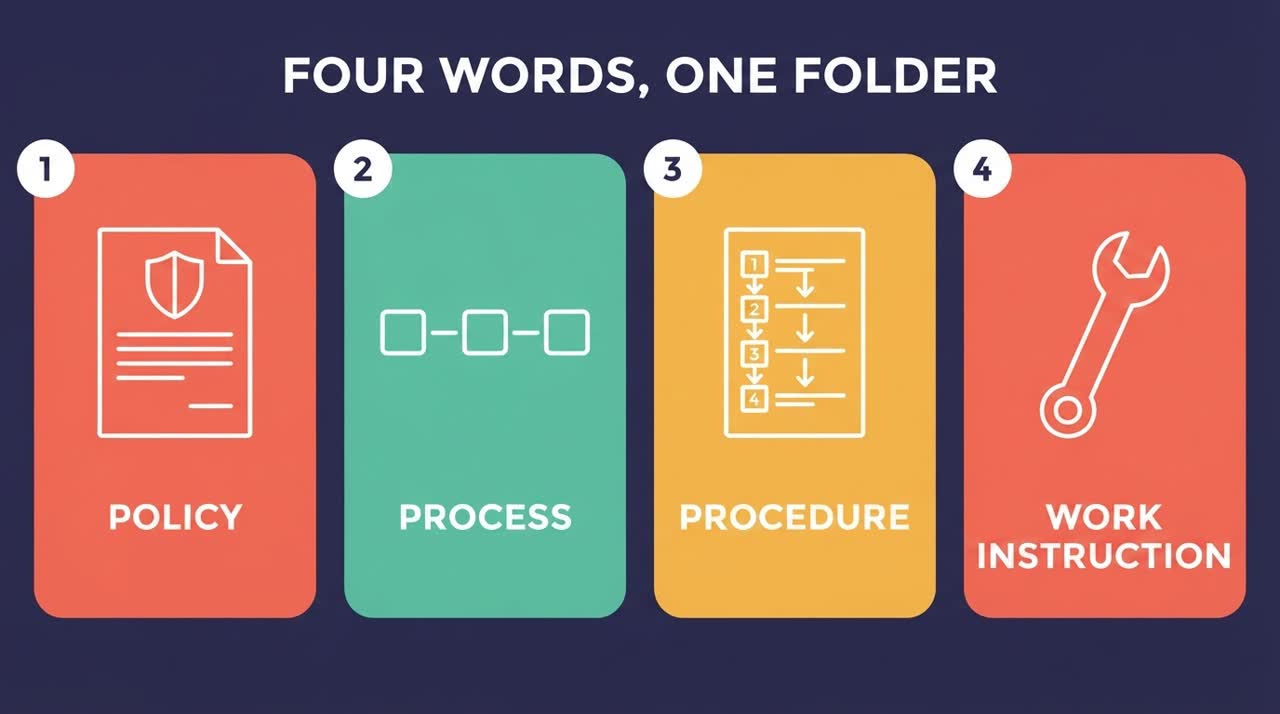
The four objects are exactly the four that were asked for: a sheet, three squares joined by lines, a numbered list, a spanner. The four words are the four that were asked for. Nothing else got in.
One thing did not survive. The brief says "two rows of two". The frame is one row of four. Corners are rounded, and the brief says square. Arrangement is a suggestion, contents are not. That split holds across every video we have made: what is in the frame obeys, how it is laid out drifts.
Scene 2
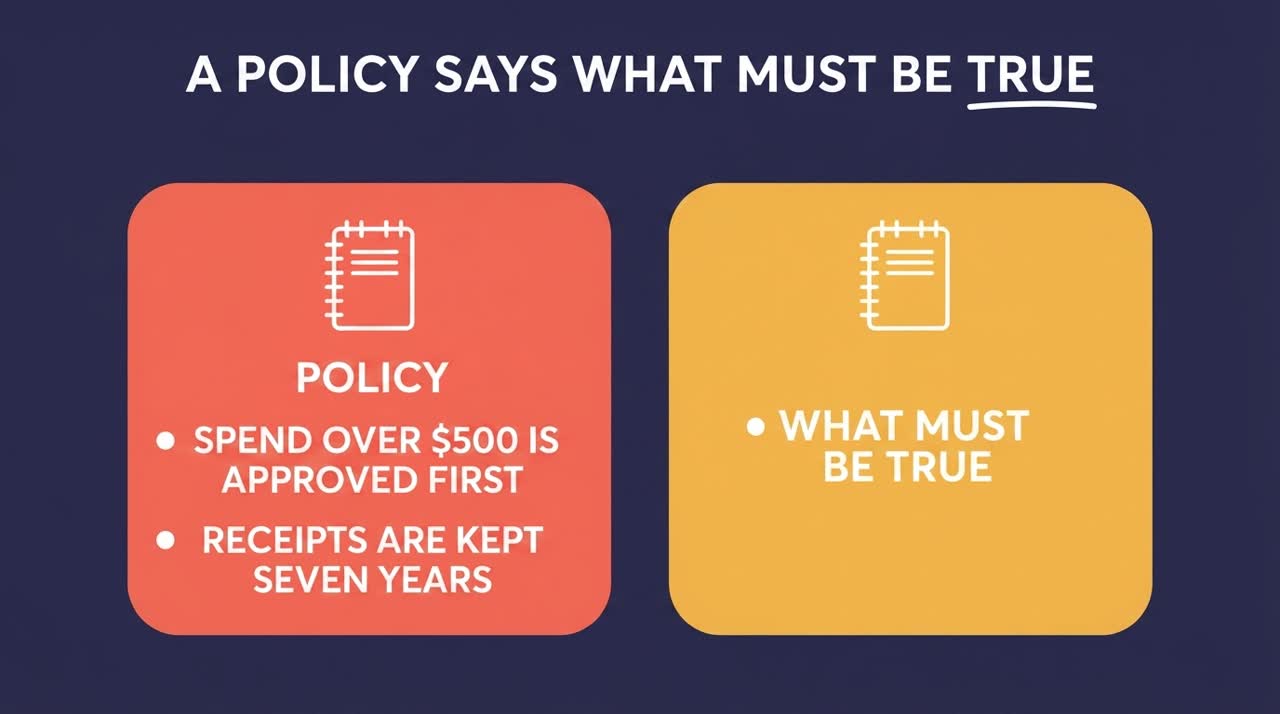
Here it goes wrong. The left card was to hold a sheet of paper and the right card a tick box with a tick in it. Both came back holding the same spiral notepad. Two different objects were asked for, one object was drawn twice, and the contrast the scene exists for is gone.
Note what the spiral is: it is not in the brief anywhere. It is the drawing style's own habit. Flat vector illustration draws a notepad when it is asked for paper, and it will keep doing it.
Scene 3
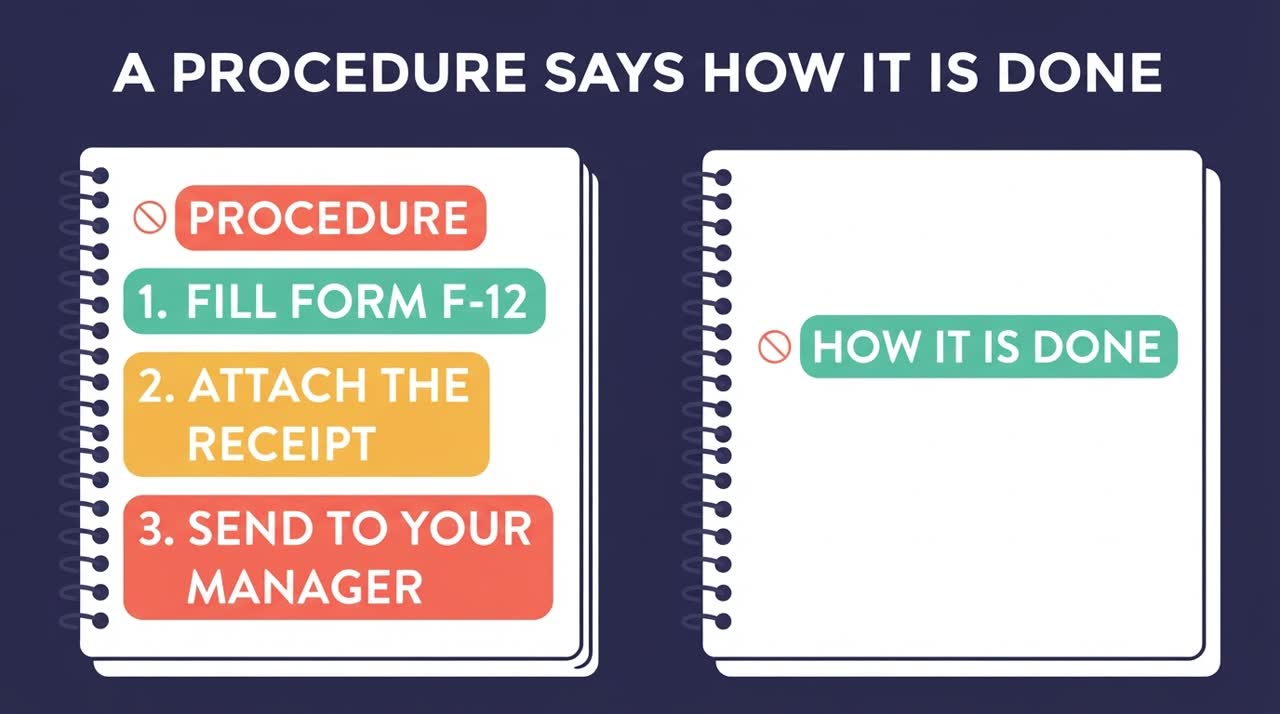
Worse, and instructive. Both cards became spiral notebooks with a stack of pages behind them. Every line of text got wrapped in a coloured pill nobody asked for. A circular prohibition sign appeared next to two lines, a symbol that is nowhere in the brief and that reverses the meaning of what it sits beside: a "not allowed" mark against the correct procedure. And the straight arrow the right card was supposed to hold is simply missing, which leaves that card almost empty.
An earlier version of this same scene carried the words "no ring binding, no spiral" in the brief. The spiral came back anyway. A prohibition does not remove an object. Only naming a different object does.
Scene 4
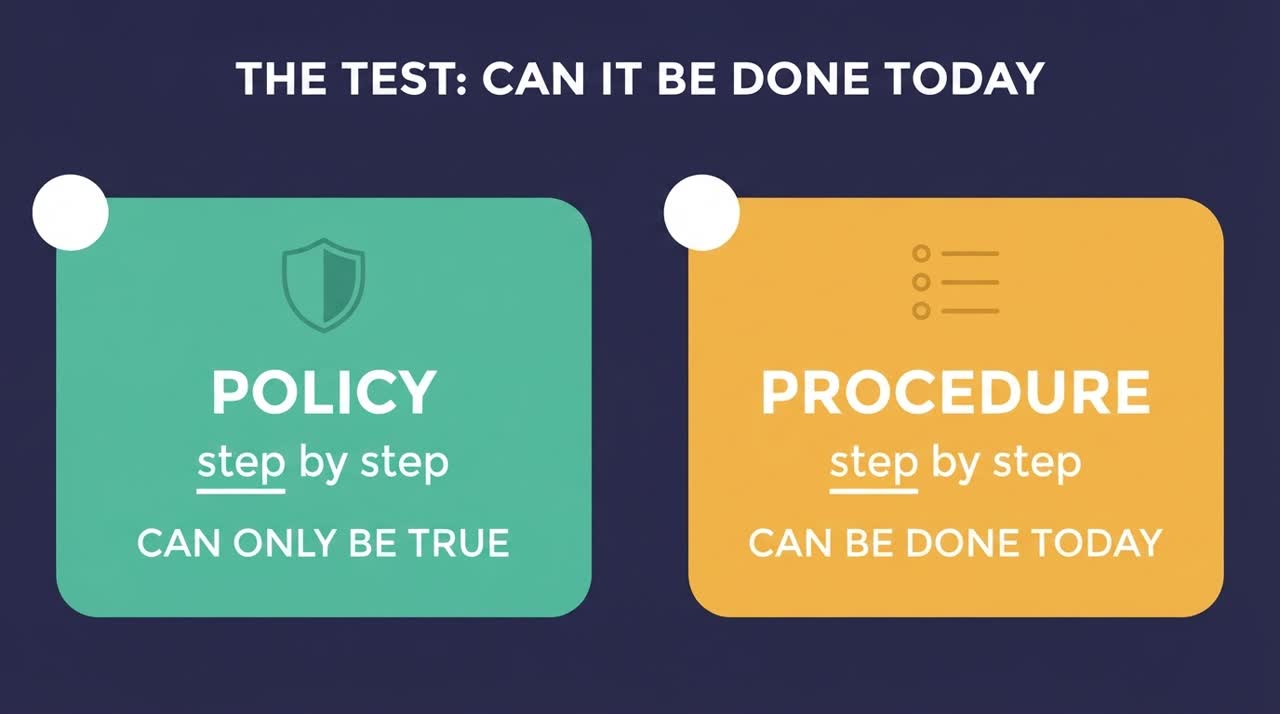
Both cards print STEP BY STEP. That phrase is not in the caption and not in the illustration brief. It is in the spoken line: "If it can be carried out today, step by step, it is a procedure."
That is the finding worth taking away from this whole page. The drawing reads the narration too. A concrete noun in a sentence that was only ever meant to be heard will turn up printed or drawn inside the frame. In an earlier take of this video the spoken lines said "one person" and "somebody", and people appeared in two frames although no brief mentioned a human being. The words were removed, and the people went with them.
The left card also carries a shield instead of the sheet of paper, and both cards grew a white circle at the top left corner. Neither was asked for.
Scene 5
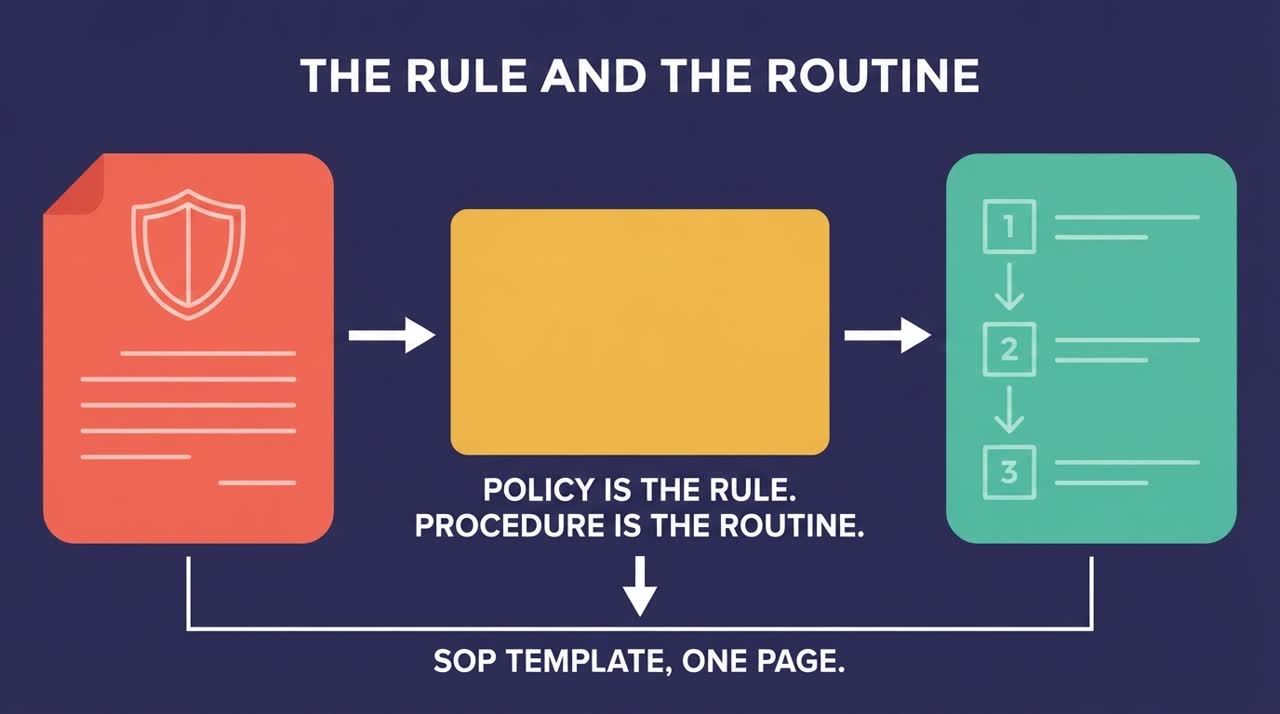
The brief asks for one wide card holding two drawings and two lines of text. What came back is a flow diagram: three shapes in a row, joined by arrows, with a bracket underneath leading down to the last line. The middle shape is empty. The shield is back.
One card became a process. That is this style's strongest habit, and no wording in a single scene overrode it.
What the example is actually teaching
Read against the frames, the rules come out in this order.
| Rule | Evidence on this page |
|---|---|
| Name a concrete object in every block | Scene 1 named an object per block and came back clean. The blocks that carried only text became notebooks. |
| Repeat the description word for word | The sheet and the numbered list keep the same sentence in four scenes each, and are recognisably the same objects. |
| Write every printed string yourself | Every word printed in every frame is a word from the brief or the caption. Nothing was left to be filled in. |
| Watch the nouns in the spoken line | "Step by step" was heard and then printed, twice, in scene 4. |
| Describe what is there, not what is not | "No spiral" did not remove the spiral. Naming a different object is the only thing that works. |
| Expect the layout to drift | Two rows of two came back as one row of four. Contents held, arrangement did not. |
The rules on their own, with the wording to use and the wording to avoid, are on how to write a video script. A whole procedure taken from document to finished video is on how to turn an SOP into a video.
The shape to copy
A scene brief that behaves has four parts, in this order.
- The ground. One sentence fixing the background, repeated identically in every scene.
- The arrangement. How many shapes, of what size, where. Give the count as a numeral.
- The contents, block by block. For each block: one named object, then the exact words printed under it, in capitals if you want capitals.
- The close. One sentence listing what must not appear, mostly to keep out page furniture, borders, logos and style names.
Written out empty, it is this:
The frame is filled edge to edge with one flat [ground].
[N] [shapes] of exactly equal size stand [where], with a gap between them.
The [first] holds [one named object drawn as a simple line drawing] at its top,
beneath it one line of capitals reading [EXACT WORDS],
and beneath that [N] lines of smaller capitals reading [EXACT WORDS].
The [second] holds [one named object] ... and so on for every block.
Nothing else appears in the frame: no further shapes, no additional drawings,
no page furniture, no border, no logo and no style name.
Two things stay out of it. Colour, because colour belongs to the style you picked and a colour named in a scene fights it. And anything carried over, because there is no carrying over: if an object is in the frame, it is described in that frame.
What it cost
Planning is free, and so is rewriting the storyboard afterwards. The price appears once the scenes are settled, and only rendering spends anything. This one is five scenes and fifty-seven seconds.
That matters more than it sounds. The version of this video before the one above put people in two frames because two spoken lines said "person" and "somebody". Fixing it meant editing five sentences and rendering again, not re-shooting anything.
Write your own storyboard. Planning it costs nothing, and the price is on the screen before anything is drawn.