Why do websites make you click traffic lights?
A test to tell people from bots, now mostly run out of sight.
Websites make you click traffic lights to prove you are a human, not a bot. The grid is a CAPTCHA, a test meant to be easy for people and hard for programs. Google's reCAPTCHA checks your browser's behavior first and shows the pictures only when you look high-risk.
The street photos have come from Google Street View since 2012. Machines are catching up: in October 2023, OpenAI's GPT-4 was found to solve CAPTCHAs.
The script
The narration is lettered on screen word for word, one scene at a time.
-
 Scene 1 · 0:00–0:05Voiceover
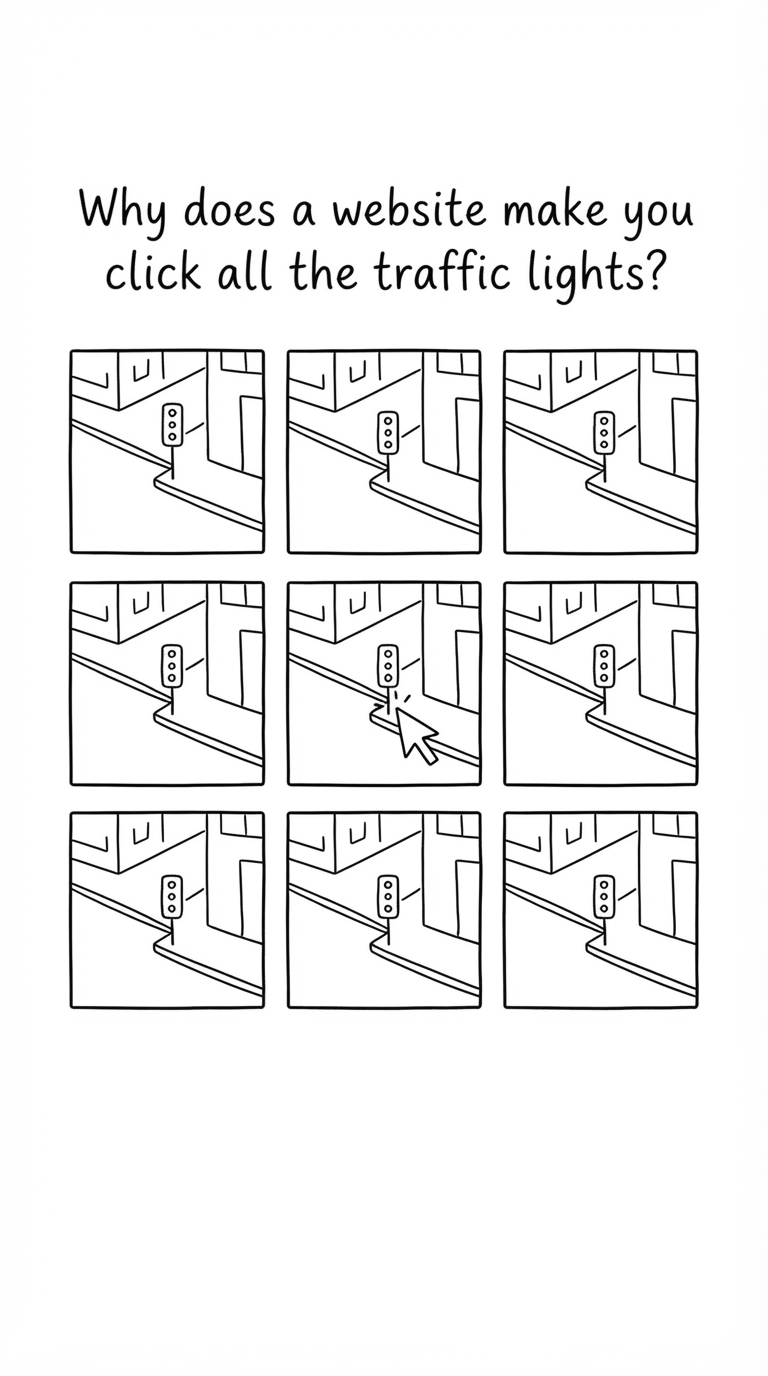
Why does a website make you click all the traffic lights?
PictureA grid of nine street-corner pictures, each with a traffic light, and a mouse cursor clicking one.
-
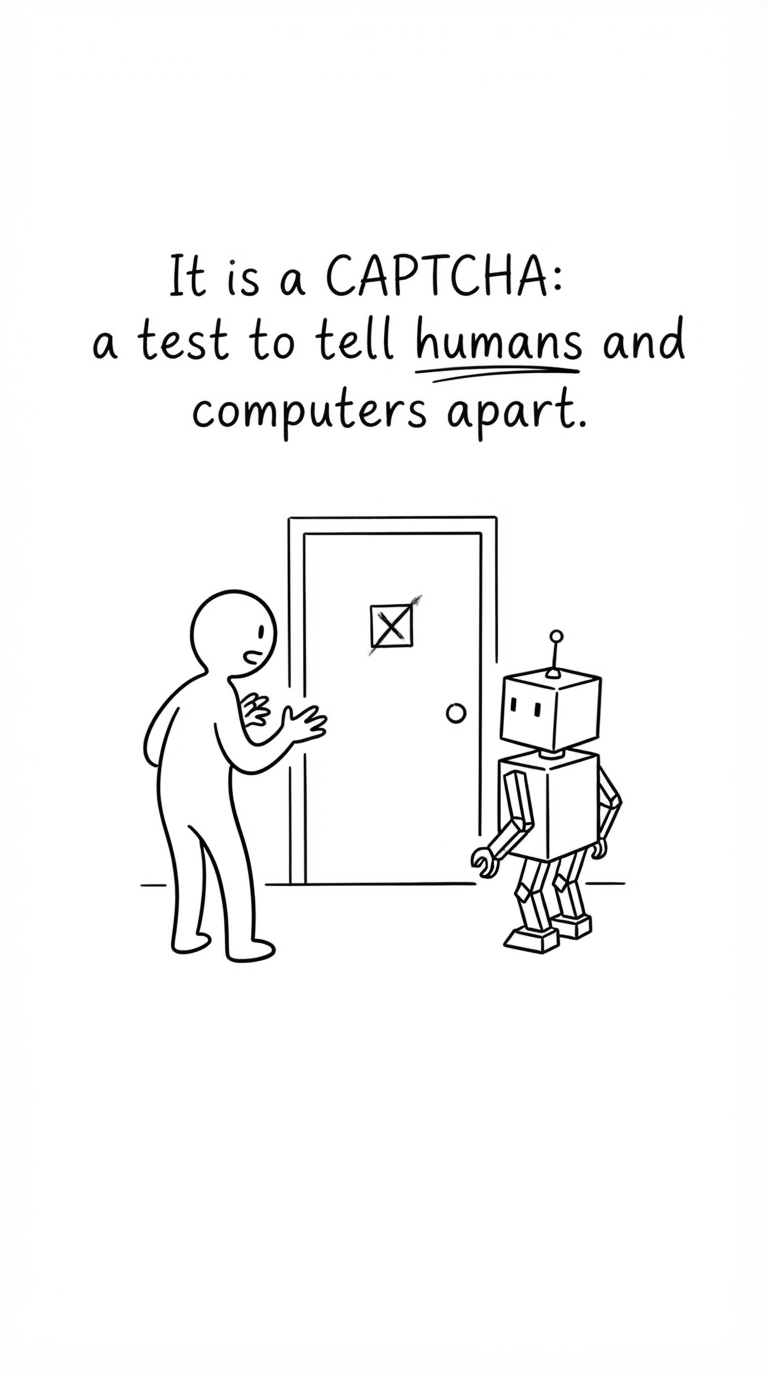 Scene 2 · 0:05–0:10Voiceover
It is a CAPTCHA: a test to tell humans and computers apart.
PictureA person and a box-shaped robot on either side of a door with a check box on it.
-
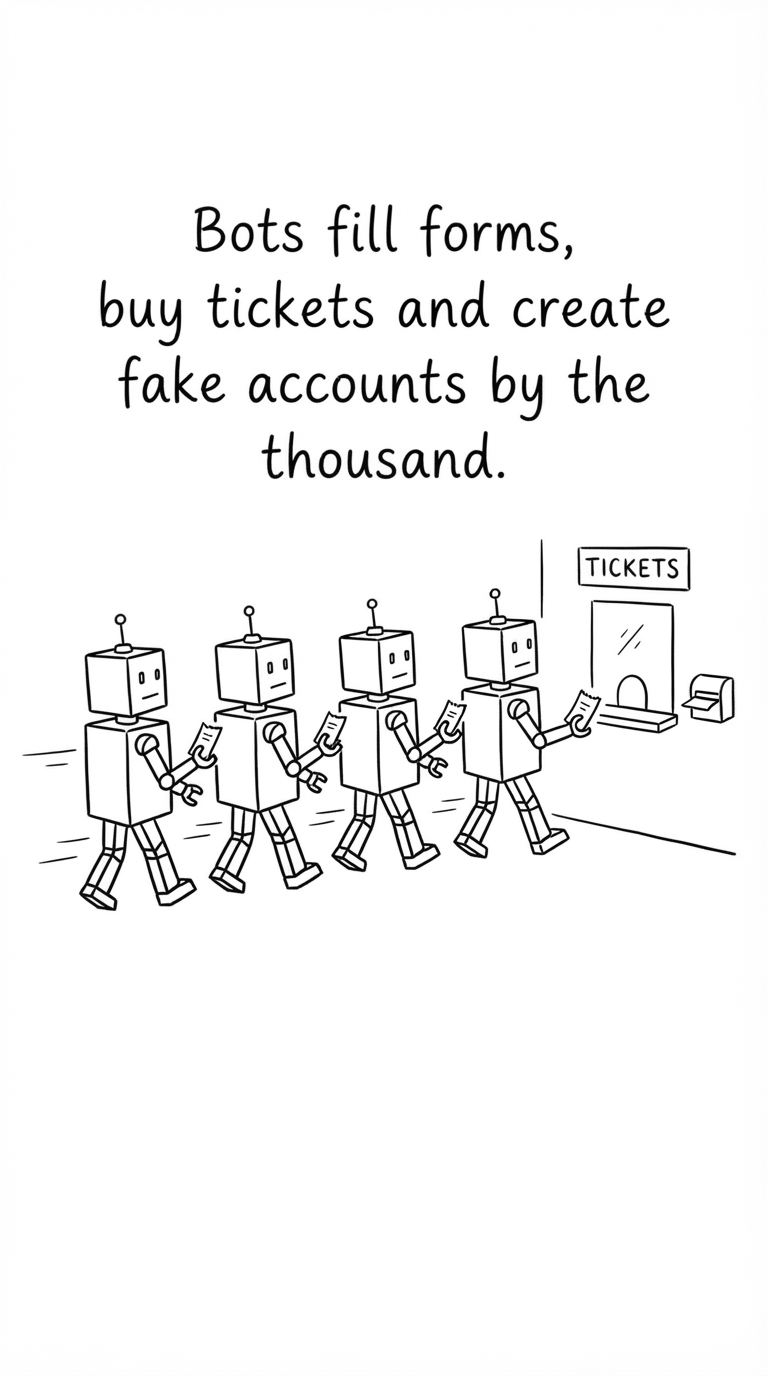 Scene 3 · 0:10–0:16Voiceover
Bots fill forms, buy tickets and create fake accounts by the thousand.
PictureA line of robots holding tickets, marching up to a ticket window.
-
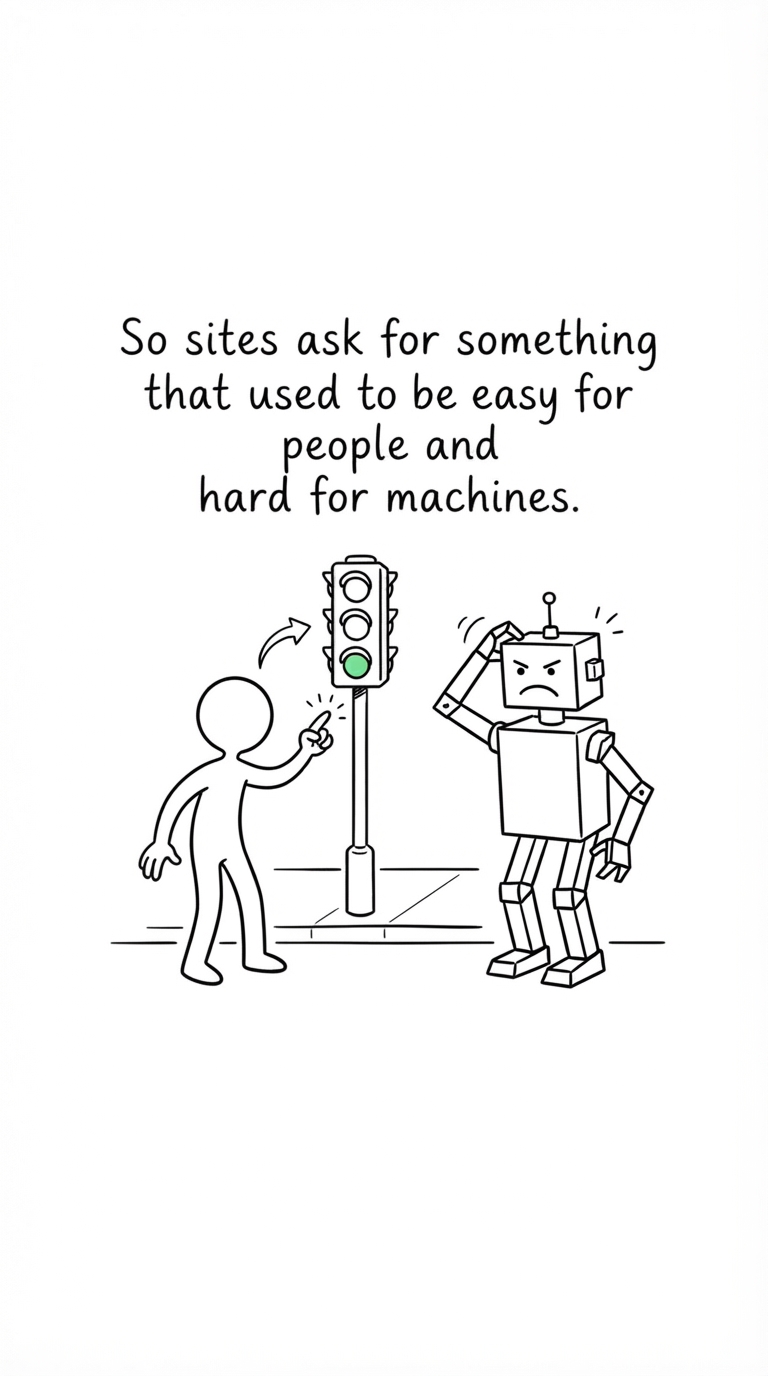 Scene 4 · 0:16–0:22Voiceover
So sites ask for something that used to be easy for people and hard for machines.
PictureA person pointing at a green traffic light while a robot scratches its head, frowning.
-
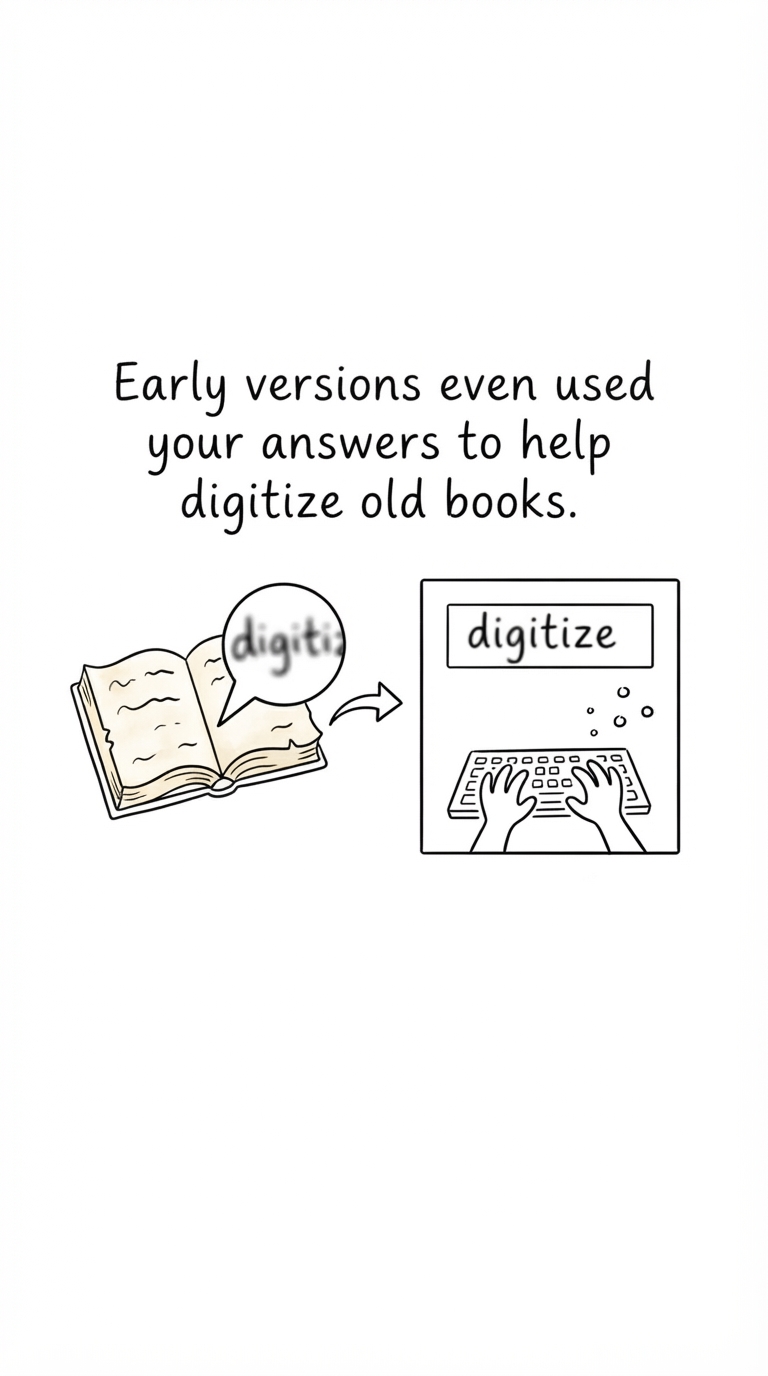 Scene 5 · 0:22–0:27Voiceover
Early versions even used your answers to help digitize old books.
PictureAn old open book with a blurry word, typed clearly into a box on a computer screen.
-
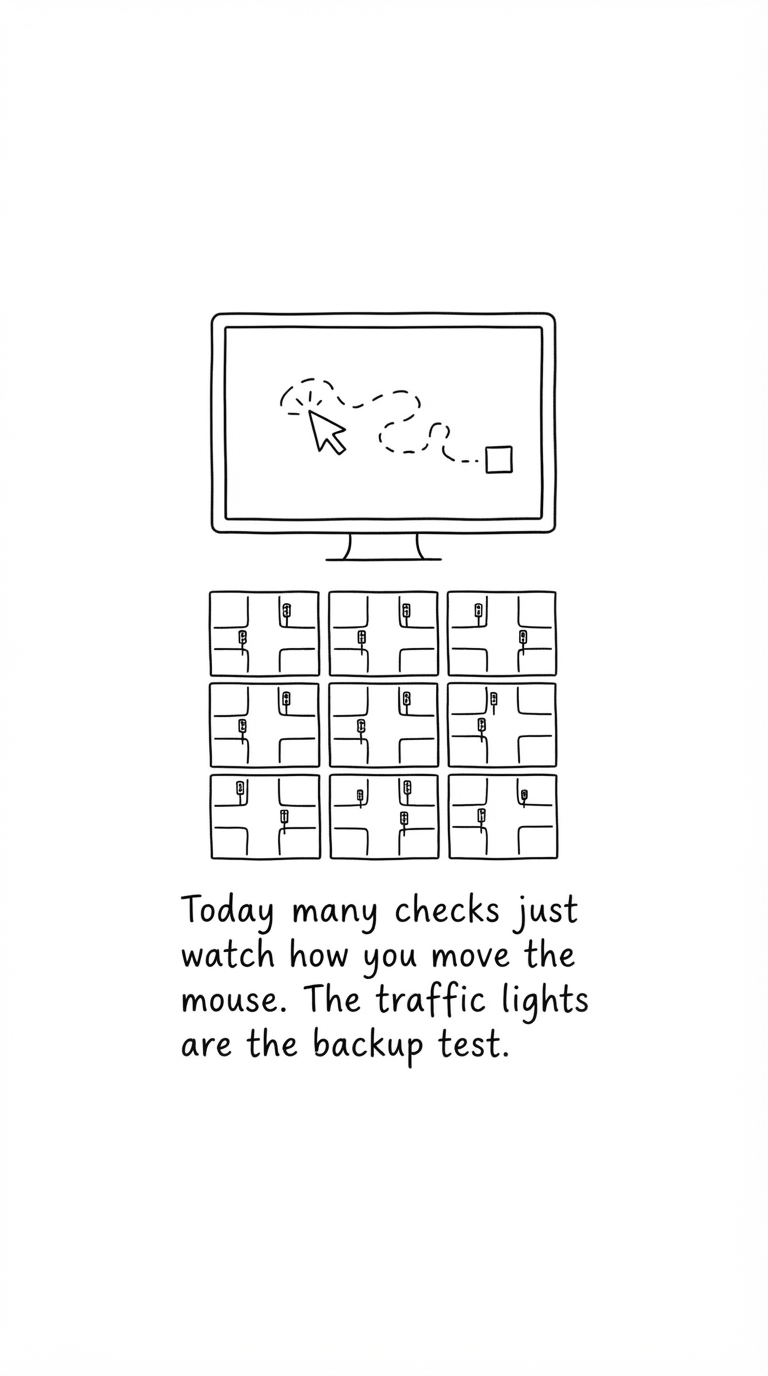 Scene 6 · 0:27–0:36Voiceover
Today many checks just watch how you move the mouse. The traffic lights are the backup test.
PictureA screen with a cursor's wobbly dotted path to a small box, above a grid of street pictures with traffic lights.
From distorted text to invisible checks
The test is older than its name. Two groups invented the distorted-text version in parallel in 1997; idrive.com put one on its signup page in 2000, and in 2001 PayPal used them in its fight against fraud, asking people to retype text that programs struggled to read. The name came in 2003 from Luis von Ahn, Manuel Blum, Nicholas Hopper and John Langford, a contrived acronym for Completely Automated Public Turing test to tell Computers and Humans Apart. Because a computer sets the test rather than a person, it is sometimes called a reverse Turing test.
Source: CAPTCHA, WikipediaThe books in the video are real. The first reCAPTCHA, built at Carnegie Mellon University and bought by Google in September 2009, showed two words from scanned pages: one the system already knew, as a check, and one that two text-reading programs could not agree on. Your answer to the second helped digitize the archives of The New York Times, and then Google Books. By 2010 it showed over 100 million CAPTCHAs a day, on sites such as Facebook, Ticketmaster and Craigslist. In 2012 it began adding photographs from Google Street View, asking people to pick out crosswalks, street lights and other objects.
Then the test started to disappear. In 2013 reCAPTCHA began analyzing how the browser behaves to predict whether the user is a human or a bot. The next year came the checkbox: people judged low-risk only tick a box, and the grid of images appears when the system is unsure. In 2017 Google added an invisible version that shows no challenge at all to low-risk users, and the original text version was shut down on March 31, 2018.
Source: reCAPTCHA, WikipediaBots have kept catching up. Solving services such as 2Captcha sell human and machine solving for as little as $0.50 per 1,000 CAPTCHAs. A 2018 deep-learning attack solved all 11 text CAPTCHA schemes used by the 50 most popular websites, and needed as few as 500 real CAPTCHAs to train. In 2023 researchers prompted ChatGPT to get a TaskRabbit worker to solve one for it, by saying it was not a robot but had impaired vision.
Source: CAPTCHA, WikipediaThe test also has critics. A 13-month study published in 2023 found that reCAPTCHA gives little security against bots and works mainly as a tool to track user data, and estimated it had cost 819 million hours of unpaid human labor. The system favors people logged in to a Google account and rates users of VPNs and anonymizing proxies as riskier. In 2020 Cloudflare switched to the rival hCaptcha, citing privacy concerns; Google says reCAPTCHA data is never used for personalized advertising.
Source: reCAPTCHA, WikipediaHow this video was made
We wrote the 6 narration lines and a one-line picture brief for each scene. explain.ink drew the scenes by hand in the chosen style, recorded the voiceover and rendered the MP4.
- Style
- Whiteboard
- Voice
- Gunner (warm, confident narrator)
- Format
- Vertical 9:16, 1080x1920, 36 seconds
- Redraws
- Scene 2 was redrawn before the final render
The story, in dates
- 1997 Two groups, working in parallel, invent the distorted-text test. Source: CAPTCHA, Wikipedia
- 2003 Luis von Ahn and colleagues coin the term CAPTCHA. Source: CAPTCHA, Wikipedia
- Sep 2009 Google buys reCAPTCHA, which is helping digitize old newspapers and books. Source: reCAPTCHA, Wikipedia
- 2012 reCAPTCHA starts using Google Street View photos of crosswalks and street lights. Source: reCAPTCHA, Wikipedia
- 2014 The checkbox arrives: low-risk users only tick a box. Source: reCAPTCHA, Wikipedia
- 2017 Google introduces an invisible reCAPTCHA that shows no challenge to low-risk users. Source: reCAPTCHA, Wikipedia
- Oct 2023 OpenAI's GPT-4 is found to solve CAPTCHAs. Source: reCAPTCHA, Wikipedia
Questions people ask
Why am I being asked to prove I am not a robot?
Because the check rated your visit as possibly automated. Newer CAPTCHAs aim to appear only when a user's actions resemble a bot's, such as requests from suspicious IP addresses, opening many pages, or clicking links too quickly.
Source: CAPTCHA, WikipediaHow can you tell if someone is a robot?
Modern systems look at behavior. reCAPTCHA collects data on the behavior and attributes of a user's browser, for example through canvas fingerprinting, and uses it to judge who is a bot. Only users it rates high-risk get an image challenge.
Source: CAPTCHA, WikipediaCan AI solve CAPTCHAs?
Increasingly, yes. A 2018 deep-learning attack solved all 11 text CAPTCHA schemes used by the 50 most popular websites, and paid services solve CAPTCHAs with software and human workers for as little as $0.50 per 1,000.
Source: CAPTCHA, WikipediaDoes CAPTCHA look at your history?
Google's reCAPTCHA looks at how you behave: it analyzes cookies and how your browser draws a page, and site owners are encouraged to add its tracking code to every page to judge each visitor's risk. Google says the data is not used for personalized advertising.
Source: reCAPTCHA, WikipediaWhat are the downsides of using CAPTCHAs?
They shut some people out: screen readers cannot read visual tests, so blind users struggle, and math puzzles can trouble people with dyscalculia. They also cost time, about 32 seconds per challenge on average by Cloudflare's 2021 estimate.
Source: CAPTCHA, Wikipedia