What is my IP address, and what does it give away?
A numeric return address for your connection, seen by every site.
Your IP address is the numerical label your device or home network uses on the internet, such as 192.0.2.1. Every packet you send carries it, so every site you visit sees it. Blocks of addresses go to internet providers, which assign them to customers, often dynamically.
From an IP address, geolocation databases estimate your country, city or ZIP code, most reliably the country. The EU and Canada treat IP addresses as personal data.
The script
The narration is lettered on screen word for word, one scene at a time.
-
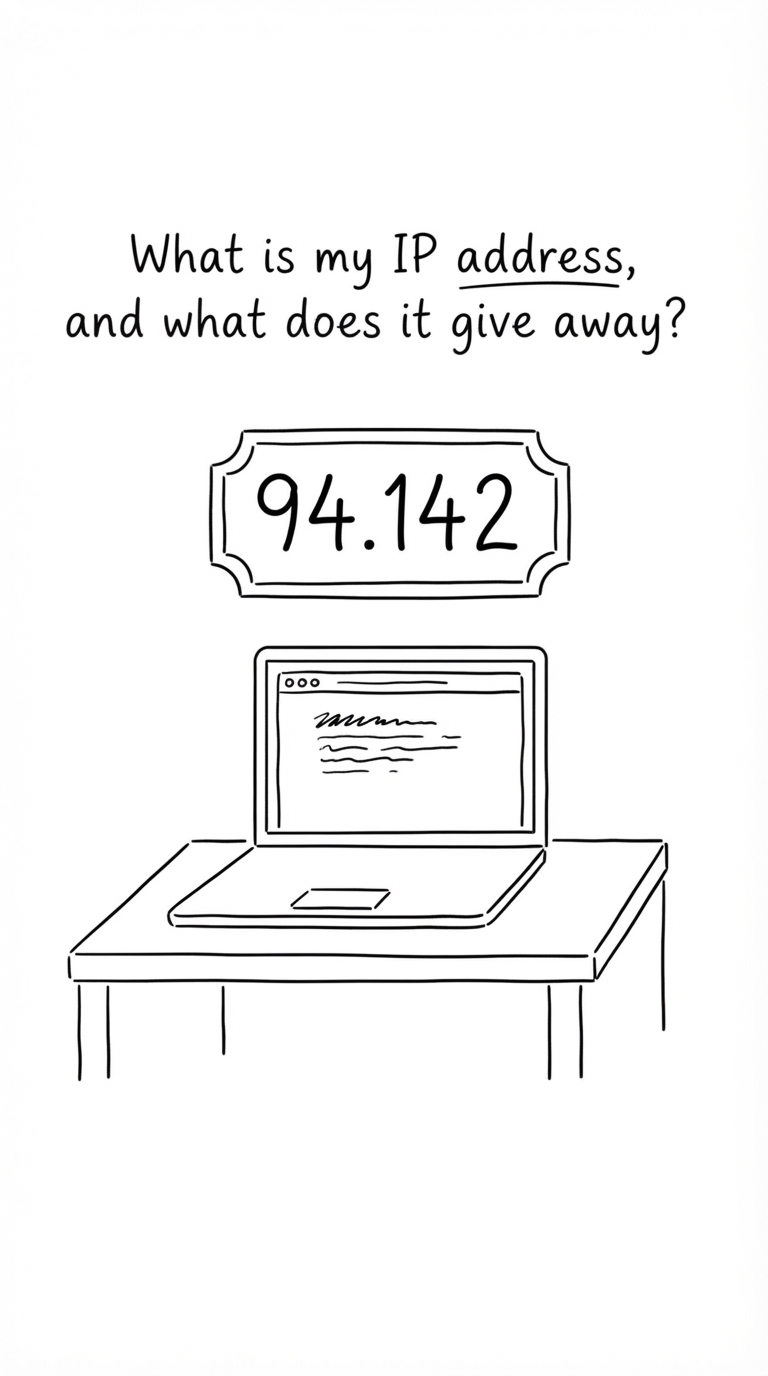 Scene 1 · 0:00–0:04Voiceover
What is my IP address, and what does it give away?
PictureA laptop on a desk with a large sign above it showing the number 94.142.
-
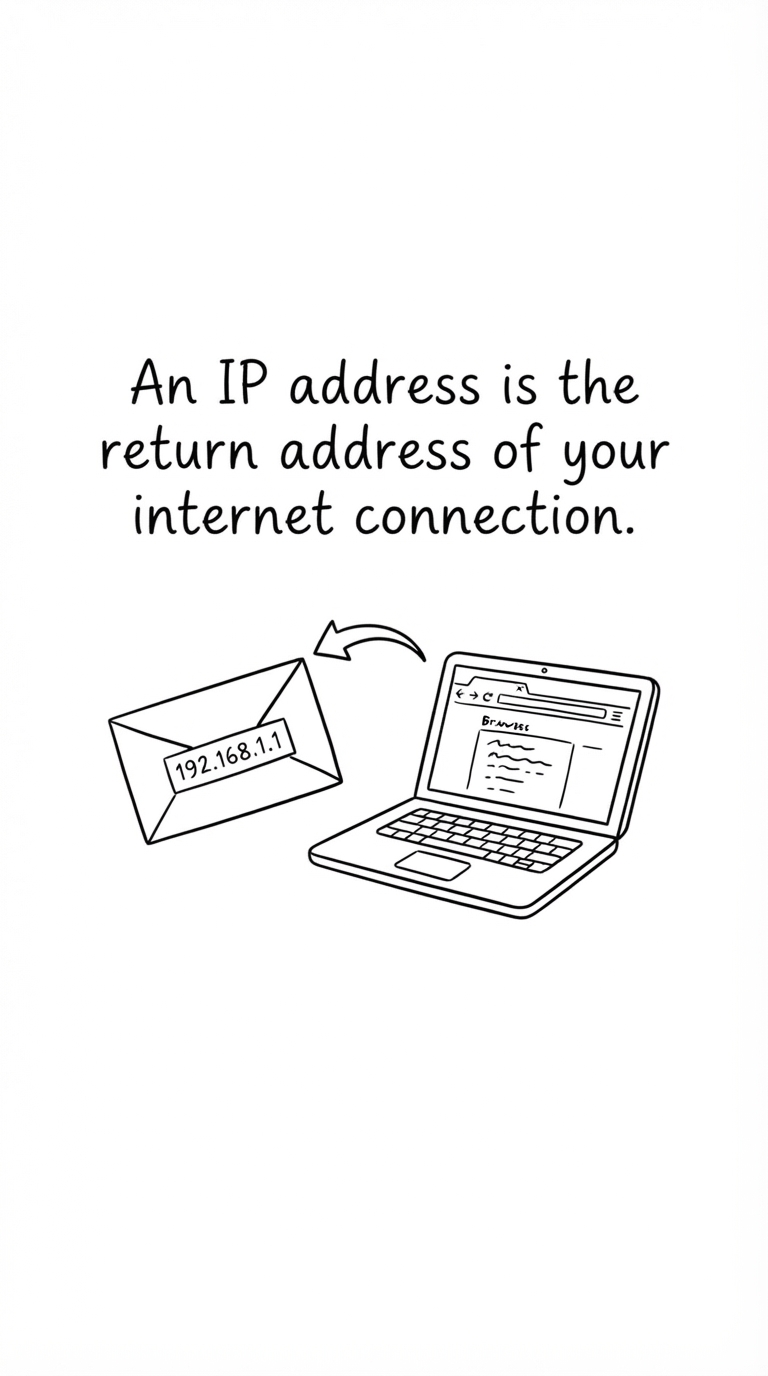 Scene 2 · 0:04–0:08Voiceover
An IP address is the return address of your internet connection.
PictureAn envelope labeled 192.168.1.1 being sent from a laptop.
-
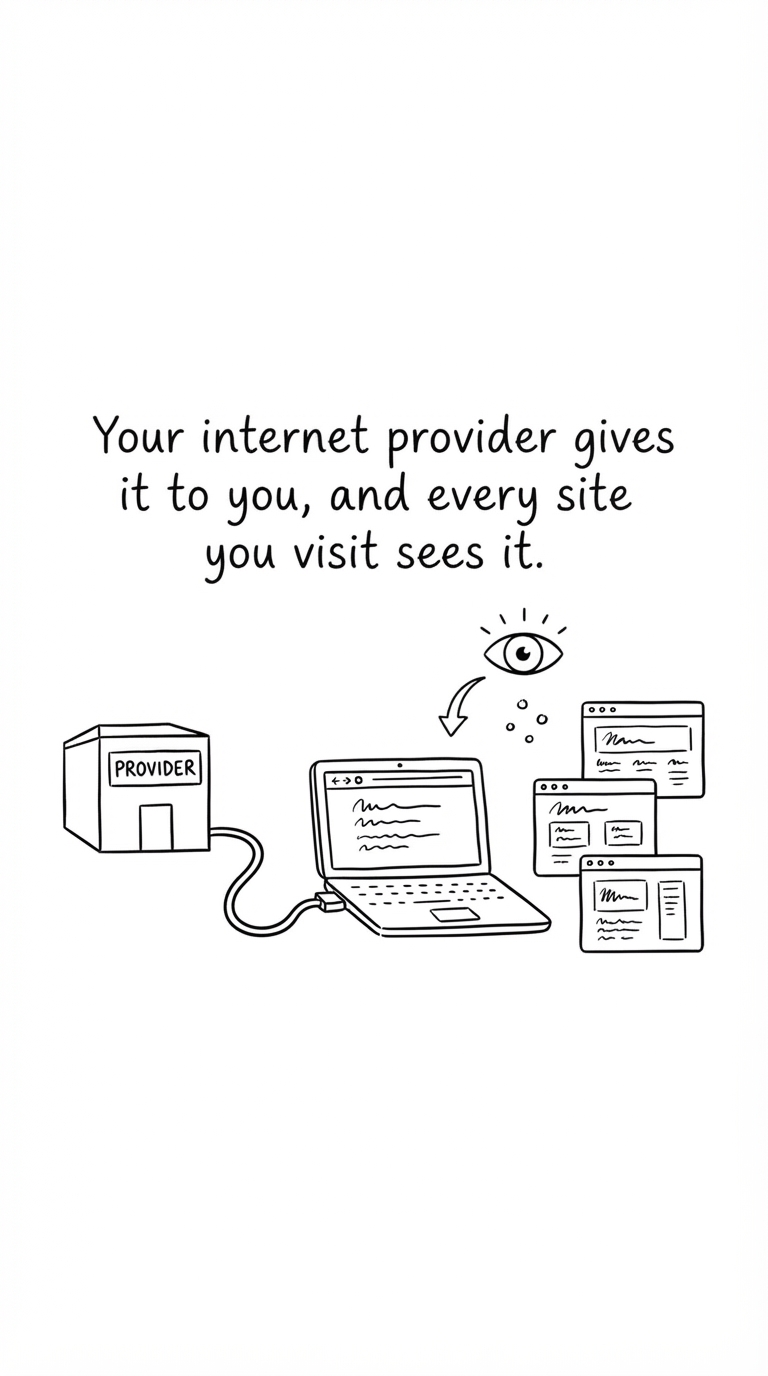 Scene 3 · 0:08–0:13Voiceover
Your internet provider gives it to you, and every site you visit sees it.
PictureA box labeled provider wired to a laptop, with an eye watching several website windows.
-
 Scene 4 · 0:13–0:18Voiceover
From it, a site can guess your rough location and your provider.
PictureA round map of city streets.
-
 Scene 5 · 0:18–0:22Voiceover
It does not show your name or your exact home address.
PictureA house crossed out, with a question mark above it.
-
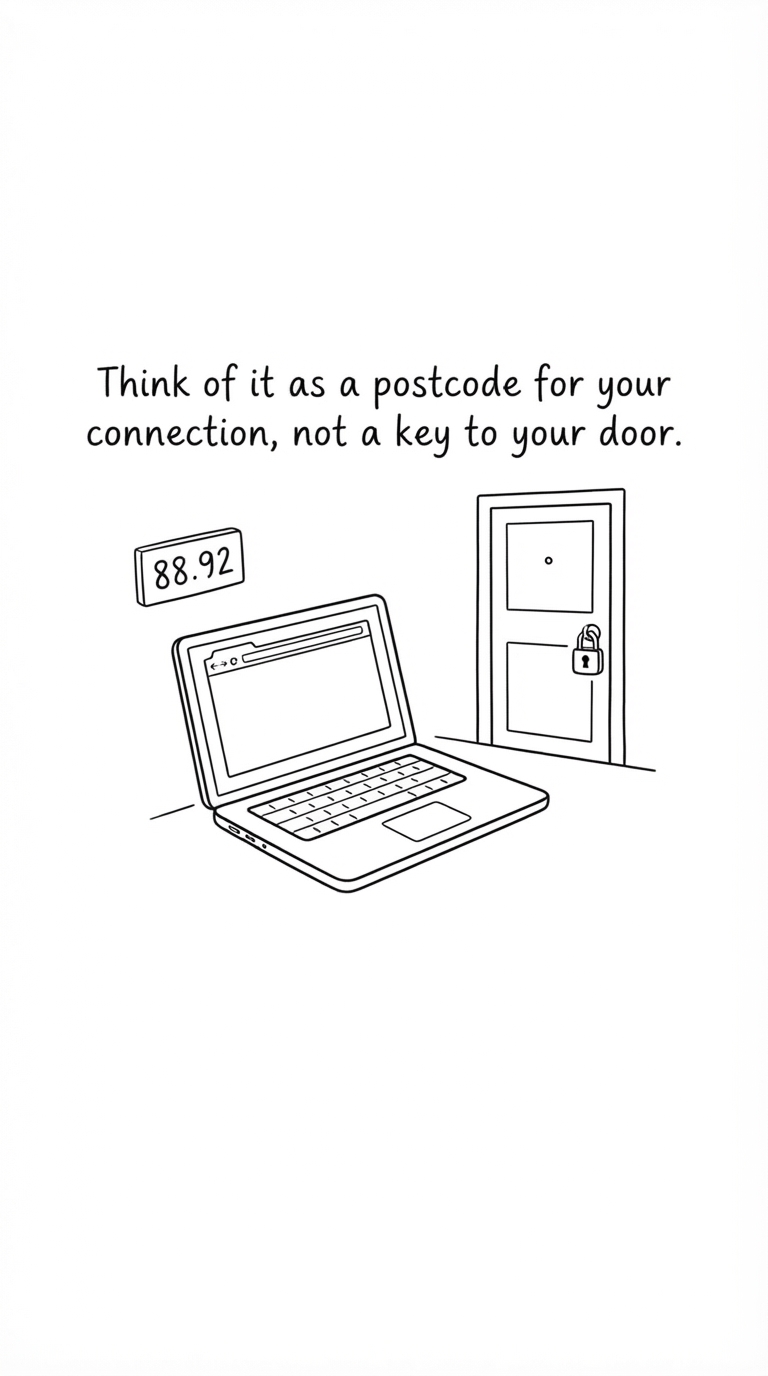 Scene 6 · 0:22–0:29Voiceover
Think of it as a postcode for your connection, not a key to your door.
PictureA laptop with a small number sign, next to a locked front door.
How the internet's addresses work
An IP address does two jobs: it identifies a device's network connection and says where it sits in the network, so data can find a path to it. Every packet carries the addresses of its sender and its destination. The first version, IPv4, went live on the ARPANET in 1983 with 32-bit addresses, about 4.3 billion in all, which ran out over the 2010s. Its successor, IPv6, designed in 1995, uses 128-bit addresses; the two still run side by side, and IPv6 recently passed 50% of use worldwide.
Addresses are handed down a chain. The Internet Assigned Numbers Authority gives blocks to five regional registries, which pass them to internet providers and large institutions, which assign them to customers. Inside a home, devices usually get private addresses, such as the 192.168.0.x range many routers use, which are not routed on the internet; the router shares one public address for all of them. Most addresses are dynamic, leased for a time and sometimes reassigned, while servers and routers usually keep static ones.
Source: IP address, WikipediaLocation comes from databases, not from the address itself. Geolocation services combine registry records, data from internet providers, Wi-Fi networks and locations users submit, and claim accuracy from country down to city or ZIP code, generally highest at the country level. The idea was tested in court in 2000, when experts in the LICRA v. Yahoo! case agreed Yahoo could have blocked French users from Nazi memorabilia sales, and the court ordered it to filter by location.
Location by IP is a business. Geolocation is used for law enforcement, marketing, compliance with online rules and location-based services, and some commercial databases add demographic data to target ads. By a 2024 study, location-based access services were projected to grow 12% a year, to $7.4 billion by 2031, while the new Geofeeds format covered only 1.5% of IPv4 address blocks.
Source: Internet geolocation, WikipediaHow this video was made
We wrote the 6 narration lines and a one-line picture brief for each scene. explain.ink drew the scenes by hand in the chosen style, recorded the voiceover and rendered the MP4.
- Style
- Whiteboard
- Voice
- Gunner (warm, confident narrator)
- Format
- Vertical 9:16, 1080x1920, 29 seconds
- Redraws
- None: every scene was kept as first drawn
The story, in dates
- 1983 IPv4 goes into use on the ARPANET, the internet's predecessor. Source: IP address, Wikipedia
- 1993 Classless routing (CIDR) replaces the original address classes. Source: IP address, Wikipedia
- 1995 IPv6 is designed to fix the coming shortage of addresses. Source: IP address, Wikipedia
- 2000 In LICRA v. Yahoo!, a court orders Yahoo to filter French users by IP location. Source: Internet geolocation, Wikipedia
- 2010s IPv4 addresses run out as the internet grows. Source: IP address, Wikipedia
- 2021 A new standard, Geofeeds, lets networks publish location data for their address blocks. Source: Internet geolocation, Wikipedia
Questions people ask
What is my IP address example?
An IPv4 address is written as four numbers from 0 to 255 separated by dots, such as 192.0.2.1. An IPv6 address is longer and written in groups of hexadecimal digits, such as 2001:0db8:0000:0000:0000:8a2e:0370:7334.
Source: IP address, WikipediaDoes each device have an IP address?
Yes, every device on an IP network gets one. At home, devices usually have private addresses, such as 192.168.0.x, that are not seen on the internet; the router connects them using a shared public address.
Source: IP address, WikipediaDoes my IP address change?
Often, yes. Most addresses are dynamic: the network leases one for a period and may give it to another device later, although many networks try to give you the same one again. Servers and routers usually have static addresses that do not change.
Source: IP address, WikipediaCan you find someone's location through an IP address?
Only roughly. Geolocation databases estimate a country, city or ZIP code from an IP address, most accurately the country. Pairing it with other data, such as nearby Wi-Fi networks or a device's GPS, gives a closer fix.
Source: Internet geolocation, WikipediaAre IP addresses linked to location?
Loosely. Regional registries record the country and coordinates of address blocks, and networks can now publish location data for their blocks, which geolocation services use to estimate where an address is.
Source: Internet geolocation, Wikipedia